

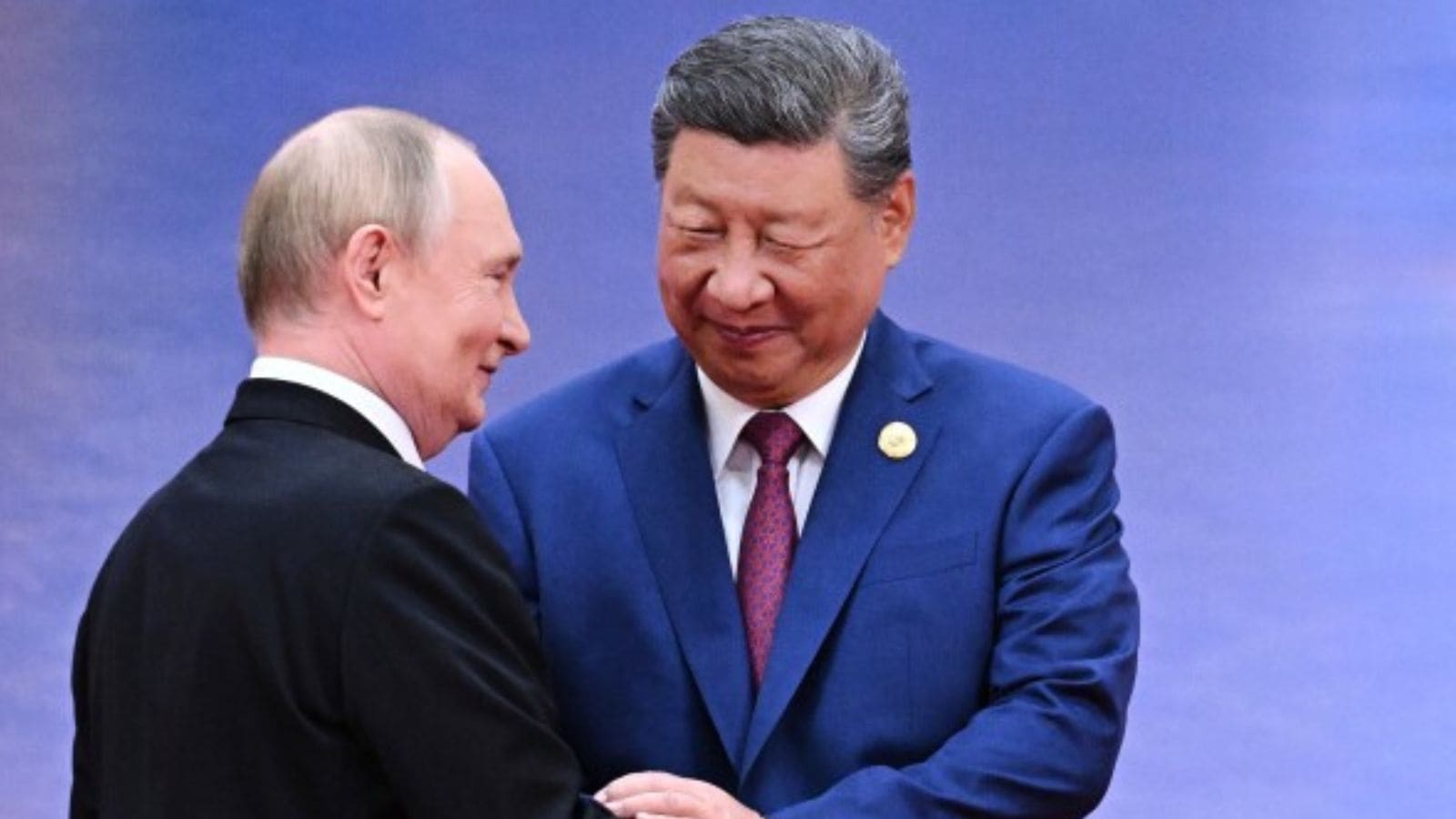
Those in Delhi who are antsy about US President Donald Trump’s visit to Beijing and the prospect of a Sino-American détente should be even more worried as Xi Jinping serenades Vladimir Putin in Beijing this week. Those perennially anxious about a G-2 between the US and China should worry even more about China’s deepening partnership with Russia. One of the core arguments for Russia’s centrality in India’s national strategy is that it serves as a balancing power in Eurasia. But the Eurasian story of the last quarter-century is about Russia’s growing bonds with China — India’s principal challenge in both economic and geopolitical terms.
If Trump’s visit was about moving the US from confrontation to stabilisation of ties with China, Putin’s is about celebrating the strategic partnership unveiled 25 years ago. Since Putin’s invasion of Ukraine in 2022, Russia has become even more dependent on China. What do the two pilgrimages to Beijing mean for India?

First, India should not be rattled by every shift in great-power relations. Since World War II, relations among the US, China and Russia have changed repeatedly, often violently. Taken in pairs, they have been allies, friends, enemies and frenemies at different moments. Dealing with that change is part of the national mandate.
Second, the real challenge for India is addressing the consequences of China’s rise and assertion. Since the 1980s, China’s relative power — economic, technological and military — has grown rapidly against every other actor in the system. For India, the problem is especially acute: A long, disputed and tension-prone boundary; Beijing’s growing influence in India’s neighbourhood; an expanding Chinese footprint in global institutions; and a trade deficit now above $110 billion, rooted in India’s deepening dependence on Chinese manufactured goods.
Third, the answer lies partly in accelerating India’s own rise. Shifts in great-power relations, the emergence of wars and global crises — these are variables India cannot control. What it can drive is its own modernisation. Although India has performed well on several fronts in the reform era that began in the early 1990s, its uneven scope and unsteady pace mean the gap with China is growing. China’s economy is today five times larger, and the disparity in higher education, R&D, technology and military capability is widening.
Fourth, India cannot close the gap with China anytime soon, but it can reduce the impact of the power imbalance through external cooperation that reinforces internal self-strengthening. Much like China, India has turned to the West for capital, export markets, technology and regional security. Since the 1990s, engagement with the US and Europe has grown rapidly.
Elevation of that engagement to higher levels is obstructed by an enduring suspicion of the US and the West in the Indian political mind, across Left and Right. Anti-imperialists and nativists alike have long united in limiting significant Western cooperation. It is this sentiment that gives sustenance to the idea of “strategic autonomy” — a term framed as neutral, but whose political content has always been about maintaining distance from the West. If the US and Europe were the problem, the answer was seen as lying in deeper ties with Russia and China, bilaterally, trilaterally and in multilateral forums.
This discourse, constructed in the 1990s, has run into a fundamental problem: An assertive China has become India’s principal challenge, Russia has become rising China’s most important partner, and India’s stakes in Western partnership have grown enormously. You may say the US under Trump is unreliable — but it is not occupying Indian territory. It is India’s largest export market, a major source of technology, and home to an influential diaspora.
Consider this number: India exports more goods to the Netherlands — a country of 19 million people — than to China and Russia combined. There is no starker illustration of how far Indian strategic discourse has drifted from basic economic reality. While Russia and China dominate India’s mindspace, the Netherlands and other small but important European partners barely figure in India’s debates. Independent India, which long privileged the Russian partnership over European ones, is now making amends.
The Indian discourse may have acquired “strategic autonomy” from the imperatives on the ground, but the government has had no choice but to reconnect foreign policy to first principles, reflected in the fact that India fought to preserve its trade relationship with the US, has pushed hard for a trade deal with the EU, and has focussed on deeper technology cooperation with both in the last two years.
Hosting the Quad foreign ministers’ meeting early next week follows the same logic. The Quad’s revival a decade ago was rooted in the need to build a multipolar Asia amid intensifying challenges from China. One Trump visit to Beijing does not alter that imperative. Over the last decade, several voices in Delhi warned that the Quad would “entrap” India in a military alliance against China and insisted on slow-walking it. Many of the same voices now say the US is about to “abandon” India. The government has taken a more measured view and has actively sustained several rounds of official consultations with Quad partners.
The enthusiasm to write obituaries for the Quad may be both premature and excessive. The visit of Secretary of State Marco Rubio — who also serves as Trump’s National Security Adviser — provides a valuable opportunity to get a first-hand account of the US-China summit, assess Washington’s changing approach to alliances, and develop a productive and sustainable agenda for the Quad.
The writer is a contributing editor on international affairs for The Indian Express. He is also distinguished professor at the Motwani-Jadeja Institute of American Studies at O P Jindal Global University and Korea Foundation Chair at the Council for Strategic and Defence Research, Delhi

