

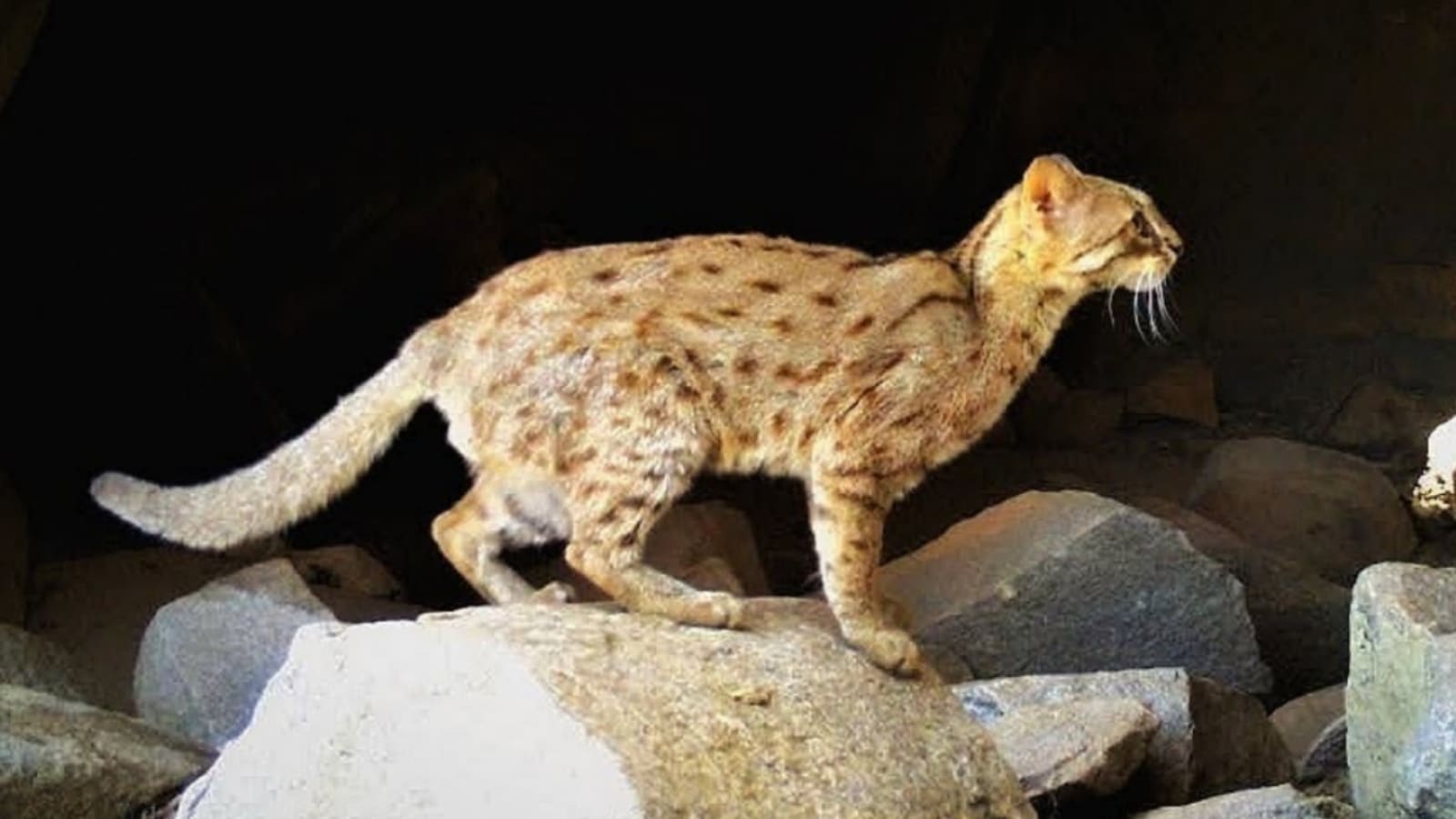
The recent photographic documentation of a rusty-spotted cat and its kitten in the Aravalli landscape near Delhi has sparked fresh concern among wildlife experts over the rapid degradation of one of India’s oldest ecological systems.
Reported last week in the peer-reviewed journal Zoo’s Print, the sighting captured a female rusty-spotted cat (Prionailurus rubiginosus) alongside her dependent kitten in Kot village of Faridabad district during field surveys conducted by researchers affiliated with the Department of Zoology at Indira Gandhi University. The finding, recorded by Amit Kumar, Tejveer Mavi, Yatin Verma, Ram Kumar Rawat, and Sohail Madan, is significant because it provides evidence of breeding and suggests the possibility of a resident population in the Aravalli landscape spanning Faridabad and Gurgaon.

The rusty-spotted cat, one of the world’s smallest wildcat species, is listed as “Near Threatened” on the International Union for Conservation of Nature Red List and is protected under Schedule I of the Wildlife (Protection) Act. Native to India, Nepal, and Sri Lanka, the elusive feline is rarely documented because of its nocturnal and secretive nature.
For experts, however, the sighting is both encouraging and alarming. According to Indrajeet Ghorpade, Conservationist and founder of Deccan Conservation Foundation, the Aravali Range represents far more than a geographical feature. “The Aravallis are one of the oldest geological formations, spreading across Haryana, Delhi, Rajasthan, and Gujarat,” he says. “They function as windbreaks, groundwater catchments, and wildlife habitats. Such fundamental ecological roles could be overlooked by defining the Aravallis solely through elevation rather than landscape character, which is deeply concerning.”
Ghorpade warns that the region has witnessed relentless ecological degradation over the years due to mining, unscientific urbanisation, and unchecked industrial and commercial development.
“Wildlife corridors are broken, and now wildlife survives in isolated, unsustainable pockets,” he explains. “Wildlife like the rusty-spotted cat is losing their habitats, breeding zones, and prey species. Endemic flora that support so many life forms are also disappearing.”
The appearance of the wildcat in a human-dominated landscape, he says, is a reflection of shrinking wilderness rather than thriving adaptation. “Sightings in human-dominated landscapes further establish the loss of natural habitats and encroached unsustainable development into the Aravalis,” Ghorpade notes.
Story continues below this ad
According to Devendra Kumar Gupta, Professor & Head (Veterinary Medicine), NDVSU, Jabalpur (M.P.), such fragmented habitats can be especially dangerous for young animals.
“Habitat loss due to urbanisation reduces safe shelter and hunting areas,” he says. “Feral and pet dogs and cats often attack or prey on kittens. Road accidents increase when animals cross roads between habitat patches.”
Gupta further explains that construction activity, farming practices, pollution, and pesticide exposure compound the risks. “Since rusty-spotted cat kittens are very small and dependent on their mother, these threats greatly reduce their survival chances,” he says.
The growing overlap between wildlife and urban settlements is also altering the behaviour of elusive species. “Increasing human proximity can strongly affect wildcats like the rusty-spotted cat,” Gupta explains. “Human disturbance may alter their hunting behaviour by forcing them to hunt at unusual times or avoid certain areas. Constant noise, traffic, and human activity can increase stress levels, leading to fear and reduced movement.”
Story continues below this ad
Over time, he says, chronic stress and habitat disturbance can affect reproductive health and reduce breeding success. “High stress and habitat disturbance may lower kitten survival rates,” Gupta adds.
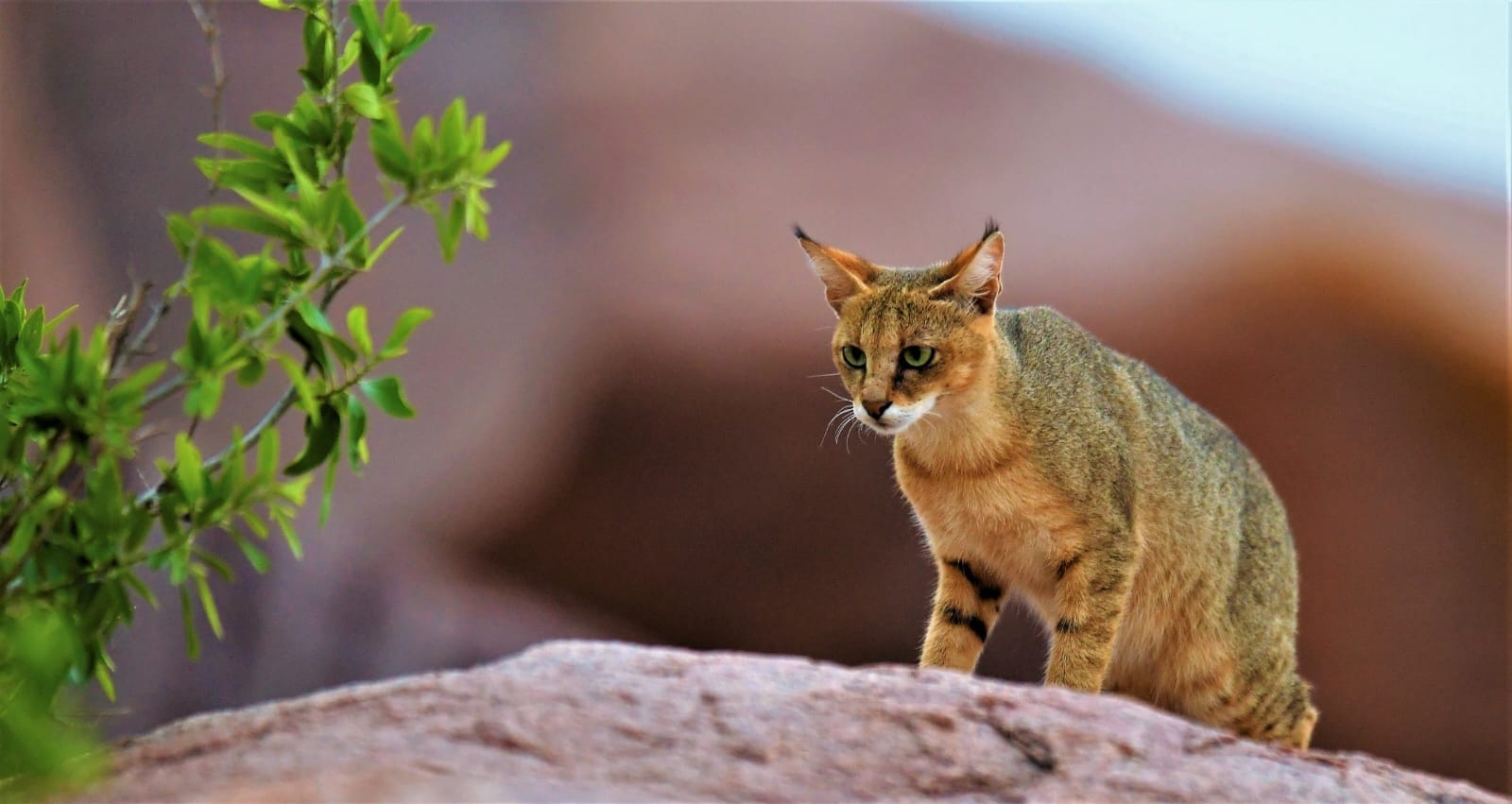 A jungle cat in Aravalis (Photo: Indrajit Ghorpade)
Blame the shrinking natural habitat
For Ghorpade, the rusty-spotted cat should become a flagship species for Aravalli conservation efforts. “Species like the rusty-spotted cat, the smallest of the cat family, need to be the focus species in conservation of the Aravalis,” he says. “What were once pristine ecosystems are now human-dominated landscapes, drastically reducing the home range of this cat and many other species living in rocky scrub jungles.”
He emphasises that conservation planning must protect entire ecosystems rather than isolated species alone. “Equal importance to these cats and other species like hyenas, jackals, foxes, and eagle owls must be given,” Ghorpade says. “The preservation of the Aravalis will enable healthy populations of these cats along with other species.”
Not a rare sighting
The conservationist also questions the way such sightings are described as “rare”. According to him, the rarity often lies in human observation rather than the species’ actual numbers.
Story continues below this ad
“Calling the incident of spotting the cat rare is because it is nocturnal, and not many people have sighted this shy cat,” he says. “Are we calling the sighting rare or the species rare?”
At the same time, he cautions that increasing sightings near settlements should not be romanticised. “Spotting these rare sights is happening because these species are now living in human-dominated landscapes, forced there as a result of losing their natural ecosystem,” Ghorpade explains. “The overlapping of human settlements and cats forced to live in semi-urban terrain is bringing these species closer to humans where they are ‘sighted’ and called ‘rare’.”
Drawing parallels with the recent caracal sighting near the India-Pakistan border, Ghorpade says such moments should encourage stronger conservation investments. “Hopefully, more of such ‘rare’ sightings will encourage investing in conservation not only of the rusty-spotted cat, but all flora and fauna of the Aravalis,” he says.

