

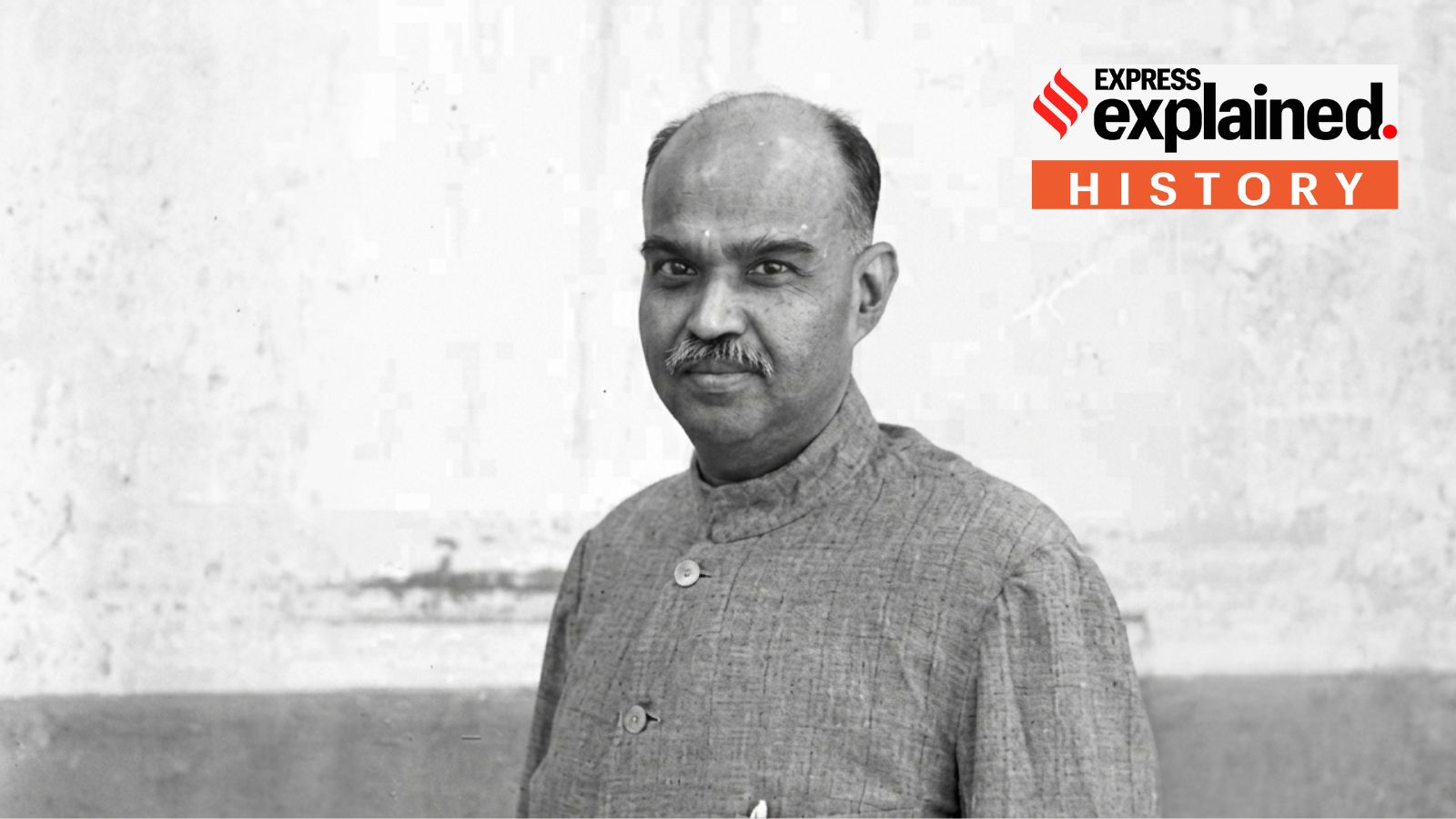
In his victory speech at the BJP headquarters on Monday evening (May 4), Prime Minister Narendra Modi said that “the soul of Shyama Prasad Mookerjee must be at peace today”. As the party won West Bengal for the first time ever, the PM recalled Mookerjee, the Bengali leader who founded the BJP’s predecessor, Bharatiya Jana Sangh, in 1951.
In 1952, the Jana Sangh had a very modest start, winning just three Lok Sabha seats, with two from Bengal. The party merged with the Janata Party in the 1977 elections to defeat Indira Gandhi, but the Janata experiment soon collapsed because of ideological contradictions. It was in 1980 that the Jana Sangh’s successor, the BJP, was founded, with Atal Bihari Vajpayee, who had once been associated with Mookerjee, as its first president.

Who was Syama Prasad Mookerjee?
Born on July 6, 1901, Mookerjee – son of Ashutosh Mookerjee, Calcutta High Court judge and Vice-Chancellor of Calcutta University – studied at Presidency College, Calcutta, and Lincoln’s Inn. He became the youngest Vice-Chancellor of Calcutta University at just 33.
He was elected to the Bengal Legislative Council in 1929 and 1930, first as a Congressman and then as an independent. Later, from 1941 to 1942, he joined the Progressive Coalition government of Fazlul Haque as Finance Minister. The government was formed in opposition to the Muslim League. Mookerjee justified his decision by saying that organising Hindus and their cooperation with Muslims who believed in joint work by the two communities was the need of the hour.
A controversial letter decrying the Quit India Movement, written by Mookerjee to the British, was also discussed by many writers during this time.
From 1943 to 1946, Mookerjee was the Hindu Mahasabha president. He took up the cause of Bengal Hindus in the run-up to Partition, opposing the United Bengal plan of Muslim League leader and Bengal Prime Minister HS Suhrawardy. The plan called for a united Bengal independent of both India and Pakistan – something that Mookerjee saw as domination of Hindus by a Muslim majority. He called for Partition of Bengal, with Hindu-majority West Bengal staying with India.
Moderate Hindutva
After the assassination of Mahatma Gandhi, Mookerjee had made the Hindu Mahasabha’s Working Committee adopt resolutions that “expressed shame that Gandhi’s assassin had been connected with the organisation, and declared support for the government in its efforts to suppress terrorism or subversive activities in any shape or form”, writes BD Graham in his book Hindu Nationalism and Indian Politics (2007). Significantly, Mookerjee resigned from the Hindu Mahasabha in November 1948, because the party rejected his suggestion that it either stay away from politics to remain a Hindu cultural outfit, or open itself to non-Hindus if it wanted to continue to be a modern political party.
Bengal Hindus
Story continues below this ad
After Partition, he raised his voice against the ‘persecution’ of Hindus in East Pakistan, leading to a steady stream of refugees coming to India. At this time, he was the Minister of Industry and Supply in the Nehru government. When riots broke out in East Pakistan, now Bangladesh, in 1949-50 — leading to large numbers of Hindu refugees crossing over into India — there was pressure on the Nehru government to find a solution.
Nehru invited Liaqat Ali Khan, the Prime Minister of Pakistan, to Delhi in April 1950, and the two signed a pact calling upon both countries to provide equality, freedom and justice to their minorities. Believing that Pakistan had been acting in bad faith where Hindus were concerned, Mookerjee, as per BD Graham, demanded a penal clause to provide for sanctions against the side that failed to honour the agreement. But since this had not been inserted in the Nehru-Liaqat pact, he resigned from the Cabinet.
It was after this that Mookerjee formed the Bharatiya Jana Sangh with the help of RSS volunteers.
The Kashmir issue
Backing the agitation of the Praja Parishad of Prem Nath Dogra — a former Swayamsevak and civil servant from Jammu — for the complete integration of Jammu and Kashmir with India, Mookerjee plunged into the movement in 1952, and died a year later in detention in the state.
Story continues below this ad
Pakistan, which laid claim to the princely state of Kashmir ruled by the Hindu Dogra king Raja Hari Singh on account of its Muslim majority, sent irregular troops, or Kabailis, to capture Kashmir in October 1947. A worried Hari Singh signed the Instrument of Accession on October 26, 1947, and Indian soldiers began pushing back the invaders. India took the case to the United Nations Security Council in January 1948, and the newly-established UN Commission for India and Pakistan (UNCIP) mediated a ceasefire.
The ceasefire brought the Line of Control into existence. The UN Security Council Resolution 47 asked both sides to demilitarise so that a plebiscite could be held to determine the wishes of the people of Jammu and Kashmir. Since demilitarisation never happened on either side, the resolution remained a dead letter. However, Article 370 of the Constitution was enacted, giving Parliament powers only in the fields of defence, foreign affairs and communication in the case of Kashmir. Indian laws didn’t apply to Kashmir beyond these three heads, while people from outside required a permit to visit the state, and were barred from buying land there.
The state’s Prime Minister, Sheikh Abdullah, abolished big land holdings in Jammu and Kashmir in 1951 under the Big Landed Estates Abolition Act, without giving any compensation, hitting Hindu landlords hard. He also adopted Urdu as the official language. The Dogra Hindu landlords resented these steps.
Dogra’s Praja Parishad launched an agitation against the Sheikh Abdullah government in the state.
Mookerjee takes up the Kashmir issue
Story continues below this ad
The Jana Sangh took up in Parliament the arrest of Dogra and his followers after a clash with the police in the state. Later, the party also opposed the adoption of a flag by the state by the Constituent Assembly of Jammu and Kashmir.
On June 26, 1952, Mookerjee pressed the Centre to convince Jammu and Kashmir to accept full integration with India. The Jana Sangh and Praja Parishad widely adopted a slogan – “ek desh mein do vidhan, do pradhan aur do nishan nahin ho sakte (in one nation, there cannot be two constitutions, two Prime Ministers and two flags).”
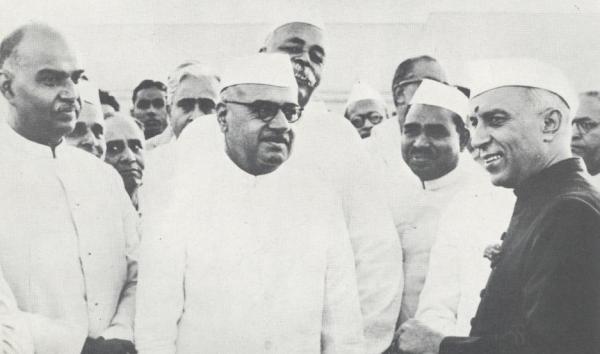 Jawaharlal Nehru with Syama Prasad Mookerjee and Jairamdas Doulatram in the rear are Govind Ballabh Pant and Jagjivan Ram (Wikimedia Commons)
Amid controversy, the Nehru government and the Jammu and Kashmir government signed the Delhi Agreement in July 1952, under which the state accepted the jurisdiction of the Supreme Court. It also accepted the supremacy of the Indian flag, though the state’s flag would also remain in use. It further accepted the President of India’s power to declare a state of Emergency in the state under Article 352, subject to the concurrence of the state in the event of internal disturbances.
The Praja Parishad, however, rejected the Delhi Agreement and, by October 1952, was planning an agitation if the Constituent Assembly of Jammu and Kashmir decided to elect a head of the state. They launched one when the assembly, by now the state’s legislative assembly, elected Karan Singh as head of the state (Sadr-e-riyasat). In November 1952, Dogra and other leaders of the Praja Parishad were again arrested.
Mookerjee calls for agitation
Story continues below this ad
At its first annual session at Kanpur in December 1952, Mookerjee’s Jana Sangh passed a formal resolution supporting the Praja Parishad’s Jammu Satyagraha for the complete integration of the state with India. It demanded a round-table conference of representatives of the Praja Parishad, the government of Jammu and Kashmir and the leaders of India, failing which it would launch an all-India agitation for full integration of the state with India.
Nehru saw the Jana Sangh’s orientation as ‘communal’ on this question. BD Graham quotes Nehru’s letter to Mookerjee, “I have no doubt that you wish well for India, but the fact remains that our conceptions of what is well for India appear to differ… I consider the communal approach to India’s problems, or to any other problems, as inherently bad, narrow and injurious to the individual, the group and the nation…” Nehru’s condition for any talks was that the Praja Parishad should stop its agitation.
Mookerjee’s Jana Sangh now decided to go into agitation mode. Atal Bihari Vajpayee, who became private secretary to Mookerjee in early 1953, was sent across the Hindi-speaking states to popularise the agitation. “He patted your back once with love, and you would be ready to die for him,” Abhishek Choudhary’s biography of Vajpayee quotes the young PS referring to Mookerjee, his boss. Vajpayee travelled across Uttar Pradesh, urging people to go to Delhi for an agitation on Kashmir. Of the 1200-odd agitators who thronged the capital, 500 were from UP. Mookerjee then travelled to Madhya Bharat — the Gwalior-Indore region of erstwhile princely states — and also to Rajasthan, Vajpayee accompanying him in these trips.
In Delhi, protestors of the Jana Sangh would suddenly emerge in parks, unanticipated by the police, and shout slogans for the full integration of Kashmir.
Mookerjee’s Jammu visit
Story continues below this ad
In May 1953, Mookerjee decided to go to Jammu without a permit — a symbolic rejection of the special status of Kashmir — with Vajpayee. They went by train to Pathankot in Punjab, and then addressed multiple public meetings across the state for three days. Mookerjee was informed at Pathankot that he would be allowed to enter Jammu and Kashmir without a permit. This made Jana Sangh workers jubilant, and a slogan was coined, as per Choudhary’s book: “Permit system toot gayi, Nehru sarkar jhuk gayi (The permit system has been shattered; the Nehru government has been made to bend)”. (“Vajpayee: The Ascent of the Hindu Right, 1924–1977”, Abhishek Choudhary, 2023)
On May 11, 1953, Mookerjee crossed into Jammu and Kashmir over the Ravi. However, the state police had put up barricades for his arrest. Mentally prepared for this, Mookerjee did not turn back and was arrested. He told Vajpayee to return to Delhi and tell everyone that he had entered Jammu and Kashmir without a permit, if only as a prisoner, writes Choudhary. Mookerjee was kept in a cottage about eight miles from Srinagar. However, the heart patient who had a blood pressure problem could not cope well in the conditions of his detention. On June 23, he fell ill suddenly, having suffered a massive heart attack, and died.
What he left behind was a sense of ‘martyrdom’ for Kashmir among his party workers. LK Advani would recall in his public speeches that a journalist in Rajasthan had informed him that Mookerjee was no more, plunging the Jana Sangh into deep mourning. “What happened? How did he die in confinement?” Advani would ask the crowd in rallies.
In allied organisations of the RSS, there is a popular slogan: “Jahaan hue balidaan Mookerjee, wo Kashmir hamara hai; jo Kashmir hamara hai, wo saare ka saara hai (where Mookerjee was martyred, that Kashmir is ours; the Kashmir that is ours is the full Kashmir).”

