

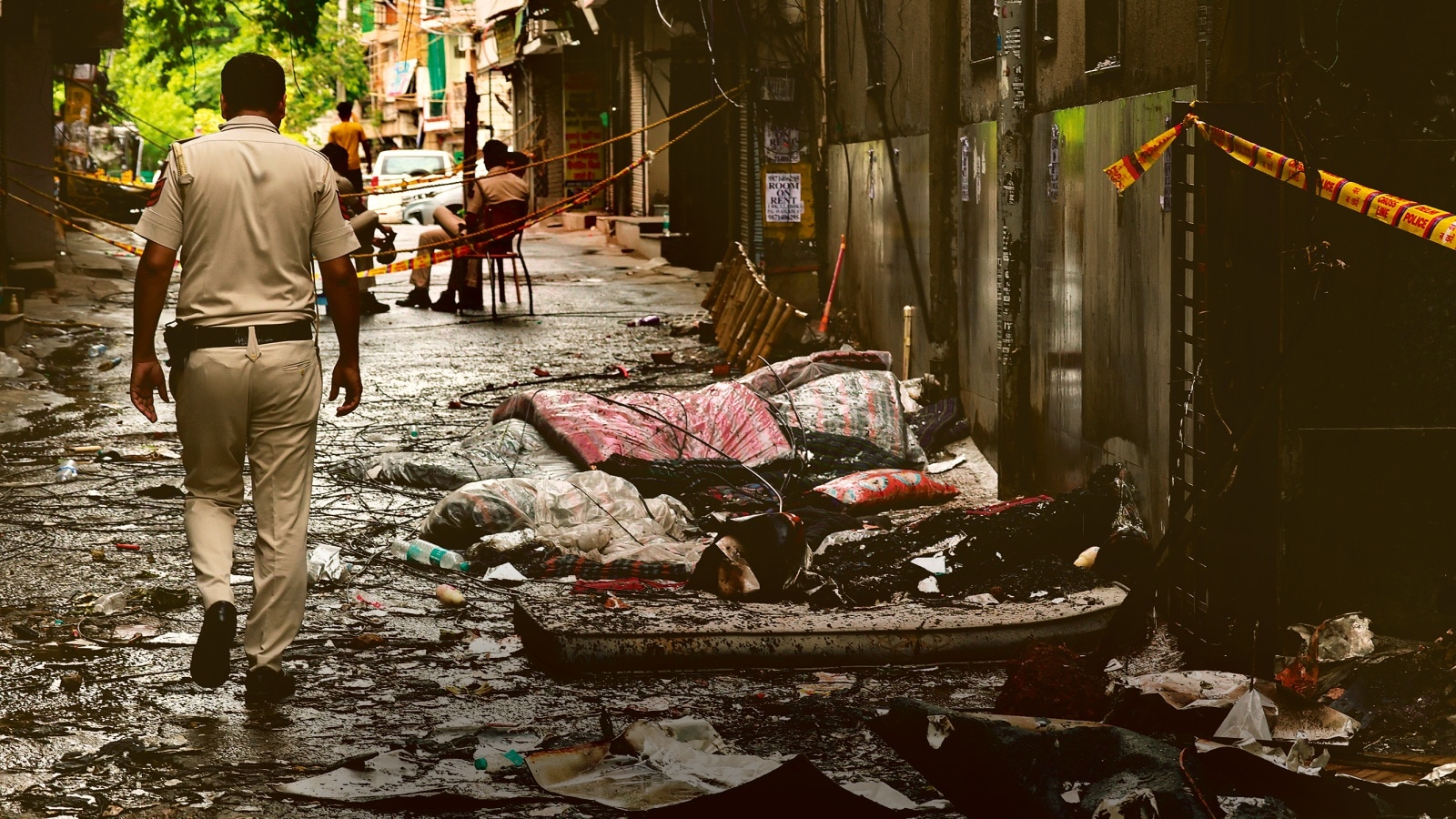
There is something about the way Mohammad observes the action unfolding beyond the police tape that reminds you of Peepli Live, the 2010 satire on the media circus that typically follows big news events. In front of charred buildings are multiple TV reporters talking into cameras, with OB vans just out of sight. They are shrill in their demands for accountability, for the arrest and prosecution of Lavkesh Bajaj, the proprietor of Flourish, the bread and breakfast facility in Delhi’s Hauz Rani neighbourhood where at least 21 people died on June 3 in one of the worst fire incidents in the national Capital.
“Dekhbe dada (Brother, you will see), in a day or two, things will go back to normal… the government will make a noise for a bit, but there are just too many people who need a place to stay. Where will they all go?” says Mohammad, who doesn’t want his full name revealed.

In his mid-30s, he is both a local and an outsider to Hauz Rani. From West Bengal, he has lived and worked in the neighbourhood as an odd-job man for over two decades. As he takes a deep sip of his chai, you can sense an almost sardonic sense of resignation in him. He speaks of both the fire and the fact that he has had to change homes multiple times because of rising rents and the political conversations around Bengali Muslims with the same detachment, even humour.
The tragedy is on everyone’s lips in the few square kilometres where the layers of Delhi — in all their beauty, complexity and sadness — sit together.
Hauz Rani is one of Delhi’s several urban villages, ‘Lal Dora’ colonies that sit uncomfortably between the realities of a burgeoning demand for land and space, and municipal laws and rules.
In the days after the yellow tape at the end of the lane is removed, the neighbourhood, with all its fault lines and sharp edges, will be back. The broken sewage lines, the buildings that jostle for space, the tangled electricity wires that pretend to be the sky — all of which come up when the city, or a part of it, grows and no one has time to plan for it. Hauz Rani could be any urban neighbourhood in India: in the headlines for the fire, and then forgotten as residents return to living with the conditions that made it possible.
‘They all need a place to stay’
Hauz Rani’s origins are almost mythical: About 800 years ago, it was a hauz or bath house for a queen forgotten to history, and a village emerged around it. Over years, post-Independence, the agricultural land was acquired by the government, while the residential areas were not.
A DDA sports complex is a street away, and upper-middle-class colonies such as Press Enclave, Ekta Apartments and Golf View Apartments are across the road, in Saket. In recent years, the massive Saket malls and the Max Super Speciality Hospital have made the difference between the two sides of the street all the more stark. The hotel that burnt down was once a Khadi Bhandar, where people bought clothes and other trinkets. The basement, where the fire broke out, was a photocopy shop that serviced the neighbourhood.
“It’s with the expansion of Max Hospital that construction exploded in Hauz Rani,” says Rinku Awasthi, owner of Rinku Beauty Parlour, about 30 metres from the site of the fire. For much of the three decades that she has run her establishment, “there was a connection between the Saket colonies and our lane. Many of my clients came from there”.
But as Hauz Rani became more diverse, it also became more closed off. “As more and more Nigerians, Somalians and people from Central Asia came to get treatment at Max, people here began opening guest houses and building extra floors. But then, it got crowded and my older clients from Saket don’t come any more. There were more barricades, less municipal attention as well. Buildings grew, but sewer lines didn’t. The point is, the hospital expanded, but no one planned for the extra people that would bring… they all need a place to stay, don’t they?” says Awasthi.
The demands for accountability, for heads to roll, are well taken by those in Hauz Rani, who are shaken by the fire and the deaths many of them witnessed first-hand. But there is also an undercurrent of fear.
Sharib, a carpenter’s apprentice, puts it bluntly: “Delhi’s home minister has said shut all hotels that don’t have permission… Next, they will come after us, some of us more than others. Who are the people who work here, or even the people who died? Workers, people who have come from far away for medical treatment and can’t afford fancy hotels? If there hadn’t been the fire, no one would care about these hotels… Do you think the government didn’t know about this before?”
Sharib’s questions do not have easy answers. After those responsible for this fire are held accountable, what will it take to ensure that the underlying problems are fixed?
The neighbourhood, its twin
“There is a symbiotic relationship between the planned and unplanned in our cities,” says Amita Baviskar, Professor of Environmental Studies and Sociology & Anthropology at Ashoka University. “For every Saket, there is a Hauz Rani; for Delhi University, there’s Mukherjee Nagar; for JNU and the middle-class colonies around it, Katwaria Sarai, etc… The ‘legal’ part of the city has an ‘illegal’ evil twin where the service class stays. Often, the older areas of Delhi, the villages, are repurposed to meet this need.”
Onyinye, 23, is reluctant at first to talk about the conditions in Hauz Rani and neighbouring Khirki village, as are many of his compatriots from Nigeria who are sitting at a tea shop opposite Max Hospital’s East Wing. He opens up, finally, when the phrase “medical tourist” comes up. He detests it. “I am not a tourist, nor an immigrant. We are here because my mother’s disease could not be treated back home, and we cannot afford to go to the West.” He has been staying in a hotel much like the one that went up in flames because “that’s where our agent suggested”. He shudders visibly at the thought that he could just as easily have been a guest at Flourish B&B, that he likely passed some of the dead in the hospital corridors or sat next to them at a restaurant. “We are paying for medical treatment and need to be close to the hospital. What choice do we have? It’s not like they are giving us rooms for free.”
Hotels are not the only cogs in this new economy. The only shop open in the otherwise shuttered lane where Flourish B&B stood is Priya Chemist. M Shopan, a customer, recalls how he was woken up by his son and had rushed out as the fire began to roar. He was staying at Lemon Green Hotel next door. In town from Dhaka to get treatment for a heart ailment at Max, he is stocking up on the medicines.
His face wrinkles as he swipes his card for Rs 43,302. “It’s still cheaper than going outside South Asia,” he remarks. The hotel he stayed at was “decent enough” forRs 3,500 a night, and only slightly above budget, and there were other Bangladeshis in the area for treatment.
At 64, Shailendra Tilak has seen many customers pause at their medical bills in his 47 years behind the counter. He assures him of the quality of the medicines. “There’s a lot that has changed over the last few years,” Tilak says. “My old customers from Saket still come here, and I deliver medicines home for many of them. More and more, though, people are ordering regular medicines online, searching for the cheapest deal from apps. The overflow from Max has helped make up the shortfall.”
The severed relationship with “across the road” is a refrain heard often from shopkeepers and workers across Hauz Rani. “There was a time when so much of our lives were there, in Hauz Rani,” recalls Nikhil Deshpande, a 46-year-old filmmaker who grew up in Press Enclave and moved back just before the pandemic. “The small gate was open, and before getting on the school bus, we would grab a chocolate from the local store. Now, Press Enclave has only one gate that opens onto the main road; the rest were gradually closed.”
Menaka Neotia, Nikhil’s wife, who works in conflict management, remembers the difference between when the couple lived in Hauz Rani for four years up to 2018, and now. “The hotel that caught fire is at the same distance from here as our old front door. But if I were there, I know I would have rushed down to see what happened, to check in with Mahadev and his son Rahul, whom I chatted with every day as I bought vegetables. Here in Saket, my privilege means I can be in a bubble.”
That bubble, though, may well be an illusion.
“The existence of places like Hauz Rani, or Saidulajab abutting Saket, where six people were killed in a building collapse on May 30, is a structural necessity in a city like Delhi,” says Ekta Chauhan, Assistant Professor, Jindal School of Art and Architecture and author of Sheher Mein Gaon.
“What we need, however, is a larger conversation about how these spaces are so essential to the city… The expanded homes, small eateries and hotels serve a growing working and service class population that makes the malls, hospitals and posh homes run.” On the other hand, she says, “if we just continue construction as is happening right now, then you’re putting safety at risk… that’s the dilemma.”
The solution, if there can be one, must be radical, according to architect and urban planner Ashok Lall. “The imagination of Delhi, in Masterplan after Masterplan, has been of a middle-class city, with no thought to a growing population that does not belong to this section.”
“What has made matters worse in the last few years is a government and planning mindset that sees land as an asset through which the city can enrich itself. The value of the land is determined by how much you can build on it, and the taxes on the increased value make the city’s income go up. But this has left half the population behind.” What’s needed, according to Lall, is to view land as a lever for development. “Developmental planning, like in Singapore or Amsterdam,” could be the answer, “where the state plays a greater role in determining value and allocating space for affordable housing in a manner that people don’t have to choose between location and safety and environment.”
Mohammad, though, will be cynical about any such radical change in governance. As he gives directions to Flourish Inn & Guest House, another hotel reportedly owned by Bajaj, he is sure it will be empty today, and perhaps filled with guests next week. “Even if they demolish it, there will be 10 more close by. People need what they need, and governments just need votes.”

