

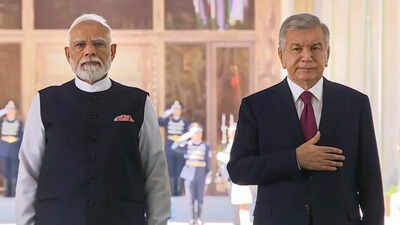
India and Uzbekistan upgraded their relations to a comprehensive strategic partnership, set an annual trade target of $ 5 billion and closed in on an agreement for uranium supply to India, as PM Narendra Modi held talks with President Shavkat Mirziyoyev in Tashkent.Modi announced that India would get into a long-term arrangement for supply of uranium from Uzbekistan, a major regional producer and exporter. Both sides agreed to establish a foreign minister-level coordination council to guide all aspects of cooperation under the elevated partnership.Following the talks that focused on expanding cooperation in defence and security, trade and investment, critical minerals, AI, agriculture and health, the 2 sides signed 11 MoUs. Areas covered included culture, education, mining, Ayurveda, tourism and restoration of Buddhist sites in the Central Asian country.Modi also underscored the need for zero tolerance against terrorism and extremism, saying a stronger India-Uzbekistan partnership will be a powerful force for peace, progress and prosperity in Central Asia.The leaders endorsed growing defence cooperation between the 2 countries, including through regular exchanges, capacity-building and joint activities, and expressed their commitment in a joint statement to address common security challenges by further strengthening such cooperation. Going forward, Modi said, both sides will promote direct linkages, co-production, and co-development between the defense industries of both nations.“Close defense and security cooperation between our two countries reflects our deep mutual trust,” said the PM.Outlining an ambitious agenda to move forward with “speed and tangible results” in this new phase of our partnership, the PM also said in his media statement that both sides will work systematically on market access, connectivity, banking, and payment systems to achieve the target of $ 5 billion trade by 2030.“We will work together to boost win-win cooperation in infrastructure development. Cooperation in Digital Public Infrastructure, AI, critical minerals, clean energy, space, and nuclear energy is making our relationship future-ready,” said Modi, adding that Uzbekistan is at the heart of Central Asia, and at the heart of India’s engagement with the region.Both sides believe that while India is one of Uzbekistan’s top 10 trading partners, their annual trade of $ 1.32 billion remains significantly below its true potential.In the meeting, the leaders agreed to undertake joint measures to broaden the range of goods traded between the two countries, remove non-tariff barriers, and promote industrial cooperation with a view to further increasing bilateral trade turnover, according to the joint statement. They also decided to create a Joint Working Group to address non-tariff issues and investment barriers.There was focus on Global South cooperation with Modi saying that Uzbekistan’s highest honour for a foreign leader that was conferred on him by the president had left India with the added responsibility of working with Uzbekistan as “Global South partners for the betterment of humanity”.“Both sides agreed to work together to preserve and protect the multilateral trading system with the WTO at its core, especially for the interests of the developing countries,” said the joint statement. Modi and Mirziyoyev discussed a recently concluded jointly feasibility study for Uzbekistan-India Preferential Trade Agreement, directing officials to explore the next steps on a time bound basis.
Share your thoughts in the comments
Be respectful · TOI community guidelines
On international cooperation, the leaders called for comprehensive UN reforms that would reflect contemporary global realities and to make it more representative and effective in dealing with issues of international peace and security, with Uzbekistan reaffirming its support for India’s candidature for permanent membership of the UN Security Council.The leaders explored cooperation in the fields of geology, mining, nuclear energy, industrial cooperation, and critical & strategic minerals, including projects for the processing of mineral resources, according to the joint statement. The 2 sides also announced partnerships between their cities and states, with Modi saying that these arrangements will continuously enhance direct connections in urban management, industry, education, tourism, and culture.
Major outcomes and announcement
- Elevating ties to a Comprehensive Strategic Partnership
- Letter of intent for conservation and restoration of ancient buddhist sites of Fayaz Tepa and KaraTepa located in Termez, Uzbekistan
- Grant of $ 1 million for afforestation in the Aral Sea region
- MoU for cooperation in the field of Ayurveda and other traditional systems of medicine
- Cooperation in the fields of Geology and Mineral Resources
- MoU for an Economic and Financial Dialogue
- Cooperation agreement for establishment of partnership relations between Gujarat and Samarkand region
- Lal Bahadur Shastri Scholarship for Hindi Language (100 Scholarships)
- ICCR Sanskrit Chair at Tashkent State University of Oriental Studies

