

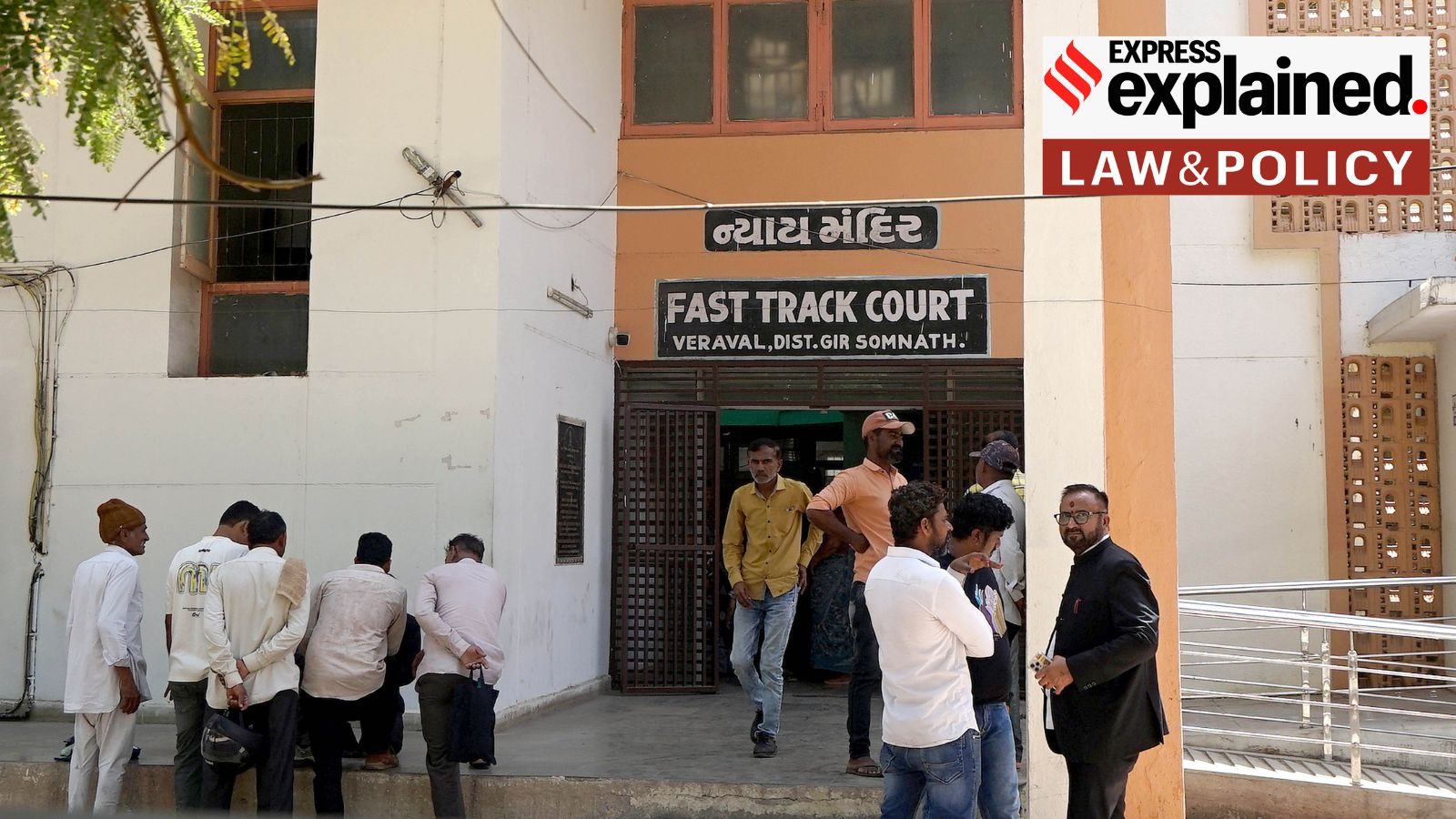
Prime Minister Narendra Modi’s promise to set up fast-track courts (FTCs) to take up paper leak cases has turned attention to what is seen as a silver bullet to judicial delays: the fast-track court. Both the government and the judiciary have periodically relied on FTCs to expedite the legal process for specific, high-priority offences.
Here is a look at how these courts function, the types of cases they handle and the constitutional principles that govern them.

What are fast track courts, and what cases do they hear?
There is no single, central legislation that governs these courts. The push to dedicate courts to specific demographics came from the Fourteenth Finance Commission (2015–2020), which recommended setting up 1,800 FTCs to expedite the trial of heinous crimes such as murder, kidnapping, and extortion, as well as property disputes pending for over five years.
It also recommended them for cases involving vulnerable demographics, including women, children, senior citizens, persons with disabilities and individuals afflicted with terminal illnesses.
In 2019, following an amendment to the criminal laws and a directive from the Supreme Court, the Union government launched a centrally sponsored scheme to establish fast-track special courts (FTSCs). Funded partially by the Nirbhaya Fund, these special courts are exclusively dedicated to the time-bound trial of rape cases and offences under the Protection of Children from Sexual Offences Act.
Can a fast-track court be set up for an individual case?
The creation of special courts must satisfy Article 14, which guarantees equality before the law. In the 1952 judgment State of West Bengal vs Anwar Ali Sarkar, the Supreme Court struck down a law that allowed the government to arbitrarily pick cases for special courts simply for the “object of speedier trial”. The court warned that “speed” is too vague and elusive a criterion on its own. To survive constitutional scrutiny, the classification of cases chosen for fast-tracking must have a rational, objective basis – such as the specific nature of the offence or the vulnerability of the victims.
However, in the recent past, courts have been less compelled to draw the same red line, especially in cases where there seems to be a public demand for speedy justice. The Andhra Pradesh High Court established a special court in February 2010 to exclusively try the multi-crore Satyam Computer Services accounting scam.
Story continues below this ad
The Supreme Court directed the Centre to establish a special court to exclusively handle the 2G spectrum allocation scam, ensuring an expeditious, day-to-day trial. The court was notified in March 2011 and operated out of the Patiala House Courts Complex in New Delhi.
It will have to be seen if the NEET case, which is currently being heard in a court in Delhi’s Rouse Avenue, will be sent to a special court by the government or through a court order.
How quick are fast-track courts?
Litigants do not have an automatic, statutory right to a fixed deadline for their trials. The Bharatiya Nagrik Suraksha Sanhita recommends that trials should ideally be completed within two years and trials for sexual offences within two months.
Under the Centrally Sponsored Scheme of FTSC, each FTSC is expected to dispose of 41 to 42 cases per quarter, which translates to a target of at least 165 cases annually.
How have they performed so far?
Story continues below this ad
As of January 2026, 862 regular FTCs were functioning across 21 states and union territories. Alongside them, 774 FTSCs — including 398 exclusive POCSO courts — were operational across 29 states and union territories.
The disposal rate for the special courts is around 96%, meaning they were either heard or dismissed. In 2024, 88,902 new cases were instituted in FTSCs, while 85,595 cases were resolved. On average, an FTSC disposes of about 9.5 cases per month, nearly three times the 3.3 cases cleared monthly by a regular trial court of similar jurisdiction.
Despite these high clearance rates, the volume of litigation means pendency remains a persistent challenge. By the end of 2023, over 2.4 lakh cases were still pending in FTSCs.
The government has acknowledged these operational bottlenecks in Parliament. In a March 2026 Lok Sabha response, the Ministry of Law and Justice stated that delays in case disposal are caused by several factors, which “include availability of physical infrastructure, complexity of facts involved, quality of investigation, nature of evidence, co-operation of stake holders viz. bar, investigation agencies, legal representation, forensic support, witnesses and litigants and proper application of rules and procedures.”
Story continues below this ad
Advocate Kartik Venu, a criminal trial lawyer, told The Indian Express, “Fast track courts will not answer the issue of heavy case burdens, case dockets, lack of judicial officers to hear them, natural delays over the course of a trial based on the twists and turns that trials normally take.” He said that FTCs are “a welcome measure… provided it is given the accompanying infrastructure.”
He said the efficacy of fast-track courts varies according to the subject matter. “The fast-track courts in POCSO, in IPC, have been an utter failure, given the sheer volume of work, the inability of courts to allocate specific judges, sufficient judges, to the proportionate amount of cases,” he said. “By contrast, in the Prevention of Corruption Act… there is perhaps a healthier ratio.”
In the 2002 landmark judgment P. Rama Chandra Rao v. State of Karnataka, a seven-judge Constitution Bench ruled that it is “neither advisable or feasible, nor judicially permissible to draw or prescribe an outer limit for conclusion of all criminal proceedings.” The court observed that criminal courts are not obliged to terminate a trial merely because a certain amount of time has lapsed, noting that setting such strict limitation bars would amount to impermissible judicial legislation.

