

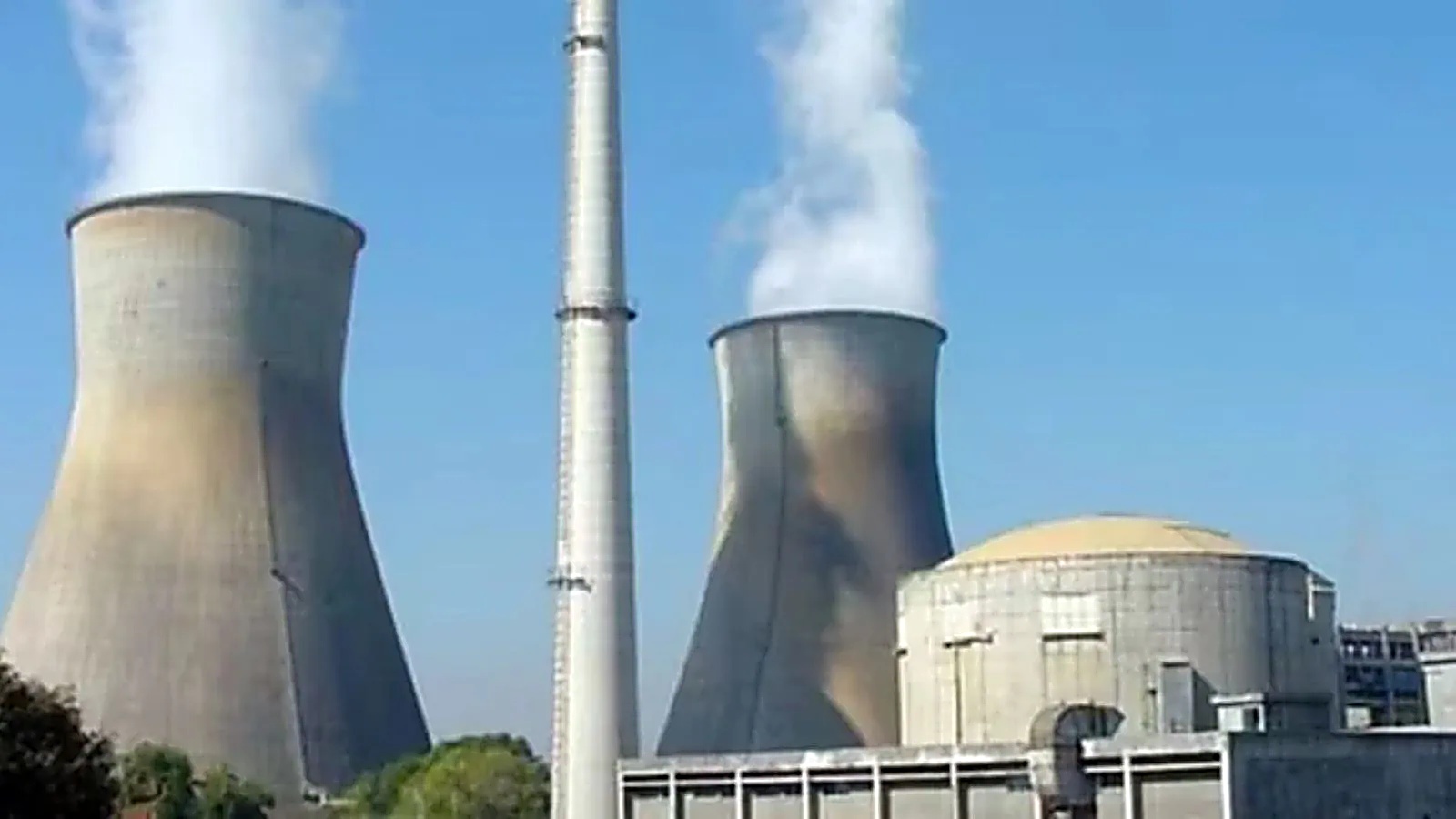
NTPC Ltd, the country’s largest integrated power generator, is emerging as a key pivot in India’s nuclear landscape after the sector was opened up through an overarching legislation late last year.
For decades, the Nuclear Power Corporation of India Ltd (NPCIL) has been the vanguard of India’s traditional nuclear establishment. With the passage of the SHANTI Act, 2005, which eased the liability framework and paved the way for greater private and foreign participation, NTPC is emerging as a second pillar of sorts and a partner of choice for global nuclear technology providers seeking a foothold in the Indian market.
Notably, an NTPC functionary is also seen as a possible contender for a top energy advisory role in the government.
The latest collaboration in the works is with New Jersey-based nuclear technology firm Holtec International, known for its flagship small modular reactor, the SMR-300. The company is understood to be in advanced discussions with NTPC and could formalise a partnership as early as next month, The Indian Express has learned.
This comes after NTPC signed a non-binding Memorandum of Understanding (MoU) in April with Électricité de France (EDF) to explore cooperation in developing new nuclear power projects in India. The company has also inked an agreement with Russia’s state-owned nuclear company Rosatom for its VVER series of reactors — a type of reactors called light water reactors, or pressurised water reactor (PWR).
NTPC is also in talks to buy a minority stake in US-based nuclear fuel technology company Clean Core Thorium Energy (CCTE), the company had informed the stock exchange in January. Both the companies are exploring the “development and deployment of a thorium-based fuel” for existing nuclear stations in India, subject to regulatory clearances, Department of Atomic Energy told the parliament earlier this year.
Both Holtec and Clean Core are among the handful of American nuclear companies which have begged ‘specific authorisations’ from the US government with respect to a restrictive American regulation referred to as “10CFR810” — (Part 810 of Title 10, Code of Federal Regulations of the US Atomic Energy Act of 1954).
Story continues below this ad
The authorisation permits these firms, subject to certain conditions, to transfer technology to Indian entities, which is otherwise barred under 810 regulations.
NTPC’s unique role, NPCIL’s hold on PHWRs
NTPC’s growing appeal among foreign nuclear technology providers stems from its unique position within India’s nuclear ecosystem. Apart from NPCIL, it is the only state-owned power company currently involved in the construction of a nuclear power project. NTPC is developing the Mahi Banswara Rajasthan Atomic Power Project through ASHVINI, its joint venture with NPCIL.
In its latest earnings call, NTPC said it has secured capacity consent for 2,770 megawatt-electric (MWe) of the proposed 2,800 MWe Mahi Banswara Rajasthan Atomic Power Project from the customers in Rajasthan, Gujarat, Chhattisgarh, and Andhra Pradesh.
The first concrete pour for the project is expected by August 2027, while synchronisation of the first unit with the grid is targeted for November 2032, the company added.
Story continues below this ad
Another factor working in favour of the state-owned thermal power major, as many in the policy circle point out, is NPCIL’s monopoly over the pressurised heavy water reactors (PHWR) technology which has long formed the backbone of India’s nuclear power programme.
While PHWRs are a technology India’s nuclear establishment has mastered, it is increasingly out of sync with the light water reactors (LWRs), or pressurised water reactors, that are now the most dominant type worldwide. The Americans, Russians and French are among the leaders in LWR technology.
NTPC deepens nuclear push
As India seeks greater international collaboration in the nuclear sector, NTPC is gradually emerging as a key counterpart for international reactor developers. In March, K. Shanmugha Sundaram, Chairman of NTPC Parmanu Urja Nigam Ltd (NPUNL), a subsidiary of NTPC, said the company’s plan to develop 30 GW of nuclear power capacity by 2047 — a significant share of India’s 100 GW nuclear roadmap — would comprise a mix of PHWRs, PWRs and a certain proportion of Small Modular Reactors (SMRs).
Last year, the company also invited expressions of interest from global companies for co-operation in indigenizing PWR technology to establish nuclear power plants with a target capacity of around 1,5000 MWe.
Story continues below this ad
The company is also laying the groundwork for a broader nuclear expansion programme. It is currently evaluating around 30 potential sites and has already signed an MoU with the governments of Madhya Pradesh and Chhattisgarh.
“Consent given by the government of Andhra Pradesh and studies have been completed. MP, Gujarat, Odisha, UP, Bihar, Maharashtra have given consent for preliminary studies. Water availability has been confirmed in some of the places. So we are working on the ground level thing, ensuring availability and the broad feasibility,” the company had said in its latest earning call.

