

SIPRI Yearbook 2026 provides a comprehensive analysis of contemporary developments in global security, military expenditure, arms transfers, and nuclear arsenals. This is relevant for your UPSC Current Affairs preparation as well as Mains preparation for international relations and internal security.
Knowledge Nugget: SIPRI Yearbook 2026
Subject: Defence
Why in the news?
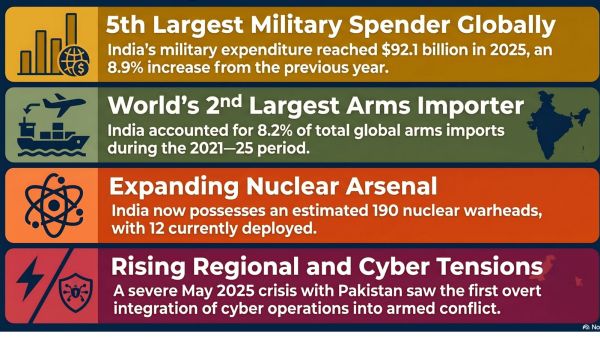
India spent $92.1 billion on its military in 2025 – the fifth highest in the world – according to a new report by the Stockholm International Peace Research Institute (SIPRI), a Sweden-based think tank. That is 8.9 per cent more than what India spent the year before.

Key takeaways:
SIPRI Yearbook 2026: Global Military & Nuclear Power
GLOBAL OVERVIEW
A Record-Breaking Year for Military Expenditure
Countries around the world spent a record $2.9 trillion on their militaries in 2025 — equal to 2.5% of the entire world’s economic output. This is the eleventh consecutive year that global military spending has increased, and the highest figure SIPRI has ever recorded since it began tracking in 1949.
$2.9T
Total global military spend in 2025
11th
Consecutive year of increase
ARMS TRANSFERS
International Arms Trade at Post-Cold War High
International transfers of major arms reached their highest level since the end of the Cold War during 2021–25, marking a 9.2% increase compared to 2016–20. The USA, France, Russia, Germany, and China together accounted for 70% of all arms exports. India was the second largest recipient of major arms in 2021–25, accounting for 8.2% of global arms imports.
TOP 5 MILITARY SPENDERS — 2025
The US Spends More Than the Next Four Combined
The United States remained the world’s largest military spender by a wide margin. India entered the top five for the first time, surpassing the UK, spending $92.1 billion — an 8.9% jump over the previous year.
Nuclear Warheads — Top 9 Countries (as of Jan 2026)
| Rank | Country | Warheads |
|---|---|---|
| 1 | 🇷🇺 Russia | 5,420 |
| 2 | 🇺🇸 United States | 5,042 |
| 3 | 🇨🇳 China | 620 |
| 4 | 🇫🇷 France | 370 |
| 5 | 🇬🇧 United Kingdom | 225 |
| 6 | 🇮🇳 India ▲ | 190 |
| 7 | 🇵🇰 Pakistan | 170 |
| 8 | 🇮🇱 Israel | 90 |
| 9 | 🇰🇵 North Korea | 60 |
▲ India slightly expanded stockpile in 2025 · World total: 12,187 warheads
“States are increasingly relying on nuclear weapons as instruments of national power — reversing decades of efforts to reduce the numbers and role of nuclear weapons — even as the risks of miscalculation and escalation are rising.”
— SIPRI Yearbook 2026, Key Findings
INDIA–PAKISTAN FLASHPOINT
First Open Use of Cyberattacks in Armed Conflict
SIPRI listed the India-Pakistan clash as one of the most dangerous flashpoints of 2025. India struck Pakistani air and missile bases — some with nuclear-related roles — but both sides took steps to avoid escalation. SIPRI recorded May 7–10 as days of intense cross-border fire, and noted it was the first time the two countries openly used cyberattacks as part of an armed conflict.
Three Destabilising Developments
⚠
Nuclear–Conventional Entanglement
The same missiles are designed to carry both nuclear and conventional warheads. This “grey area” creates a risk that conventional strikes could be misread as nuclear, triggering escalation — as seen in the India-Pakistan clash.
◆
MIRVs — Multiple Warheads, One Missile
Multiple Independently Targetable Re-entry Vehicles (MIRVs) allow a single missile to carry several warheads programmed to hit different targets, vastly multiplying destructive potential. India conducted a successful flight-trial of an advanced Agni missile with MIRV capability in May 2026.
◉
Submarine-Based Nuclear Weapons
An increasing number of nuclear-armed states are deploying weapons on submarines, which are harder to track and destroy. This proliferation of undersea nuclear capability adds a new layer of strategic instability.
GLOBAL GOVERNANCE
How the World Tries to Regulate Nuclear Weapons
Four major international frameworks govern nuclear weapons — with varying reach. India has not signed three of them, and the last bilateral US-Russia arms control treaty expired in February 2026.
★
NPT — Non-Proliferation Treaty (1968)
Aims to prevent spread of nuclear weapons. Recognises only 5 nuclear states (US, Russia, UK, France, China). 191 signatories. India conducted its first nuclear test in 1974 but has not signed, instead advocating universal non-proliferation.
⚖
TPNW — Treaty on Prohibition of Nuclear Weapons (2017)
First multilateral legally-binding treaty to prohibit development, testing, production, and use of nuclear weapons. India, China, Pakistan, and the USA have not signed.
◈
CTBT — Comprehensive Nuclear-Test-Ban Treaty (1996)
Bans all nuclear explosions for any purpose. Adopted by the UN General Assembly in 1996 but still not in force — 18 key states have yet to ratify it. India has not signed.
✕
New START — Expired February 2026
The last remaining nuclear arms control treaty between the US and Russia, limiting deployed strategic warheads and delivery systems, expired in February 2026. Russia had suspended inspections in 2023 amid the Ukraine war. Its expiry leaves no binding limits on either superpower’s arsenal.
Sources: SIPRI Yearbook 2026 · Indian Express · Stockholm International Peace Research Institute
What is SIPRI?
— Established in 1966, SIPRI is an independent international institute dedicated to research into conflict, armaments, arms control and disarmament. It provides data, analysis, and recommendations based on open sources to policymakers, researchers, the media, and the interested public.
— SIPRI’s statistical data on arms transfers relates to actual deliveries of major arms, as defined by SIPRI. SIPRI measures the volume of international transfers of major arms using a common unit—the trend-indicator value (TIV).
What are the key takeaways from SIPRI 2026?
1. Countries around the world spent a record $2.9 trillion on their militaries in 2025 – equal to 2.5 per cent of the entire world’s economic output. This is the eleventh year in a row that global military spending has gone up, and the highest figure SIPRI has ever recorded.
2. The United States spent the most $954 billion in 2025 (7.5 per cent lower than in 2024)– which is roughly one-third of all military spending in the world. China came second at $336 billion, accounting for 12 per cent of the world total, while Russia, the third largest spender ($190 billion), accounted for 6.6 per cent, followed by Germany ($114 billion) and India ($92.1 billion).
3. SIPRI listed the India-Pakistan clash as one of the most dangerous flashpoints of the year. The report said India struck Pakistani air and missile bases – some of which are believed to have nuclear-related roles – but noted that “both sides took steps to avoid escalation.”
Story continues below this ad
 Infographics by NotebookLM
4. The report also pointed out that it was the first time India and Pakistan openly used cyberattacks as part of an armed conflict. In its timeline of major events for the year, SIPRI recorded: “May 7–10: India and Pakistan exchange intense cross-border fire.”
5. International transfers of major arms reached their highest level since the end of the Cold War during 2021-25, marking a 9.2% increase compared to 2016–20. USA, France, Russia, Germany and China accounted for 70 per cent of export of arms. India was the second largest recipient of major arms between 2021-25, accounting for 8.2 % in Global arms import.
What does the Report say about the global Nuclear force?
6. India is believed to have slightly expanded its nuclear stockpile in 2025 and continued developing new types of nuclear delivery systems, while Pakistan’s focus has been on new delivery systems and accumulation of fissile material in 2025, as per SIPRI 2026.
7. As of January 2026, India had around 190 nuclear warheads, and Pakistan had around 170, according to SIPRI estimates. India is believed to have added slightly to its stockpile in 2025 and is working on missiles that can travel longer distances.
Top 9 nuclear-armed countries in the world, as of early 2026:
Story continues below this ad
| Rank | Country | Total Nuclear Warheads |
| 1 | United States | 5,042 |
| 2 | Russia | 5,420 |
| 3 | United Kingdom | 225 |
| 4 | France | 370 |
| 5 | China | 620 |
| 6 | India | 190 |
| 7 | Pakistan | 170 |
| 8 | North Korea | 60 |
| 9 | Israel | 90 |
| Total | 12, 187 |
8. “Key findings of SIPRI Yearbook 2026 are that states are increasingly relying on nuclear weapons as instruments of national power – reversing decades of efforts to reduce the numbers and role of nuclear weapons – even as the risks of miscalculation and escalation are rising,” the institute said.
9. The yearbook points out that the recent modernization and scientific developments are making the world more dangerous. Nuclear–Conventional Entanglement, proliferation of multiple independently targetable reentry vehicles, and submarine based nuclear weapon delivery systems are destabilizing developments, rising the risk of global nuclear escalation.
10. Nuclear–Conventional Entanglement: It refers to the “grey-area” where the same equipment, especially missiles, are designed to carry nuclear and non nuclear (conventional) military capabilities. This creates a potential risk of conflicts escalating to nuclear confrontation.
11. Multiple independently targetable re-entry vehicles (MIRVs) allow multiple warheads, which could be nuclear as well, to be loaded on a single missile delivery system and programmed to hit different targets, thus greatly enhancing the missile’s destructive potential.
Story continues below this ad
| In May 2026, the Ministry of Defence (MoD) announced that India had successfully conducted a flight trial of an advanced version of the nuclear-capable Agni missile with a Multiple Independently Targeted Reentry Vehicle (MIRV) system from Dr APJ Abdul Kalam Island, Odisha. |
12. Submarine-based nuclear weapon delivery systems have also been proliferating, with an increasing number of nuclear-armed states deploying their weapons on submarines.
BEYOND THE NUGGET: How does the world regulate nuclear weapons?
1. Non-Proliferation of Nuclear Weapons (NPT): NPT, formed in 1968, is an international treaty whose objective is to prevent the spread of nuclear weapons and weapons technology, to foster the peaceful uses of nuclear energy, and to further the goal of disarmament.
The treaty defines nuclear-weapon states as those that have built and tested a nuclear explosive device before January 1, 1967 – the US, Russia (formerly USSR), the UK, France and China – and effectively disallows any other state from acquiring nuclear weapons. 191 states have joined the treaty. India carried out its first nuclear tests in 1974 but has not signed it, and instead reiterated the principle of universality in preventing nuclear proliferation.
2. Treaty on the Prohibition of Nuclear Weapons (TPNW, 2017): It is the first multilateral legally-binding instrument for nuclear disarmament. The treaty prohibits a full range of nuclear-weapon related activities, such as undertaking to develop, test, produce, manufacture, acquire, possess or stockpile nuclear weapons or other nuclear explosive devices, as well as the use or threat of use of these weapons. India, China, Pakistan, USA and many other countries haven’t signed it.
Story continues below this ad
3. Comprehensive Nuclear-Test-Ban Treaty (CTBT, 1996): It is a multilateral treaty that bans all nuclear explosions, whether for military or peaceful purposes. Although it was adopted by the United Nations General Assembly in 1996, it’s still in the ratification stage — 18 countries are yet to ratify (the process by which a state indicates its consent to be bound to a treaty). India has not signed it.
4. New START Treaty: The New Strategic Arms Reduction Treaty (New START), which limits the number of deployed strategic nuclear warheads and delivery systems for the US and Russia, expired in February, 2026. It was the last remaining nuclear arms control treaty between both countries.
Notably, the treaty run into difficulties, most recently in 2023, when Russia suspended inspection activities under New START amid its war in Ukraine. In September last year, Vladimir Putin proposed a one-year voluntary extension.
Post Read Questions
(1) Consider the following countries: (UPSC CSE 2015)
1. China.
2. France
3. India
4. Israel
5. Pakistan
Which among the above are Nuclear Weapons States as recognized by the Treaty on the Non-Proliferation of Nuclear Weapons, commonly known as Nuclear Non-Proliferation Treaty (NPT)?
(a) 1 and 2 only
(b) 1, 3, 4 and 5 only
(c) 2, 4 and 5 only
(d) 1, 2, 3, 4 and 5
Story continues below this ad
(2) The “New START” treaty was in the news. What is this treaty? (UPSC CSE 2011)
(a) It is a bilateral strategic nuclear arms reduction treaty between the USA and the Russian Federation.
(b) It is a multilateral energy security cooperation treaty among the members of the East Asia Summit.
(c) It is a treaty between the Russian Federation and the European Union for energy security cooperation.
Story continues below this ad
(d) It is a multilateral cooperation treaty among the BRICS countries for the promotion of trade
| Answer key |
| 1. (a) 2. (a) |
(Sources: India had a $90 billion defence bill in 2025. Only 4 countries spent more, India deploys active nuclear warheads: What changed in 2025?, SIPRI Report 2026 summary )
Subscribe to our UPSC newsletter. Stay updated with the latest UPSC articles by joining our Telegram channel – IndianExpress UPSC Hub, and follow us on Instagram and X.
🚨 Click Here to read the UPSC Essentials magazine for May 2026. Share your views and suggestions in the comment box or at manas.srivastava@indianexpress.com🚨

