

6 min readNew DelhiUpdated: Jun 3, 2026 01:52 PM IST
The Delhi High Court recently granted Rs 9,000 monthly maintenance to a woman despite upholding a family court’s decision declaring her marriage void (invalid), observing that denying financial support to an “indigent” and “destitute” woman would result in “grave hardship and injustice”.
Justices Vivek Chaudhary and Renu Bhatnagar noted that the woman was residing in an old-age home, had no independent source of income, property or family support, whereas the estranged husband was a retired government employee drawing a regular pension and was in a better financial position to provide assistance.

“The respondent(husband) is a retired government employee receiving a regular pension with no substantial liabilities, as per the affidavit filed by him dated 29.05.2023. He is, therefore, in a comparatively better financial position to provide support. In these circumstances, denial of maintenance would result in grave hardship and injustice to the appellant. This court is of the considered view that this is a fit case for grant of reasonable maintenance to secure her sustenance and dignity,” the May 29 order read.
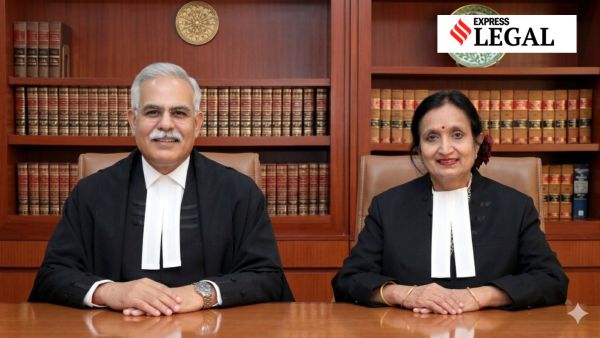 Justices Vivek Chaudhary and Renu Bhatnagar noted that the woman was residing in an old-age home, had no independent source of income, property or family support.
The high court was hearing an appeal filed by the wife challenging a July 2018 family court judgment that declared the marriage between the parties null and void ab initio on the ground that her earlier marriage had not been legally dissolved.
Maintenance despite void marriage
- The high court directed the husband to pay Rs 9,000 per month to the woman towards permanent alimony and maintenance.
- The high court noted that the woman had argued that the marriage was arranged through a mediator and that the husband was fully aware of her previous marriage and alleged customary divorce.
- However, the court held that the evidence on record, including the testimony of the mediator, failed to establish the existence of a legally recognised custom of divorce or prove that the woman’s earlier marriage had been validly dissolved in accordance with a relevant custom.
- The high court held that the family court has correctly held that the evidence placed on record falls short of the strict standard required to prove a valid custom, which must be ancient, certain, reasonable, and continuously observed.
- The court noted a valid custom must be ancient, certain, reasonable and continuously observed, and the wife had failed to produce any prior instances, judicial recognition or authoritative material to substantiate the alleged customary divorce.
- The court further reiterated that a marriage performed while a previous marriage subsists is void under the Hindu Marriage Act and that mere knowledge of the earlier marriage or alleged customary divorce cannot cure the legal defect.
- The high court noted that the family court had earlier granted interim maintenance to the tune of Rs 5,000 per month to the woman by an order dated October 23, 2015, at a time when the husband was still in service, till disposal of the original petition.
- A void marriage is non est in the eyes of law and is treated as having never come into existence from its inception.
- The court added that in the absence of any legally admissible evidence establishing the dissolution of the wife’s earlier marriage, it must be held that the said marriage was subsisting at the time of her marriage with the man.
I am not in contact with former husband
It was claimed that the marriage between the couple took place in June 2013 as per the Hindu rites and customs. At the time of marriage, it was claimed that the husband was a widower with three children from his previous marriage. The wife allegedly had also been previously married.
Her case is that her previous marriage stood dissolved through a customary divorce before a panchayat, and that she had not been in contact with her former husband for over 25 years.
It was also an admitted position, even before the family court, that she had not taken divorce from her previous husband from any competent court.
Story continues below this ad
The husband filed a petition seeking a declaration that the marriage was void on account of the subsistence of the woman’s earlier marriage.
Subsequently, the family court allowed the petition and declared the marriage between the estranged couple as null and void on the ground that the wife had failed to prove that she was legally divorced from her former husband at the time of marriage with the alleged present husband.
Aggrieved by the same, the woman reached the Delhi High Court with a present petition.
I am literate, economically dependent woman
Representing the estranged wife, advocate Meera Kaura Patel argued that the family court gravely erred in declaring the marriage null and void by ignoring material evidence on record.
Story continues below this ad
It was submitted that the husband, having entered into the marriage with full knowledge of the woman’s prior marriage and alleged customary divorce, is precluded from seeking a declaration of nullity on that very ground.
It was further submitted that the wife, an illiterate and economically dependent woman, was misled and prejudiced by the conduct and the said judgment, which not only overlooked the subsisting marital relationship and cohabitation between the couple but also disregarded her entitlement to maintenance under settled principles of law.
Lastly, it was submitted that even if the marriage was held to be void, the wife remains entitled to maintenance pendente lite or, in the alternative, to permanent alimony concerning the facts and circumstances of the case.
Former husband is alive
Appearing for the man, advocate Jaskaran Singh argued that the woman has utterly failed to discharge the burden of proving dissolution of her prior marriage.
Story continues below this ad
It was urged that unless a valid customary divorce is proved, the earlier marriage can only be dissolved in accordance with statutory provisions; otherwise, subsequent marriage would be rendered void ab initio due to subsistence of the earlier marriage.
It was further submitted that the woman, whose former husband is admittedly alive and with whom no legally recognised divorce has taken place, cannot claim any legal rights against the alleged present husband.

