

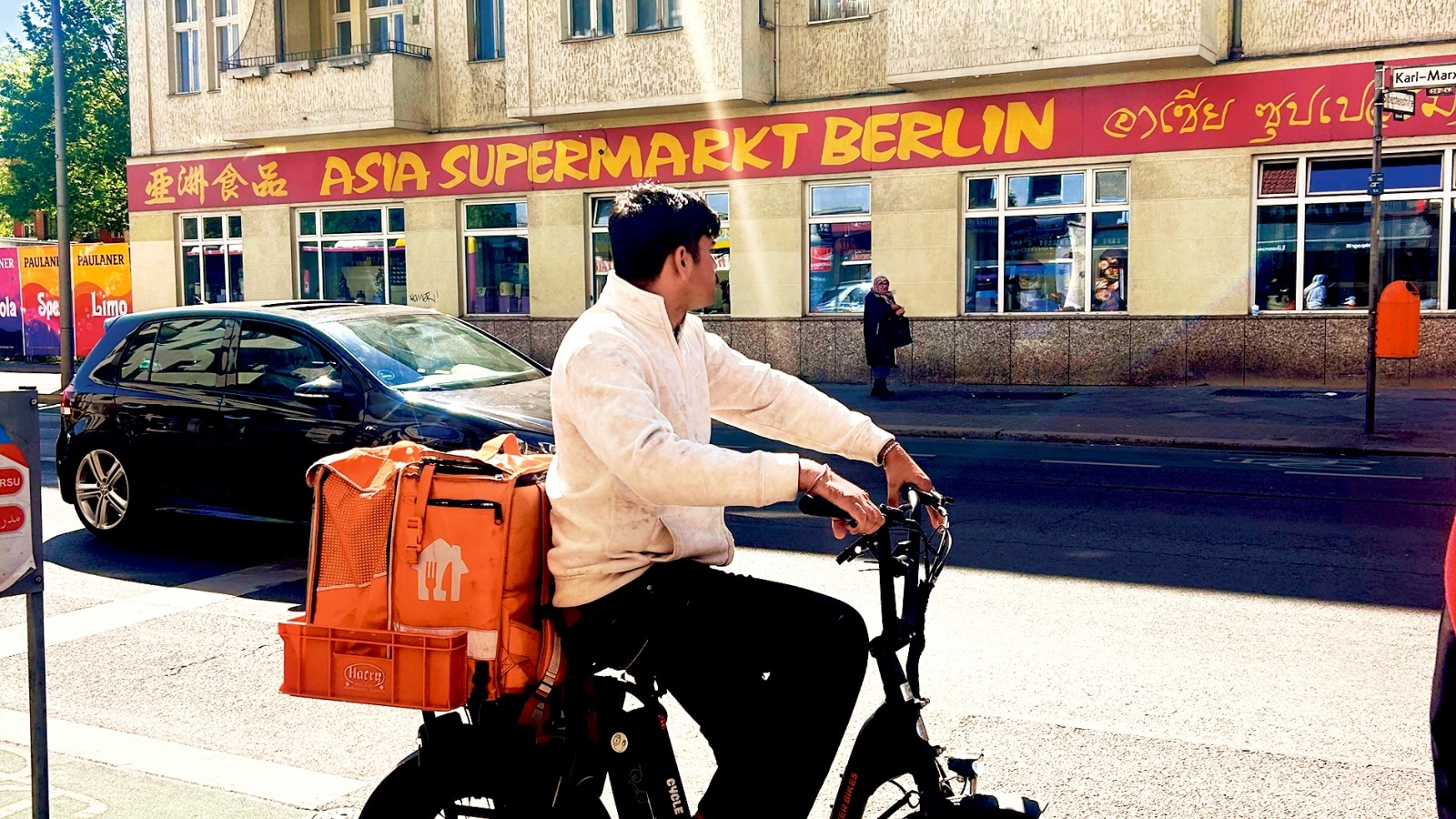
At 11, Mihir hurriedly drinks his morning cup of chai and lines up three mobile phones in front of him. The first has the Uber Eats app open, the second Wolt and the third Lieferando, the only food delivery platform where he is legally employed as a delivery worker. The sunlight, soft and unfiltered, bounces off his apartment walls, though a lingering chill remains. “Aaj nahin banegi order (It is not the best day to get orders),” he says, looking out of the window.
The two years that he has spent in Germany hasn’t softened the Haryanvi in his Hindi and he has been making do with rudimentary German – “it’s good enough if you can say Danke schön (thank you), Schönen Tag (have a good day) and Bitte schön (you’re welcome)” – but he already considers himself a Berliner.

“There is something about Berlin. I feel free… See, if I am seen drinking a glass of beer in public in Germany, no one will judge me. In fact, people might join in and give me company. But in India, I might just get arrested. And before I know it, I will be all viral on social media,” says Mihir.
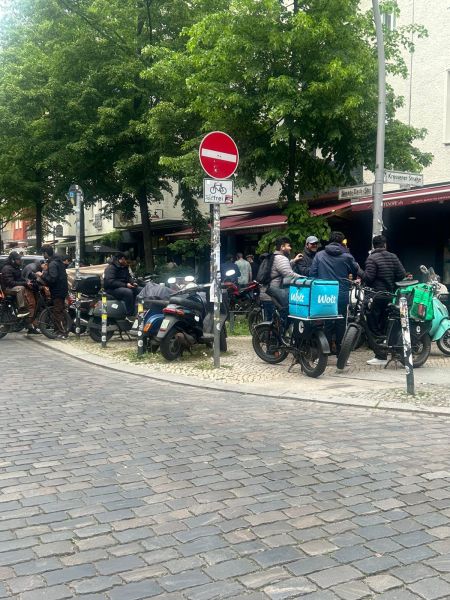 Gig workers at Simon-Dach-Straße, the central Berlin street that’s lined with cafés, bakeries and brunch spots. (Photo: Adrija Roychowdhury)
The 25-year-old, who arrived in Germany in May 2024, recently completed a Master’s degree in tourism and hospitality from a private university in Berlin and is currently on a job-seeker visa. But that was simply a route he took. All he wanted was to work in Germany.
Since October last year, he has been working as a fahrer (driver/rider) or kurier (courier), as delivery workers are called in Germany.
As Germany’s platform economy expands, migrant workers have become its most visible workforce, with Indians and other South Asians prominent in food-delivery jobs in cities such as Berlin.
On a weekday afternoon, many of them turn up at the bustling Simon-Dach-Straße, the central Berlin street that’s lined with cafés, bakeries and brunch spots. As they sit astride their electric bikes, waiting for their phones to ping with orders, some thumb through their phones, others trade jokes and swap stories of their day on the road.
Story continues below this ad
While there is no official data on Indians as gig workers in Germany, Abu John, a Berlin-based lawyer who researches migration and platform economies, says they make up the bulk of the workforce. “One can be certain that more than 90 per cent of the food delivery workers in Berlin at least are recent migrants. Of that, 50 per cent are Indians and another 25-30 per cent Bangladeshis or Pakistanis,” he says.
This way to Berlin
While the conservative Christian Democratic Union government under Friedrich Merz has steered Germany away from its traditional “open door” stance towards migration, it has simultaneously worked to promote legal immigration in a bid to address labour shortages in sectors such as logistics, hospitality, healthcare and engineering.
Programs such as the Opportunity Card, or Chancenkarte, which allows qualified non-European Union job seekers to live in Germany for up to a year while searching for employment, besides the steady expansion of international student routes and vocational training programmes, have made Germany increasingly accessible to young migrants from countries such as India.
The number of Indians in Germany has gone up from 86,000 in 2015 to 280,000 in the beginning of 2025. According to a statement by DAAD, the German organisation that supports academic exchange, as of 2025, Indian students (49,483 of them in 2024-25, up from 20,819 in 2018-19) formed the largest international community in Germany.
Story continues below this ad
Like Mihir, many choose the student route to enter Germany’s labour market. Unlike countries such as the US or UK, where international education often requires high tuition fees and expensive private universities, Germany’s public universities charge little or no tuition fees even for foreign students. But they have stringent entry requirements and so, many enrol in the newer private universities, some of which operate in a loosely regulated space.
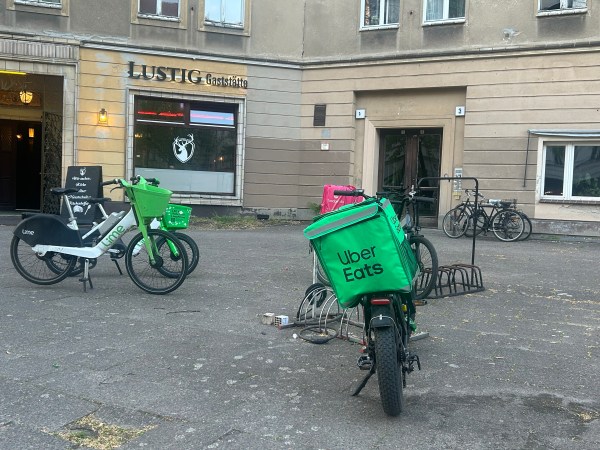 Many of the migrant students start with gig work, either as a means to enter the German workforce or as a way to earn while studying (Photo: Adrija Roychowdhury)
Germany’s relatively easier post-study work options help too. International students are also allowed to work part-time for up to 20 hours a weeks, and after graduation, they can stay back for a year to look for jobs.
As is apparent on the streets of Berlin, many of them start with gig work — including food delivery, warehouse shifts, or ride logistics — either as a means to enter the German workforce or as a way to earn while studying.
Explaining the increasing visibility of South Asians on food delivery platforms, Patrick Feuerstein, co-principal investigator at Fairwork Germany, a global initiative studying the working conditions on digital labour platforms, says, “Most of the riders are young, tech savvy, need the money, and are flexible. There seems to be a lot of body referral going on, with people from the same communities referring their friends and family to the jobs.”
‘There are so many rules’
Story continues below this ad
The son of a farmer, Mihir decided to move out of his village Chuli Khurd, in Hisar district, after the Agnipath scheme disrupted his dreams of joining the Army. “I thought, if I have to do dehadi mazdoori (daily-wage labour), I might as well do it abroad,” he says, looking at the East Berlin street outside the window of his two-room apartment that he shares with four boys from Hissar.
His initial choices were Australia, Canada and the UK, but his agent suggested Germany.
In February 2024, Mihir received his acceptance letter from Berlin School of Business and Innovation (BSBI), a private university in Berlin. He paid around Rs 25,000 to the agent and applied for a bank loan of Rs 15 lakh to pay the university fees. The agent, he says, convinced him there was no need to know German. “Thoda bohot English se kaam chal jaayega (one can work around with a little bit of English),” he told him.
Within 15 days of arriving in Germany, he got his first job – as a cleaner with a Berlin-based online platform – and quickly switched to work as a gardener. Classes were held only thrice a week, and he would frequently head out in the middle of college hours to attend to his work shifts. “The teachers were very understanding; they would give me attendance,” he says.
Story continues below this ad
In August 2024, he applied to Lieferando to work as a delivery worker. Luckily for him, knowledge of German was not a requirement; he only needed to know how to ride a bike. A quick phone interview later, he had the job. He later picked up jobs with Uber Eats and Wolt, and now earns about €2,500 a month if he works for eight hours all seven days a week.
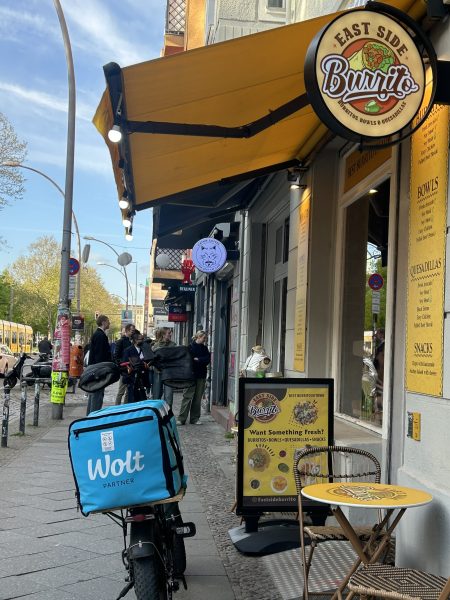 Delivery platform Wolt says all their delivery riders “work under fair, lawful, and transparent conditions” (Photo: Adrija Roychowdhury)
Like Mihir, Tajinder Singh, 30, from Chandigarh, came to Berlin to study Marketing at Arden University, the Berlin campus of a private UK university. It was his agent who suggested both the university and the course, he says.
Soon after reaching Berlin, he joined Amazon as a delivery worker to manage his living expenses. A year later, he joined Lieferando. He now has six months left on his job seeker visa and has been learning German in the hope of landing a job soon.
Tajinder says most Indian students prefer delivery jobs because they are “stress free” and “flexible”. “In most other jobs, you need to know German, but here, you just hand over the packet, nod, at best say bitte schön (you are welcome) and leave,” says Tajinder.
Story continues below this ad
When Mihir arrived in Berlin in May 2024, he was blown away. “Ek number ka city (No 1 city)… Everything was so clean. It seemed like I was breathing fresh, clean air for the very first time,” he recalls.
Soon after landing in Berlin, he moved into a student accommodation. Very quickly, however, he found himself overwhelmed by the sheer number of rules in the country. “There are rules for walking, talking, living, and even breathing, I realised,” he says.
What was especially tough was that he had to practise speaking softly. “India mein, apne ghar mein kuch bhi karo, no problem (Back home, you can do whatever). But here, especially after 10 pm, there must be pin drop silence at home so that the neighbours do not get disturbed. On most days, I come home late after work and can’t even cook in a pressure cooker. The neighbours would call the police if the whistle went off at that hour,” Mihir says.
Sticking to the right-lane while on his bike to deliver orders was tricky, too. “It’s just the opposite of what it is at home,” he says. He would frequently slip into the wrong lane, inviting angry stares and yellings from other drivers.
Story continues below this ad
The winter months were the worst. Riding on the snow-covered streets of Berlin was tricky and he would often slip. “Now I am used to it. I can get from one end of the city to another in less than an hour,” he says.
Mihir says he still trips over the German names of streets. “I only know the main roads that lead out from near my home. For the rest, there’s Google Maps.”
A shorter route: The subcontractors
At 2.10 pm, Mihir’s phone rings out sharply. He finally had the first order of the day from Wolt. These orders are critical. On Uber Eats and Wolt, where he works through subcontractors, he is paid per delivery.
Over the last few decades, a number of sectors in Germany, from construction to logistics and delivery, which rely largely on migrant labour, have adopted the subcontractor route to hire workers.
Story continues below this ad
There have been allegations of hirings that circumvent German laws on minimum wages, with the subcontractors paying per delivery and demanding a payment from the workers to get them on board. Besides, there is little job security. Mihir says that a few months ago, when he visited India for 40 days, he lost his Uber Eats gig though he had paid the subcontractors €600 euros for the job. Since then, he has been using his friend’s ID to work on Uber Eats.
A 38-year-old from Chandigarh says the subcontractor he worked with mostly hired delivery workers through ‘mini job’ contracts — a part-time job provision that allows students to earn a tax-free income up to €603. “But the riders would often work full time, and the remaining income is paid in cash. It is a blatant misuse of the student visa,” he says.
Following a 2025 investigation by RBB, a state-owned public broadcasting corporation that had highlighted allegedly serious abuse in the food delivery service sector, there were calls for the subcontractor system to be abolished.
At Lieferando, where Mihir is a direct employee, he gets the minimum wage of €13.90 per hour, is not allowed to work for more than 20 hours a week as mandated by his student visa, and gets other employee benefits such as sick leaves, and medical aid. But the amount wasn’t enough for him to pay off his student loan and he needed to send money back home, so he signed up with subcontractors of Wolt and UberEats, where he is paid per delivery.
Amrita Datta, a sociologist working on Indian migrants in Germany, says the problem is not as much with gig work as with the infrastructural issues the sector has given rise to, especially the subcontracting model that often leaves migrants vulnerable to exploitation.
Last year, Lieferando, which was the only delivery app that had been hiring directly until then, announced that they too were exploring the subcontracting route, sparking protests from among its workers’ collective.
“Germany is a welfare state, so the baseline is very different from India,” argues Debarun Dutta, a filmmaker whose 2025 documentary, The Delivery Guy, highlighted some of the struggles in the industry. “But despite these norms and a very strong culture of social welfare, the platform economies have found ways of circumventing them.”
Florian Anders, head of PR and communications at Wolt, Germany, however, said in an email interview that all delivery riders, “whether directly employed or engaged through partners… work under fair, lawful, and transparent conditions.”
Anders insisted that subcontractors are expected to meet high standards and employ their couriers on a permanent basis, treat them responsibly, and comply with all legal requirements. “To ensure this, Wolt has implemented rigorous onboarding processes and conducts regular compliance checks,” adds Anders.
Uber’s Mobility Communications Lead, DACH, Maja Ruhbach, said, “Since entering the German market in May 2021, we have not employed couriers directly; 100% of deliveries are handled exclusively by independent third-party fleet partners or by restaurants employing their own staff…While these fleet partners act as independent employers with full authority over their staff, we contractually obligate them to comply strictly with all German labor laws, including mandatory social security contributions and the payment of the statutory minimum wage.”
Emails sent by The Indian Express to the press office at Lieferando and the Federal Ministry of Labour and Social Affairs went unanswered.
A 38-year-old Indian working with Lieferando says some of the blame lay with the workers who exploited German labour regulations, pushing firms to adopt the subcontracting route. “Riders would often log in during their shift times but not step out to do the deliveries. Since the labour rules ensured they would be paid on a per hour basis regardless of the number of deliveries, they made the most of the system. Ultimately, the platforms turned to hiring indirectly through subcontractors.”
Between two worlds: India and Germany
It’s 2:30 pm by the time Mihir reaches the restaurant to pick up his first order of the day. He is already behind schedule. He pedals hard for the next five or six kilometers, reaching the commercial neighbourhood of Neukölln in southeastern Berlin in 20 minutes.
He walks up to the apartment gate where the customer is waiting for the order. He is nearly half an hour late. Mihir apologises, the customer shrugs to say it’s alright.
“This is the big difference between India and Germany,” he says. “People are polite here. They say ‘please’, ‘thank you’. They even apologise if I have to climb up too many stairs to deliver the order.” In Hisar, where he worked for a week, “people would refuse to pay if the order reached them a bit late. I earned less than Rs 2,000 in an entire week, and ended up paying over Rs 500 from my pocket for fuel.”
Mihir gets two more orders, both on the outskirts of West Berlin. By now, his bike’s battery indicator is flashing low and he decides to go home to recharge it.
After a couple of hours, he steps out again in the evening. It’s a sunny spring day and most people are out on the roads. “This is a bad season for food deliveries. Winters are the best,” he says, talking about a bitingly cold January day, when he made his highest single-day earnings of €250, working for 12 hours straight.
Today is different. By 10 pm, he has completed six orders. After deductions, he is left with under €50. “Sometimes I don’t get a single order,” he says.
Those days are the hardest. Yet, returning to India is not an option he considers. “The delivery work is just a temporary job. Someday, I’ll be a chef at a restaurant… I am willing to cook anything — Mexican, Italian, Korean…,” he says.
The next morning, at 11 am, Mihir is ready with his three phones, scanning for orders. Outside, the air is colder. “Perhaps today will be better,” he says.

