

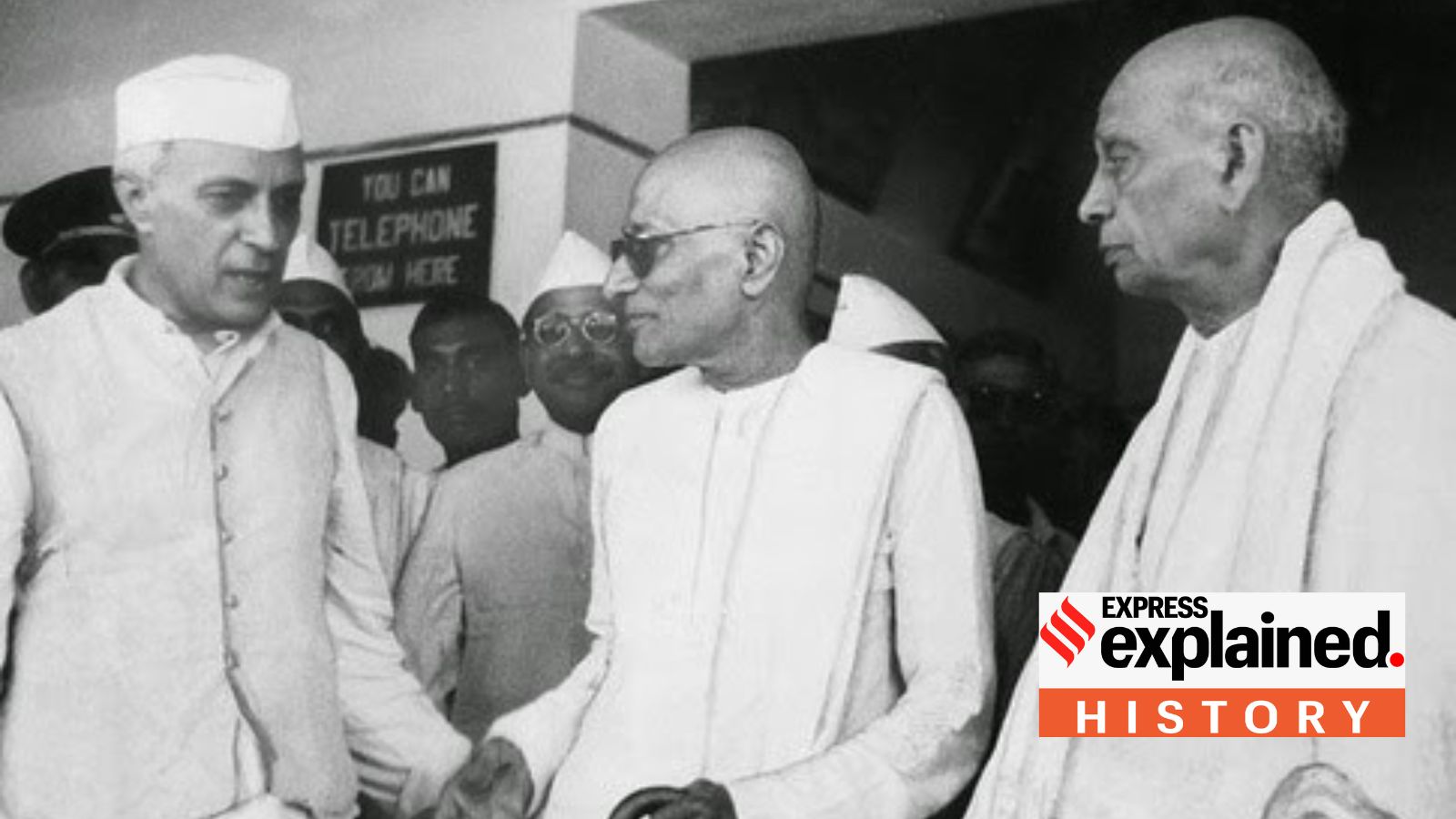
First, Governor Rajendra Arlekar asked Vijay to prove his majority despite the Tamilaga Vettri Kazhagam emerging as the single largest party. Then, just as the party appeared to have secured enough support, the arithmetic became wobbly again, prompting the Governor to defer Vijay’s Saturday morning swearing-in. On Saturday night, TVK finally cobbled up the required numbers.
A similar crisis was playing out around the same time nearly 75 years ago in the same region. The 1952 Assembly election in the erstwhile Madras State — made up of the present-day Tamil Nadu, Kerala, Karnataka and Andhra Pradesh — threw up independent India’s very first fractured verdict.
The deadlock set in motion a series of events involving Prime Minister Jawaharlal Nehru that would eventually lead to statesman C Rajagopalachari (Rajaji) stepping in as the state’s Chief Minister between April 1952 and April 1954.
This is the story of what happened in those tumultuous days between February and early April that saw a fledgling republic managing to overcome, albeit imperfectly, its first serious Constitutional test.
What happened in the 1951 Assembly election in Madras State?
The election to the 375-seat Madras State Assembly was held over the course of nine days between January 2 and January 25. They were the first elections held in the state following independence.
As the results trickled in, it became clear that no party had secured an outright majority.
Story continues below this ad
The Congress won 152 seats. The Communist Party of India (CPI) came in second with 62 seats, followed by the J B Kripalani-founded Kisan Mazdoor Praja Party (KMPP) with 35 seats. There were also 63 independent members.
Even though the Congress was the single largest party, its election performance was seen as a debacle. Then Congress chief minister P S Kumaraswami Raja and five of his cabinet members lost their seats.
Historian and biographer Rajmohan Gandhi, in his book Rajaji: A Life, puts the Congress’s poor performance down to a series of factors — a foodgrain crisis, loss of touch with the masses, the appeal of the Communists, and, importantly, the strong support in the Telugu-speaking Andhra region for a former Congress leader.
Story continues below this ad
This leader was T Prakasam, who was premier (equivalent to chief minister) of the Madras Presidency from 1946 to 1947 as a Congress member. Prakasam joined Kripalani’s KMPP in 1951 over differences with the Congress leadership.
Gandhi writes: “Though he had lost his own seat, Prakasam claimed the support, not proved, of a front of 166 MLAs, including the Communists and independents.”
This left the Madras State Governor, Maharaja Krishnakumarsinhji of Bhavnagar, in a quandary.
On one side was Prakasam’s claim. On the other side was the single largest party, the Congress, and its leader K Kamaraj’s assertion that “only the Congress is going to rule”.
Story continues below this ad
Krishnakumarsinhji, who was due to retire, referred the question to the President.
Rajmohan Gandhi notes that the Congress leadership went into a huddle over the issue. But it “did not know what advice to give Nehru, who did not know what to advise the President, who was thus unable to send any word to the Governor”.
What was Nehru’s stance on the hung Assembly?
Nehru was clear in his preference for an elected government over President’s Rule.
He wrote to President Rajendra Prasad on February 3, 1952, saying President’s Rule should be considered only if it became clear that “there is no possibility of any party or coalition succeeding in forming a stable Government”.
Story continues below this ad
But he added: “President’s rule cannot be normal or prolonged in the circumstances. It must yield place either to a Government envisaged in the Constitution or to a fresh election.”
He acknowledged that the Congress did not possess an outright majority, and was keen that the party “avoid any appearance of hankering after office”.
At the same time, he underlined the importance of the state’s administration being carried on.
Story continues below this ad
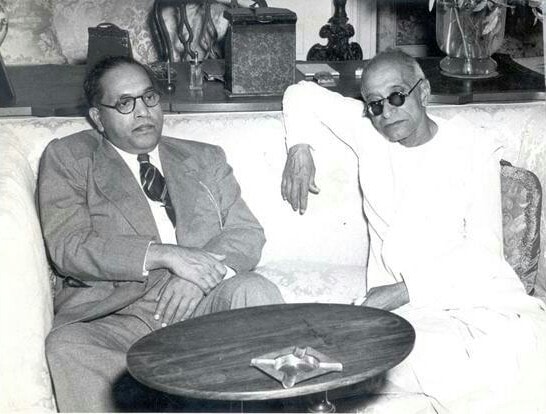 Rajaji with B R Ambedkar. (Wikimedia Commons
Consensus builds around Rajaji
Rajaji, or CR, was one of the most important figures of the Indian freedom movement. In 1948, he became Governor-General and, thus, independent India’s first Indian head of state.
As the situation in Madras continued to fester, Rajmohan Gandhi notes that the Congress was internally forming a consensus around nudging the 73-year-old leader. The thinking was that the prestige he commanded would ensure support for his government.
“If he was drafted, their link with power could continue. If not, there would be President’s rule, if not Red rule…,” the author wrote.
Story continues below this ad
Rajaji’s elevation was also backed by the new Governor of Madras State, Sri Prakasa.
According to Rajmohan Gandhi, Sri Prakasa wrote to President Prasad: “After endless parleys, everybody came to one and only one solution — that the only person who could save the situation was Rajaji.”
On March 4, 1952, Nehru wrote to Rajaji underlining the significance of steering clear of President’s Rule in Madras, doing which “hurriedly would, in my opinion, lead to unfortunate consequences later in Madras. Elsewhere too the consequences would be regrettable.”
Story continues below this ad
Nehru wrote: “If the old set of leaders have proved helpless and lacking in capacity, we shall have to search for new ones.”
On the same day, in a letter to Kamaraj, Nehru stressed that he had been “repeatedly approached by people from Madras and asked to induce Shri Rajagopalachari to take up the leadership of the Congress Legislature Party in Madras” adding that he had, received a “telegram signed by 62 newly elected M.L.As” in this regard.
And on March 29, Nehru stated that he received a letter from Madras Congress leader Kumaraswami Raja, conveying the state legislature party’s resolution backing Rajaji to take over its leadership.
Nehru accepted that decision — but he still had one lingering doubt.
An unelected chief minister
Nehru hesitated in effectively parachuting in a non-elected person to the chief minister’s post.
He wanted Rajaji to be elected to the Assembly. This was the sticking point.
While Rajaji said on March 31 that he was willing to take over as chief minister, he was also clear that he would not stand for election.
Following discussions among Governor Sri Prakasa, Kumaraswami Raja and Rajaji, a solution was found. Rajaji would be nominated to the upper house of the state legislature. President Prasad was informed about this on April 1.
Rajmohan Gandhi notes: “To install C.R. on his terms would amount to flouting Nehru’s wish, but the alternative was to lose C.R. and, with him, every chance of a Congress government.” So, Kumaraswami Raja, with the Governor’s cooperation, moved swiftly to swear Rajaji in as Chief Minister — “before Nehru could come to know of CR’s inflexible condition.”
Nehru was clearly unhappy with being blindsided, and expressed this in a letter to the Governor on April 3. But he also acknowledged in the letter: “At the same time, I could suggest no other and better alternative to all this and so I left it to our friends in Madras… All we can do is to leave further developments now to Rajaji and his colleagues there.”
And in an April 7 letter to Rajaji, he assured him of “all our help”.
Vijay’s current huddle with smaller parties, who may eventually be accommodated in ministerial berths in a coalition government led by him to keep the DMK-AIDMK combine from staking claim, bears striking similarity with Rajaji’s decision in 1952. To keep the Communist-led opposition from power, Rajaji’s ministry included Commonweal Party leader Manickavelu Naicker in his cabinet and members of the N G Ranga-led Krishak Lok along with over five dozen independents.
So why was Nehru unhappy with the upper house route?
According to Nehru, President Prasad had termed the nomination of Rajaji to the Legislative Council as “a wrong step, wrong not only in the spirit of the Constitution but also the letter of it.”
Nehru’s key concern, as expressed in a letter to Governor Sri Prakasam on April 7, was that it could set a bad precedent.
“I do not entirely agree with what the President has written, but I must confess that I was taken aback by these nominations, which were clearly political and made with the object of strengthening a political party,” he stated.
But he also accepted that “drastic situations” require “drastic remedies”.
“Perhaps the situation in Madras was such a drastic one. Anyhow the thing is done now and we must accept the consequences that flow from it.”
Interestingly, other prolific political figures from what is now Tamil Nadu took a similar route to the CM’s chair: its first CM C N Annadurai was first sworn-in an a Member of the Legislative Council and then as CM; five-time CM and DMK patriarch M Karunanidhi, for a short stint in the 1980s, had switched to the Council before returning to contest Assembly polls.

