

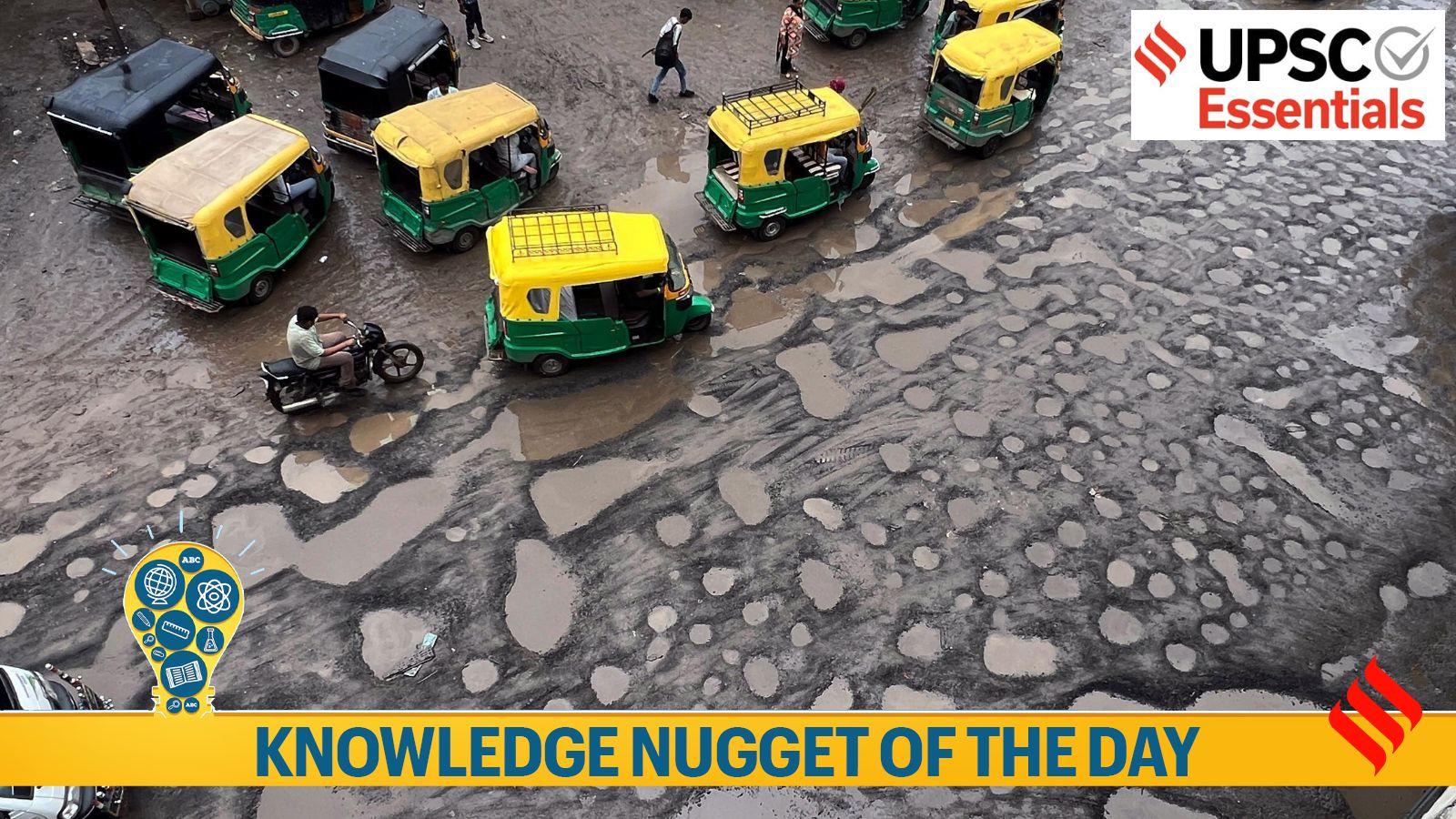
Take a look at the essential concepts, terms, quotes, or phenomena every day and brush up your knowledge. Here’s your knowledge nugget on pothole repairing technologies for today.
Potholes have always been a problem on Indian roads. They slow traffic, make rides uncomfortable, and can cause serious accidents. In the rains, they turn into pools and become bigger hazards. To fix the problem, the Municipal Corporation of Delhi (MCD) is looking for a more effective, scientifically driven fix to the problem this year.
Gear up forUPSC Prelims 2026—Practice smarter, revise faster, and succeed with ourSpecial Quiz Magazine.Click Here
Key takeaways:
1. The MCD is considering three technologies for pothole repairing, The Indian Express has learnt. These technologies are patented by the Council of Scientific and Industrial Research-Central Road Research Institute (CSIR-CRRI), the country’s premier R&D organisation on the maintenance, construction, and design of roads.
2. Two basic materials are used in road repairs: aggregate, or crushed stone that gives the road its structure; and binder, the bituminous material that holds the mix together. A key question in road resurfacing is how much of an old road can be reused rather than replaced with fresh material.
3. The technologies under consideration are Ecofix, a ready-to-use steel-slag-based pothole-repair mix; Rejupave Rejuvenator, a material for dense carpet work and resurfacing of roads; and Modified Mix Seal Surfacing or MSS+, a cold-mix surfacing technology that reduces the need to heat road material.
Story continues below this ad
4. ECOFIX: Ecofix is a ready-to-use material that can be placed in a damaged part of a road and compacted with a small vibrator or hand rammer. The repaired surface is ready for traffic in about 10 minutes.
— It is produced from processed steel slag that can be applied without using a tack coat and without draining water from the pothole. According to CRRI, Ecofix is a way to use processed metallurgical waste in road repair, reducing dependence on natural aggregates.
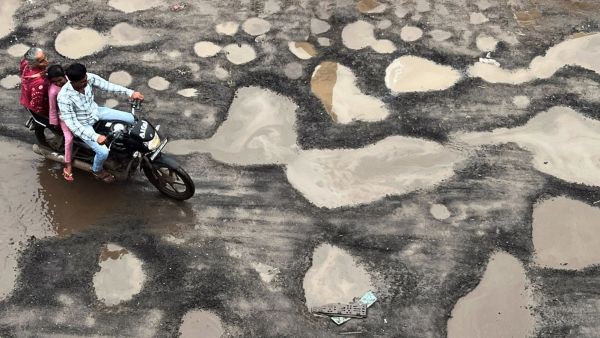 The Municipal Corporation of Delhi (MCD) is looking for a more effective, scientifically-driven fix to the problem of potholes this year. (Express photo)
5. REJUPAVE REJUVENATOR: Dense carpet is a bituminous surfacing layer laid over an existing road to improve the riding surface and renew the top layer. It is usually taken up when a road has aged or developed surface distress but does not require full reconstruction.
— According to CRRI, using a small quantity of Rejupave Rejuvenator — 0.5% to 1% of the dense carpet mix — can improve the reusability of aggregate and binder from the current 25% to about 60-70%.
Story continues below this ad
6. MSS+: Modified Mix Seal Surfacing, or MSS+, is a cold-mix method for dense carpet work. It allows binder and aggregate to be used at ambient or room temperature, unlike conventional hot-mix road work where the material has to be heated before it is laid.
— Conventional methods are carried out at around 150-160°C, while the developed methods require only 120-125°C, leading to a substantial reduction in greenhouse gas emissions.
Potholes leading to road fatalities
1. According to the data tabled by the Ministry of Road Transport and Highways (MoRTH) in the Lok Sabha in February, 2206, deaths due to potholes have increased by over 53% since 2020.
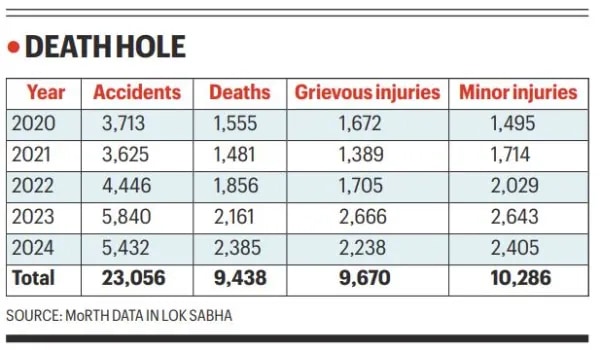
2. A total of 1,555 persons died in 2020 in pothole-related road accidents, which increased to 2,385 fatalities in 2024. This translates into over six road deaths due to potholes daily.
Story continues below this ad
3. The state-wise analysis of the data shows Uttar Pradesh alone contributed more than half of the national total of pothole deaths. The state consistently reported the highest number of fatalities in the country — from 759 deaths in 2020 to 1,369 in 2024.
4. Madhya Pradesh saw a notable increase in fatalities from 96 in 2020 to 277 in 2024. This was followed by Punjab, Tamil Nadu and Assam. The top five states put together account for over 82% of the total road accident fatalities due to potholes.
5. In terms of number of annual road accident fatalities, India tops globally, followed by China, which accounts for just 36% of India’s total, and the US at 25%. India has the second-largest road network in the world — about 63.45 lakh km, including 1.46 lakh km of NHs and 1.80 lakh km of state highways.
BEYOND THE NUGGET: Bio-bitumen technology
1. CSIR-CRRI has developed the bio-bitumen technology using pyrolysis of rice straw (parali) for sustainable flexible pavement construction. During the technology transfer event in January 2026, the Union Minister of State for Science and Technology Dr Jitendra Singh said that India has entered an era of “Clean, Green Highways” following the successful technology transfer of “Bio-Bitumen via Pyrolysis: From Farm Residue to Roads”.
Story continues below this ad
2. India’s bitumen imports result in an annual foreign exchange outgo of approximately ₹25,000 crore. As evident in the ongoing West crisis, it exposes the sector to global crude oil price volatility and supply-chain risks.
3. India generates more than 600 million tonnes of agricultural residue annually. A significant fraction of this biomass, particularly rice straw (parali), is burnt in open fields due to the absence of economically viable utilisation pathways. This leads to severe air pollution, greenhouse gas emissions, soil nutrient loss and public health impacts.
4. Bio-bitumen technology provides a convergent solution to the problem. It simultaneously reduces bitumen import dependence and mitigates stubble burning which is essential for sustainable, resilient and environmentally responsible road infrastructure development.
5. CSIR-CRRI, in collaboration with CSIR-Indian Institute of Petroleum (IIP), has developed bio-bitumen technology using pyrolysis of rice straw. The resulting bio-oil is upgraded through chemical unit operations to produce a bio-binder suitable for flexible pavement applications, either as a partial replacement or as a modifier to conventional VG-grade bitumen.
Story continues below this ad
Rice Straw → Pyrolysis → Bio-Oil → Bio-Binder → Flexible Pavements
6. The trial section of bio-bitumen technology was successfully constructed on 26 October 2024 on the NH-6 (Jorabat–Shillong Expressway), demonstrating satisfactory field performance under traffic.
Post Read Question
Rejupave Rejuvenator and Ecofix were in the news recently, it is related to:
(a) Solid waste management
(b) River cleaning
(c) Road construction
(d) Clothing
(Sources: Pothole-related road fatalities increase by 53% in 5 years, Smoother rides this monsoon: MCD looks at 3 new technologies to plug Delhi’s infamous potholes, crridom.gov.in)
Subscribe to our UPSC newsletter. Stay updated with the latest UPSC articles by joining our Telegram channel – IndianExpress UPSC Hub, and follow us on Instagram and X.
Story continues below this ad
🚨 Click Here to read the UPSC Essentials magazine for April 2026. Share your views and suggestions in the comment box or at manas.srivastava@indianexpress.com🚨

