

Preliminary Examination: Current events of national and international importance.
Main Examination: General Studies-III: Science and Technology, Awareness in the fields of IT, Space.
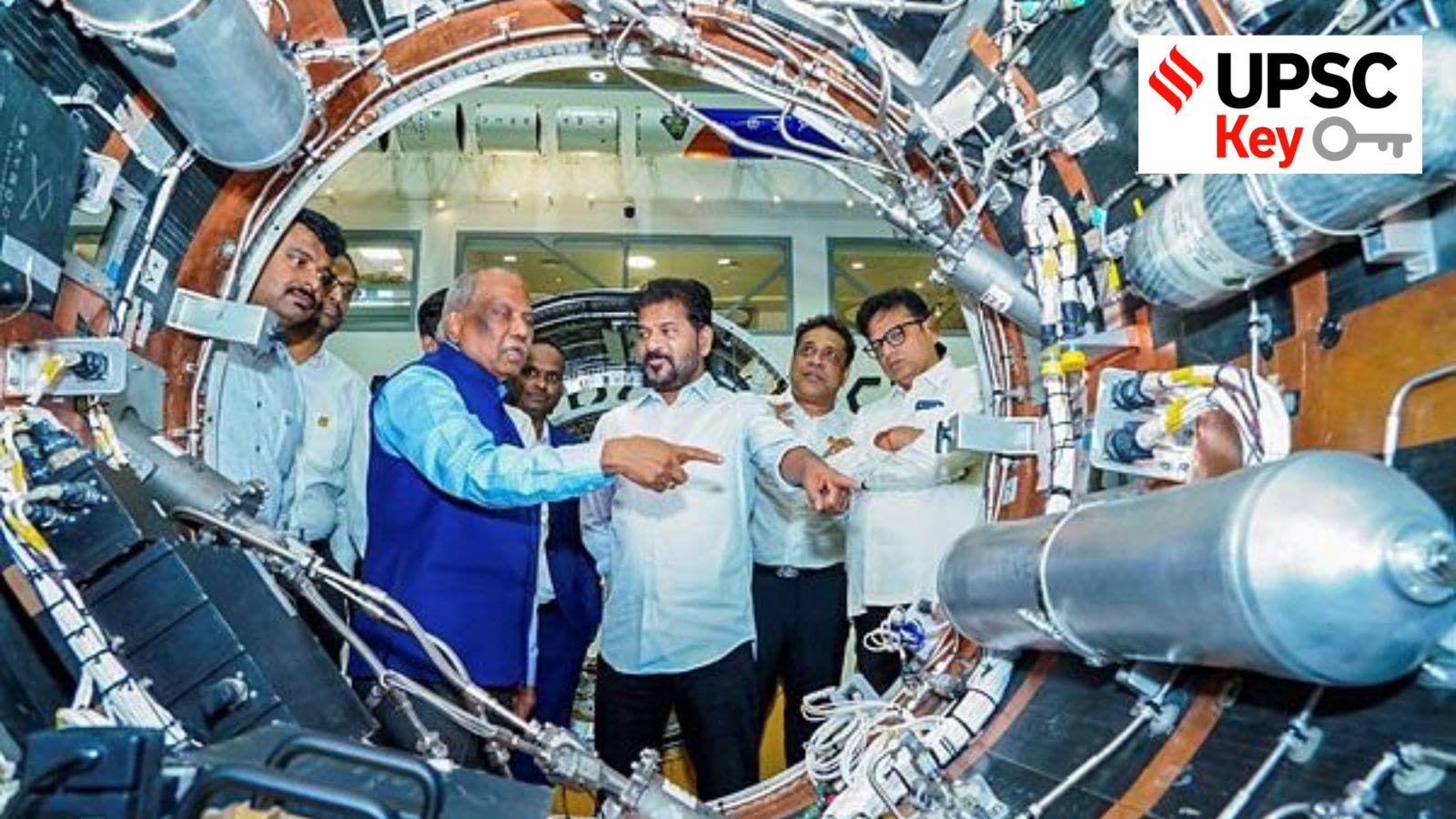
What’s the ongoing story: In a major boost to India’s space industry, Skyroot Aerospace is likely to become the first private company to launch an orbital space rocket. On Saturday, Skyroot flagged off the payload fairing for its Vikram-1 rocket in Hyderabad, with the launch of the rocket slated for later this year.
Key Points to Ponder:
— Read about the Vikram-1 launcher.
— What is the significance of the Vikram-1 rocket?
— What is the status of private sector participation in India’s space sector?
— How does the Indian space sector benefit from private-sector participation?
— What are the challenges related to the private sector participation in India’s space industry?
Story continues below this ad
— What are the various launch vehicles of ISRO and what are their specifications?
— What are the various types of orbits in which spacecraft are usually placed?
Key Takeaways:
— The payload fairing — the upper nose cone of the launch vehicle that houses the satellites — is now headed for India’s only spaceport in Sriharikota, where it will be integrated with the rest of the launch vehicle.
— Telangana Chief Minister A Revanth Reddy, also present at the flag-off event, said that it was a key milestone in the state’s pursuit of becoming a global leader in the aerospace sector.
Story continues below this ad
— Telangana is among a handful states with their own space policy — the first step towards creating space manufacturing hubs, such as the launch vehicle hub in Tamil Nadu and a satellite hub in Gujarat.
— The launch of India’s first privately manufactured PSLV (polar satellite launch vehicle) — ISRO’s workhorse launcher — is also likely to take place this year.
— Among Skyroot’s many small launch vehicle projects, Vikram-1 is a multi-stage launch vehicle with solid and liquid fuel-based engines designed for launching satellites weighing up to 350kg to low earth orbit. The low earth orbit is the region of space from 160 km to 2,000 km above the surface of Earth. The number of satellites being launched in this region has skyrocketed in recent years, with many being the Starlink communication satellites.
— What makes Vikram-1 different is that the rocket is made of carbon composite instead of metals, and houses a 3D-printed indigenously made engine — making its manufacturing and assembly easier, quicker and cheaper.
Story continues below this ad
— The launch vehicle has been named to honour Dr Vikram Sarabhai, considered to be the father of the Indian space programme, and its propulsion systems honour several other scientific greats — the solid propulsion system is called Kalam, the liquid Raman, and the cryogenic Dhawan.
— “The launch of this orbital rocket will mark a major milestone for India’s emerging private space-tech industry. With Vikram-1, we aim to open up space by enabling on-demand satellite launches for a fast-growing global market,” said Pawan Kumar Chandana, co-founder and CEO, Skyroot Aerospace.
— Skyroot was also the first private company to carry out a single-stage sub-orbital flight in 2022, followed by another company, Agnikul. A sub-orbital flight is launched at a slower speed than the orbital velocity, so it reaches outer space but cannot get into an orbit around Earth.
Do You Know:
— Satellite Launch Vehicle-3 (SLV-3) was India’s first experimental satellite launch vehicle which successfully launched Rohini Satellite into a Near-Earth Orbit on July 18, 1980. It became the base structure for major Launch Vehicles like Augmented Satellite Launch Vehicle (ASLV), Polar Satellite Launch Vehicle (PSLV), and Geosynchronous Satellite Launch Vehicles (GSLVs).
Story continues below this ad
— The PSLV is the third generation of Indian satellite launch vehicles. PSLV development started in 1982, and its maiden successful launch took place in October 1994. Most significantly, it marked India’s entry into the Big Rockets league, as it could carry a payload of up to 1,000 kg. It has also been called “the workhorse of ISRO” for consistently delivering various satellites into low Earth orbits (less than 2,000 km in altitude) with a high success rate.
Other Important Articles Covering the same topic:
📍What is the Skyroot Aerospace Vikram 1 rocket, which PM Modi has unveiled?
Previous year UPSC Prelims Question Covering similar theme:
(1) With reference to India’s satellite launch vehicles, consider the following statements : (UPSC CSE 2018)
1. PSLVs launch the satellites useful for Earth resources monitoring whereas GSLVs are designed mainly to launch communication satellites.
Story continues below this ad
2. Satellites launched by PSLV appear to remain permanently fixed in the same position in the sky, as viewed from a particular location on Earth.
3. GSLV Mk III is a four-staged launch vehicle with the first and third stages using solid rocket motors; and the second and fourth stages using liquid rocket engines.
Which of the statements given above is/are correct?
(a) 1 only
(b) 2 and 3 only
(c) 1 and 2 only
(d) 3 only
FRONT
India gears up for 2030 CWG, but unpaid bills, court cases of 2010 linger
Syllabus:
Preliminary Examination: Current events of national and international importance.
Mains Examination: General Studies-II: Government policies and interventions for development in various sectors and issues arising out of their design and implementation.
Story continues below this ad
What’s the ongoing story: As India gears up to host the 2030 Commonwealth Games in Gujarat, financial dues of the games’ Delhi edition held in the country for the first time two decades back in 2010, continue to linger.
Key Points to Ponder:
— What are the Commonwealth Games (CWG)?
— What is the difference between the Asian Games, Commonwealth Games and the Olympic Games?
— What are the structural and challenges to host CWG in India?
— How can hosting the 2030 Commonwealth Games help improve India’s global sporting image?
— Do mega sporting events create long-term fiscal liabilities?
Story continues below this ad
— What is the role of the Comptroller and Auditor General of India in ensuring accountability in mega sporting infrastructure projects?
— What is the role of government schemes like ‘Khelo India’ in developing sports infrastructure and athlete support in India?
Key Takeaways:
— An outstanding liability of Rs 28.05 crore was cleared in 2025-26. An estimated Rs 50 crore has been set aside for 2026-27. More than Rs 13 crore spent on legal and arbitration fees. And 29 cases are still being heard at various courts.
— Four years from now, Ahmedabad will welcome more than 70 nations in 2030 in what will be the centenary year of the Commonwealth Games. Earlier this month, a Commonwealth Sport delegation led by president Donald Rukare and chief executive Katie Sadlier toured venues across Ahmedabad, Gandhinagar, Vadodara and Ekta Nagar, praising the “scale of planning” and “quality of venues”.
— Yet the legal and financial fallout of the scandal-tainted 2010 Delhi Games continues to drag on, according to details obtained by The Indian Express under the Right to Information (RTI) Act and from public records.
— Responding to RTI requests seeking details of the outstanding liabilities of the erstwhile Organising Committee of the 2010 CWG, the Ministry of Youth Affairs and Sports said it cleared dues to the tune of Rs 28.05 crore in 2025-26. This payment was made to MTNL.
— A parliamentary committee report tabled in the Lok Sabha on March 18 estimated that Rs 50 crore will be required in 2026-27 to clear remaining liabilities. However, the ministry did not confirm the figure in its RTI reply.
— Some of the major vendors listed are Nussli Switzerland, which was awarded a contract of Rs 128 crore for games overlays, according to a 2011 report by the Comptroller and Auditor General (CAG). The list also includes Electronics Corporation of India for a contract approved at Rs 346 crore.
— According to the CAG report, the estimated cost of the 2010 CWG had ballooned from Rs 297 crore, mentioned in a Cabinet note of May 2003, to Rs 18,532.31 crore in October 2010. The final financial burden may take years to fully emerge as cases continue in courts.
— The country has now set its sights on hosting the 2036 Olympics, with the 2030 Commonwealth Games seen as a key platform to restore credibility. For the 2030 Games, operational costs are projected between Rs 3,000 crore and Rs 5,000 crore, alongside a broader ‘Amdavad 2030’ infrastructure push spanning transport, hospitality and sports facilities.
Do You Know:
— Twenty years after the controversy-ridden Delhi Games, India is set to host the Commonwealth Games again in 2030. They might be the Games that few want, going by the troubled 2022 and 2026 editions and fairly muted response for 2030. But for India, hosting the Commonwealth Games will still be beneficial.
— Purely from a sporting point of view, hosting the CWG can provide a boost to the ecosystem at a time when the performance of Indian athletes across sports is stagnating.
Other Important Articles Covering the same topic:
📍After CWG, Olympics pitch, India now targets 2038 Asian Games
📍With 2030 Commonwealth Games, India’s chance to be a sporting destination
Previous year UPSC Prelims Question Covering similar theme:
(2) Consider the following statements in respect of the 32nd Summer Olympics: (UPSC CSE, 2021)
1. The official motto for this Olympics is ‘A New World’.
2. Sport Climbing, Surfing, Skateboarding, Karate and Baseball are included in this Olympics.
Which of the above statements is/are correct?
(a) 1 only
(b) 2 only
(c) Both 1 and 2
(d) Neither 1 nor 2
A 2,500-year-old site throws up a curious burial pattern—upside-down pots
Syllabus:
Preliminary Examination: History of India.
Main Examination: General Studies-I: Indian culture will cover the salient aspects of Art Forms, literature and Architecture from ancient to modern times.
What’s the ongoing story: An ongoing excavation at a megalithic site in Virli Khandar has revealed distinctive burial architecture, rare artefacts and unusual pottery arrangements, offering fresh insights into ancient funerary practices in Vidarbha.
Key Points to Ponder:
— What are megalithic burials?
— What are menhirs and stone circles in megalithic culture?
— How do burial architectures reflect cultural beliefs in ancient societies?
— What is the importance of megalithic burial practices in understanding ancient societies in India?
— What is Accelerator Mass Spectrometry (AMS) dating?
— How do regional variations in megalithic sites contribute to our understanding of early Indian history?
Key Takeaways:
— The site, located in Pauni tehsil of Bhandara district, in Maharashtra was first reported in 2008 by researchers from Rashtrasant Tukadoji Maharaj Nagpur University and is currently being excavated under archaeologist and Head of Department of Ancient Indian History, Culture, and Archaeology, RTMNU, Dr Prabash Sahu.
— According to Professor Sahu, the site was selected for three reasons, including its unique burial pattern. “We have stone circles and within them menhirs (tall stone set upright), making it a composite megalithic structure — a combination of two burial types,” he said.
— So far, researchers have documented 69 megalithic burials using drone mapping and field surveys. Of these, four have been selected for excavation, including two stone circles with menhir in periphery and boulders, and two with only boulder circles.
— While skeletal remains have not yet been conclusively identified, excavations are ongoing. Significant artifacts have been recovered from one of the burials, including copper objects such as a necklace, iron implements like axes, chisels, ladles and arrowheads, semi-precious stone beads, notably etched carnelian beads, and a gold earring. Fragmentary bone remains have also been recovered alongside these finds.
— One of the most striking discoveries is a unique cluster of pottery, not previously reported in the Vidarbha region. In one burial, nearly 50 pots were found arranged systematically, with larger bowls covered by inverted bowls.
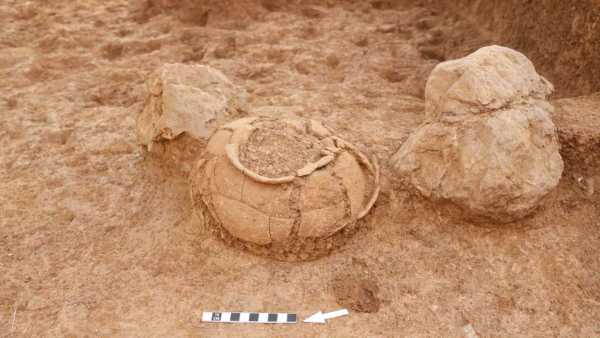 In one burial, nearly 50 pots were found arranged systematically, with larger bowls covered by inverted bowls. (Express photo)
— At least 23 such pairs – amounting to 46 pots – were documented in a single cluster, along with additional red and black-and-red ware pots and associated iron objects.
— Sahu noted another peculiar feature: almost all pots, including larger vessels, were placed in an inverted position, with one pot covered by another from above.
— “None of the pots were found upright. It appears they were deliberately placed upside down within the burial context,” he said. The exact reason for this arrangement is yet to be established and will be studied further.
— Archaeologists believe the pots may have originally contained food, grains or liquids as part of burial offerings. Samples have been collected for residual and chemical analysis to determine their contents.
— The pots were carefully placed over a layer of black cotton soil laid above the natural lateritic (murum) base. The sticky nature of this soil helped stabilise the vessels, keeping them largely in position despite breakage caused by the weight of overlying soil.
— Explaining burial practices, Sahu said such structures were prepared by digging pits where skeletal remains, if present, were placed along with “grave goods” – objects associated with the deceased, reflecting beliefs in life after death.
— In another significant find, charcoal remains discovered at the site are expected to help determine its age through Accelerator Mass Spectrometry (AMS) dating. Preliminary observations suggest the site could be at least 2,500 years old.
— Archaeologists believe the findings at Virli Khandar could significantly contribute to understanding megalithic cultures in the region and their broader cultural practices.
Previous year UPSC Prelims Question Covering similar theme:
(3) Consider the following pairs: (UPSC CSE 2021)
(Historical Place) (Well-known for)
1. Burzahom : Rock-cut shrines
2. Chandraketugarh : Terracotta art
3. Ganeshwar : Copper artefacts
Which of the pairs given above is/are correctly matched?
(a) 1 only
(b) 1 and 2 only
(c) 3 only
(d) 2 and 3 only
ECONOMY
Textiles, garment exports fall 2.2% in FY26, says GTR
Syllabus:
Preliminary Examination: Current events of national and international importance.
Mains Examination: General Studies-II: Indian Economy and issues relating to planning, mobilisation, of resources, growth, development and employment.
What’s the ongoing story: The country’s textiles and garment exports fell 2.2 per cent to USD 35.8 billion in 2025-26 due to contraction in shipments of key segments such as cotton, think tank GTRI said on Saturday. In rupee terms too, the exports fell 2.1 per cent during the last fiscal.
Key Points to Ponder:
— What is the share of the textile sector in the Indian economy?
— What are man-made fibres?
— What is the contribution of the textile sector to employment?
— What are the reasons behind the recent decline in India’s textile and garment exports?
— What is currency depreciation? How does it impact export and import?
— What are the challenges faced by the textile sector?
— What are the key government initiatives related to the textile sector?
— How is the ongoing war affecting India’s import and export performance?
Key Takeaways:
— GTRI said the declining pattern is visible across major segments – ”cotton textiles (- 3.9 per cent), ready-made garments (- 1.4 per cent), and carpets (- 5.3 per cent). Only handicrafts grew slightly by 1.5 per cent during the fiscal.
— The contrast between INR and USD growth highlights a deeper structural concern, the Global Trade Research Initiative (GTRI) said. Its founder, Ajay Srivastava, said India is exporting more in value terms domestically but earning fewer dollars globally. For instance, man-made textiles show a 3.6% rise in INR (Indian Rupee) but a 0.8% decline in dollar terms, and garments show a 2.9% INR increase despite a 1.4% dollar contraction, he said.
— This suggests that currency depreciation and not competitiveness is behind the apparent growth, he said, adding that in real terms, India is losing market share.
Do You Know:
— India’s textile industry is among the largest in the world, spanning a vast value chain from cotton cultivation to high-end apparel manufacturing.
— The size of India’s textile and apparel industry cannot be understated—it contributes 13% to industrial production, 12% to exports, and roughly 2% to GDP.
— The entire cotton textile value chain—from processing raw fibre and spinning yarn to weaving fabric, dyeing, and stitching—employs over 4.5 crore people.
Other Important Articles Covering the same topic:
📍Leader in fibre production, but growth, exports lagging: What ails India’s textile industry
Previous year UPSC Prelims Question Covering similar theme:
(4) Consider the following statements: (UPSC CSE 2020)
1. The value of Indo-Sri Lanka trade has consistently increased in the last decade.
2. Textile and textile articles” constitute an important item of trade between India and Bangladesh.
3. In the last five years, Nepal has been the largest trading partner of India in South Asia.
Which of the statements given above is/are correct?
(a) 1 and 2 only
(b) 2 only
(c) 3 only
(d) 1, 2 and 3
Previous year UPSC Mains Question Covering similar theme:
Analyse the factors for highly decentralised cotton textile industry in India. (UPSC CSE 2013)
Why SC used its ‘complete justice’ powers to fix the highways
Syllabus:
Preliminary Examination: Indian Polity and Governance-Constitution, Political System, Panchayati Raj, Public Policy, Rights Issues, etc.
Mains Examination: General Studies-II, III: Governance, polity, government policies and interventions for development in various sectors and issues arising out of their design and implementation, Infrastructure: Energy, Ports, Roads, Airports, Railways, etc.
What’s the ongoing story: The Supreme Court passed a significant order for preventing road accidents and issued a 13-point directive to the road departments at the centre and state level in its suo motu case, where 34 lives were lost in two separate road accidents in November 2025.
Key Points to Ponder:
— What is Article 142 of the Constitution? How does it ensures ‘Complete Justice’?
— What is ‘Right to Life’ enshrined under Article 21 of the Constitution of India?
— What is that “Extraordinary Power” granted to the Supreme Court under Article 142 of the Indian Constitution?
— Why did the Supreme Court invoke Article 142 in this matter?
— What is judicial activism?
— What causes the high number of road accidents and fatalities in India?
—What initiatives has the government taken on road safety?
—What measures should be taken to ensure road safety?
— What is the criticism of Article 142?
Key Takeaways:
— The order, dated April 13, came down heavily on road agencies National Highways Authority of India (NHAI) and state public work departments (PWDs) and said that a road, particularly a high-speed Expressway, must not become a corridor of peril due to administrative lethargy or infrastructural gaps. It also recognised that Article 21 of the Constitution, which deals with protection of life and personal liberty, also includes safety of commuters on road.
— “The loss of even a single life to avoidable hazards like illegal parking or black spots etc., represents a failure of the State’s protective umbrella. The ‘Right to Life’ enshrined under Article 21 of the Constitution of India is not merely a guarantee against the unlawful taking of life, but a positive mandate upon the State to ensure a safe environment where human life is preserved and valued,” said the court.
— The top court exercised its extraordinary powers under the Article 142 of the Constitution in the matter.
— In its directions, the court has clearly said that no heavy or commercial vehicle shall park or stop on any National Highway carriageway or paved shoulder except at a designated bay, lay-bye, or Wayside Amenity. The court said that the authorities should use Advanced Traffic Management System (ATMS) to track such vehicles, send alerts to police with GPS-timestamped photographic evidence and integrate it with e-Challan.
— These directions must be complied within 60 days from the date of the Supreme Court order. It has also prohibited the construction and operation of any new dhaba, eatery, or commercial structure within the Right of Way (ROW) of any National Highway.
— The court has ordered that District Magistrates shall enforce the demolition of all new and existing unauthorised structures. State governments shall further issue notifications within 60 days prohibiting change of land use within 40 metres (residential) and 75 metres (commercial) from the mid-point of any National Highway, the court said.
— The court has called for the constitution of dedicated highway surveillance teams of state police and transport department personnel like NHAI to ensure round the clock monitoring of highways and its adjacent areas.
— It has also asked the NHAI to completely operationalise its ATMS with TMCC cameras, VSDS speed detectors, VIDS cameras, variable message sign boards, and Emergency Call Boxes across all four and six lane highways and expressways.
— For quick response in an accident case, the court has directed NHAI to deploy BLS ambulances and recovery cranes at intervals not exceeding 75 km on every National Highway stretch, at toll plazas, Wayside Amenities, or dedicated posts.
— National Highways constitute approximately 2% of India’s total road length but account for nearly 30% of all road fatalities.
Do You Know:
— Article 142 provides a unique power to the Supreme Court, to do “complete justice” between the parties, where, at times, the law or statute may not provide a remedy. In those situations, the court can extend itself to put an end to a dispute in a manner that would fit the facts of the case.
Other Important Articles Covering the same topic:
📍UPSC Issue at a Glance | Road Safety: 5 Key Questions You Must Know for Prelims and Mains
ALSO IN NEWS |
|
| Simplify KYC processes, make common norms: FM tells SEBI | Finance Minister Nirmala Sitharaman on Saturday asked the Securities and Exchange Board of India (SEBI) to help drive the adoption of standardised know your customer (KYC) norms and the simplification and digitalisation of its processes across the Indian securities market. Sitharaman said SEBI must also be ready to meet emerging challenges — and the most pressing of these is cybersecurity. |
| Who is Ashok Kumar Lahiri, the new Vice Chairperson of policy think tank NITI Aayog | The government has reconstituted the NITI Aayog, appointing Ashok Kumar Lahiri as its vice chairman and four new full-time members. Lahiri, a former Chief Economic Advisor (CEA) and a member of the 15th Finance Commission, will take over from Suman Bery, whose term ends later this month. |
| Setback for talks: Araghchi leaves Pak, Trump cancels envoys’ trip | President Donald Trump cancelled a trip by two US envoys to Iran’s war mediator Pakistan on Saturday, dealing a new setback to peace prospects after Iran’s foreign minister flew out of Islamabad following talks in the capital. |
🚨Click Hereto read the UPSC Essentials magazine forApril 2026.Share your views and suggestions in the comment box or at manas.srivastava@indianexpress.com🚨
Subscribe to ourUPSC newsletter.Stay updated with the latest UPSC articles by joining our Telegram channel –Indian ExpressUPSC Hub, and follow us onInstagramand X.

