

5 min readApr 22, 2026 05:06 PM IST
First published on: Apr 22, 2026 at 05:05 PM IST
For 30 years, India’s Women’s Reservation Bill has lived a frustrating half-life — conceived repeatedly, passed occasionally, and implemented never. On April 17, the Constitution (131st Amendment) Bill, which sought to operationalise the 33 per cent quota by 2029, fell 54 votes short of the two-thirds majority. In the ledger of missed chances, this was the seventh.
The post-mortems have been predictable. The Opposition argued that tying reservation to a delimitation exercise would penalise southern states that had successfully controlled their population, and that women’s representation was being used as cover for a far larger redrawing of India’s political map. The government argued that without decoupling from a new Census, the 2023 Act would not take effect until 2034 at the earliest. Both sides have points. But beneath the technical quarrel lies an older, uglier truth that nobody wants to name: Most male MPs have never actually wanted this law to work.

The evidence is on the record. When the bill was first introduced in 1996, it was opposed, stalled, and allowed to lapse. In 1998, the situation in the House did not even allow it to be introduced. Mulayam Singh Yadav once suggested, in a now-notorious remark, that reservation should not be enacted because it would encourage male parliamentarians to wolf-whistle at female colleagues — an argument so revealing it deserved to be framed.
Behind the public debates about OBC sub-quotas and Muslim reservation, there has always been a quieter consensus among sitting male MPs: The rotation of reserved constituencies that 33 per cent would trigger is, from their seats, a personal threat. Until 2023, there was never a moment when the ruling party and the main Opposition were genuinely on the same page. It must also be highlighted that the BJP has been consistent in its support of the bill, when in government or in opposition. And when 2023 produced a rare such moment, the implementation was engineered by everybody, collectively, to land safely beyond the next election.
This is why the mathematics of women’s political representation in India cannot be solved by women alone. At 15 per cent of the Lok Sabha, women simply do not have the floor strength to pass a law that restructures the gender of the floor. The arithmetic is cruel and circular. They need the reservation to get the numbers, and they need the numbers to get the reservation. The only way out of the loop is through men specifically, through male politicians willing to spend their own capital on a reform that, in the short term, threatens the seats of people exactly like them.
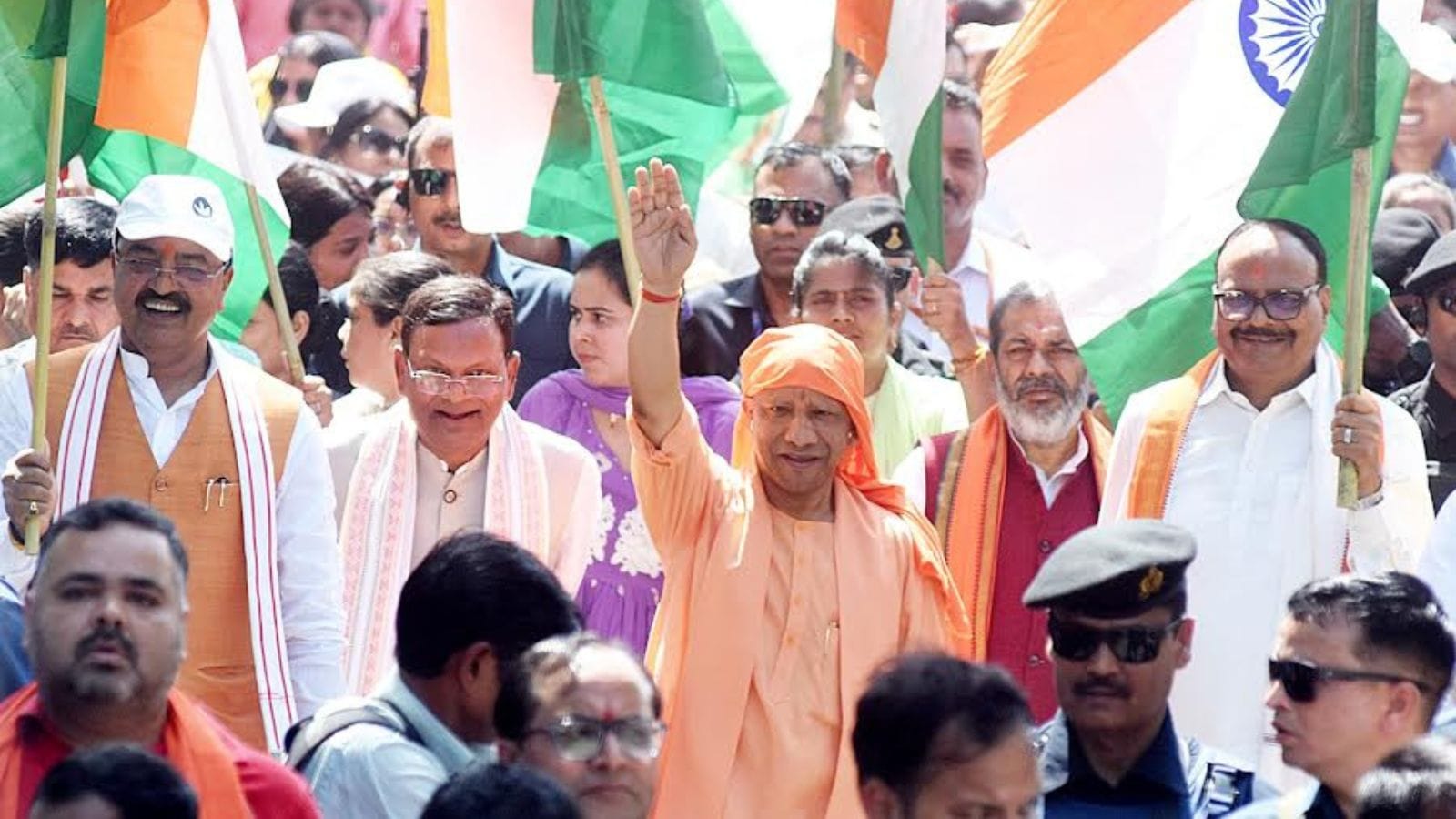
Which is what makes Yogi Adityanath’s Jan Aakrosh Mahila Padyatra in Lucknow this week worth paying attention to, beyond the immediate partisan choreography. On Tuesday, the Uttar Pradesh Chief Minister led a 1.75-kilometre march from his official residence to the state Assembly, flanked by both Deputy Chief Ministers, the state BJP President, women ministers, and thousands of women supporters. He called the bill’s failure a symbol of the Opposition’s anti-women behaviour. Critics will claim this is a partisan stance. But one should also notice what is new in the picture.
An influential male CM, not personally threatened by the 131st Amendment, not a woman, not a token, walking publicly for a women’s rights law is not a routine event in Indian politics. The overwhelming pattern since 1996 has been that men with political capital quietly let women’s representation die, while publicly claiming sympathy. What happened in Lucknow, whatever its electoral calculation, breaks that pattern. It is the kind of visible, unambiguous backing that changes the cost calculation for other male politicians. Once a sitting CM is marching, a backbencher cannot quite as easily mumble that he is personally supportive while voting the other way.
The Opposition’s counter that the BJP is using women’s representation to smuggle through a demographic realignment deserves engagement on its own terms. But it also deserves a harder question in return: If the objection is to delimitation, where is the Opposition’s own bill to deliver the 33 per cent quota without it? In 30 years, no party has produced one. Outrage that is only ever reactive is a form of consent.
The uncomfortable lesson of this week is that women in Indian politics do not yet have the luxury of choosing their allies by ideology. They need well-meaning male politicians from every bench, BJP, Congress, SP, DMK, and Trinamool to do what Yogi Adityanath did on Tuesday, on their own turf, for their own reasons. To march, to speak, to vote, and then to march again. Not because women cannot fight for themselves; they have been fighting for three decades. But because in a House that is 85 per cent male, someone has to hold the door open.
Kala is a writer, including of the novel,Almost Single

