

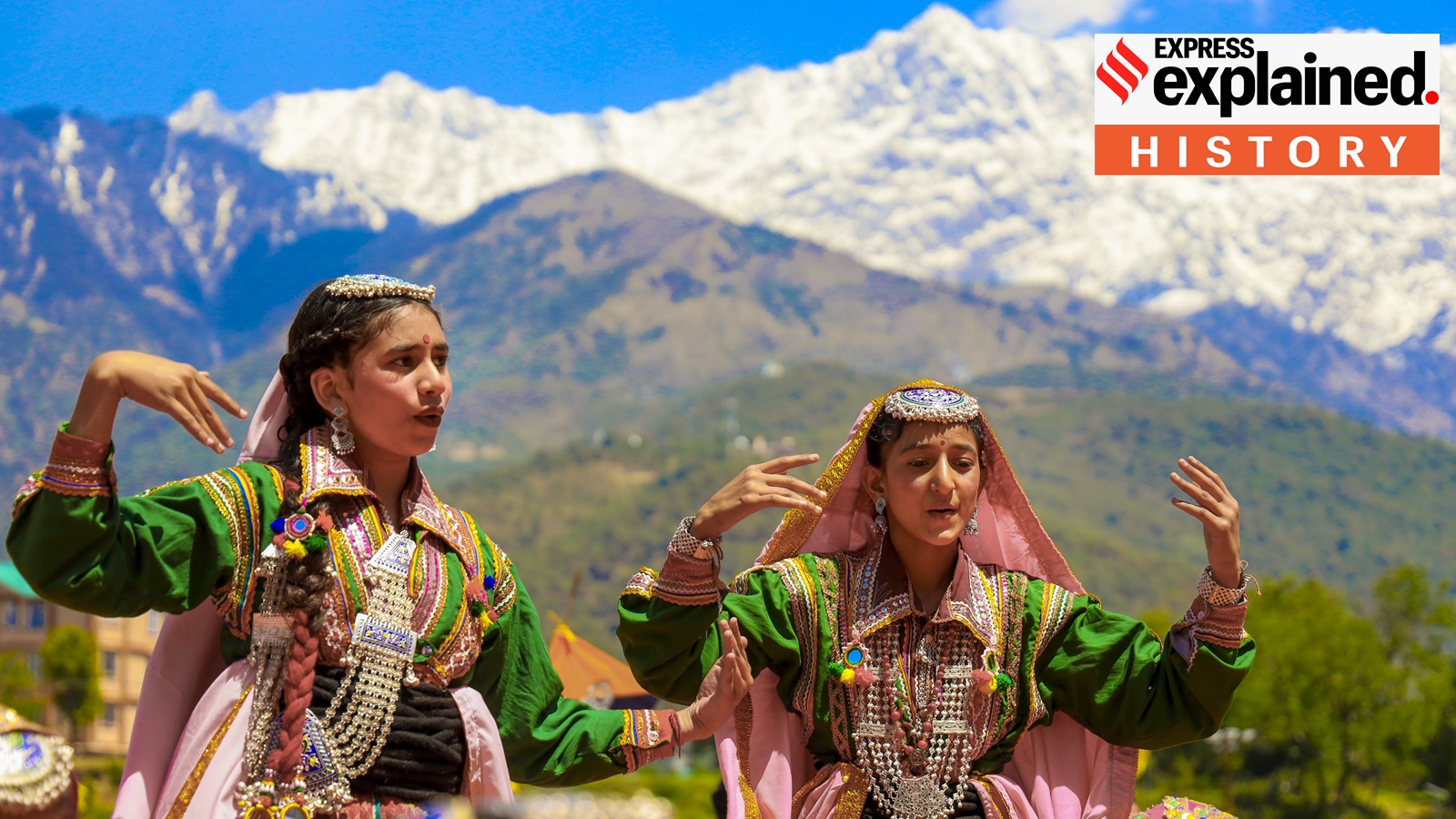
Himachal Pradesh marks 79 years of its formation on April 15 (Wednesday) this year. It came into being as a chief commissioner’s province — that is, a centrally administered territory — on April 15, 1948, with the integration of 30 erstwhile princely states.
It would take two more decades for Himachal to become a full-fledged state, on January 25, 1971. Before this, however, Himachal was also a Union Territory — and nearly even became part of Punjab. The States Reorganisation Commission had backed this merger in a majority recommendation in 1955. So why did the move not go through? Here’s a look.
Himachal Pradesh was created by integrating 30 princely hill states after Independence. It was initially administered as a chief commissioner’s province. Such provinces were administrative units in British India that were centrally governed and often lacked elected assemblies.
These units continued to exist until the Constitution came into force on January 26, 1950, and divided the country into 28 states under four categories — Part A, B, C and D.
Part A states comprised the erstwhile governors’ provinces that had elected legislatures. Part B states were former princely states, or a group of princely states, that had elected legislatures and a ‘rajpramukh’. Part C states included both the former chief commissioners’ provinces and some princely states, and were governed by a chief commissioner appointed by the President. Part D states were introduced as territories administered by the central government, with no provision for a local legislature.
Himachal was included as a Part C state.
The next year, the Union government enacted the Part ‘C’ States Act, 1951, paving the way for the creation of a Legislative Assembly in certain Part C states, including Himachal. Bilaspur, another Part C state, was merged with Himachal in 1954.
The call for merger
Story continues below this ad
In December 1953, months after the formation of Telugu-speaking Andhra Pradesh, Nehru appointed a States Reorganisation Commission (SRC) to deal with the growing demands for creation of states on the basis of language.
The commission, comprising Justice Fazl Ali, KM Panikkar and HN Kunzru, submitted its report in September 1955. It based its recommendations for states’ reorganisation on not just linguistic and cultural factors but also financial, economic, administrative and national security considerations.
The majority of the commission recommended the merger of Himachal Pradesh with Punjab. It viewed Himachal as a small, resource-poor unit that could not financially or administratively sustain itself in the long term. The commission also said that national security along the India-China border required a “stronger and more resourceful unit” than Himachal alone.
It also noted that the catchment areas for the Sutlej and Beas, which also flowed through Punjab, were in Himachal. “Soil conservation in the hills is vitally important from the point of view of the plains. Integration of these areas will, therefore, be to the mutual benefit of the people of the plains and of the hills,” it said.
Story continues below this ad
The proposal also aligned with the commission’s broader push to abolish the Part C state category. Its report said: “The existing Part C States which provide no adequate recompense for all the constitutional, administrative and financial problems which they pose should, to the extent practicable, be merged in the adjoining larger State…”
But the chairman of the Commission, Justice Ali, dissented from the proposal to merge Himachal with Punjab. Indeed, the report mentions that its recommendations are “subject to Chairman’s note on Himachal Pradesh”.
Justice Ali cited the “genuine and widespread” local sentiment against a merger with Punjab, and said that it would destabilise the hills’ social order. One of his key arguments was also that the interests of the hill people could be “downed” in a common legislature dominated by representatives from the plains. On the question of national security, he said Himachal’s location close to China required Central control rather than merger with Punjab.
As the website of the Himachal Pradesh Vidhan Sabha notes: “In 1956, despite majority recommendation of the States Reorganisation Commission for its merger with Punjab, Himachal Pradesh retained its separate identity, thanks to the famous dissenting note of the Commission’s Chairman Justice Fazal Ali which found favour with the Centre.”
Union territory status and eventual statehood
Story continues below this ad
The year 1956 marked another change in the administration of Himachal Pradesh. After the promulgation of the States Reorganisation Act of 1956, Part C and Part D states were converted into Union Territories. Himachal officially became a Union Territory on November 1, 1956.
Ten years later, it saw yet another momentous change to its structure. The Punjab Reorganisation Act, 1966, partitioned Punjab amid demands for a Punjabi-speaking state. The Act created the Hindi-speaking state of Haryana, and established Chandigarh as a Union Territory and joint capital of Punjab and Haryana.
Large parts of the hill regions of the erstwhile Punjab were also transferred to Himachal Pradesh. Among these regions were Kangra (which then encompassed Una and Hamirpur), Kullu, Lahaul and Spiti, and Shimla. The transfer dramatically increased Himachal’s geographical scale to its present size of around 55,000 sq km, and eventually paved the way for its statehood.
In December 1970, Parliament passed the state of Himachal Pradesh Act. Finally, on January 25, 1971, Himachal Pradesh was declared a full-fledged state, becoming the 18th state of the Union of India.

