

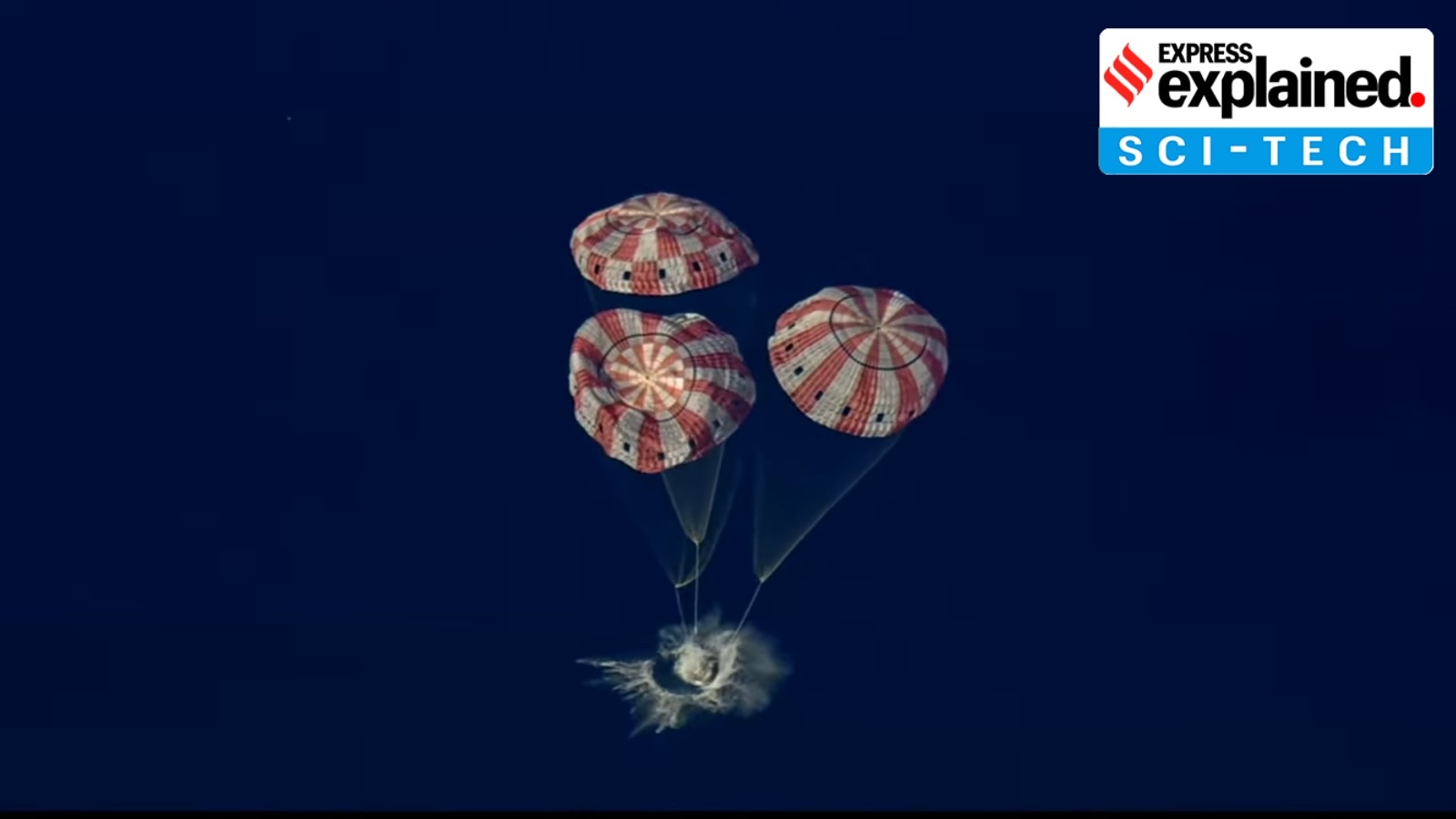
After a historic journey around the Moon, the four astronauts onboard NASA’s Artemis II mission returned to Earth this morning (April 11).
The Orion spacecraft, carrying astronauts Reid Wiseman, Victor Glover and Christina Koch of the US, and Jeremy Hansen of Canada, splashed down in the Pacific Ocean, off the coast of southern California, at 5.37 am IST on Saturday.
The four astronauts were the first to venture near the Moon in more than five decades, and even though they did not make a Moon landing, the trajectory of their spacecraft took them further in space than any of the Apollo missions that made the Moon landings in the 1960s and 1970s. Their spacecraft reached 4,06,778 km from the Earth at its furthest, which was about 6,606 km more than the distance the Apollo 13 mission reached in 1970.
The Artemis II mission
In all, during their 10-day journey, the astronauts on the Artemis II mission travelled a distance of about 1.12 million km, which incidentally is not the highest by a manned mission.
The Apollo 17 mission, the last of the Apollo missions, for instance, travelled a total distance of about 2.38 million km. The average distance of the Moon from the Earth is about 3,84,400 km, so a point-to-point return journey would be at least 7,68,800 km.
But spacecraft have complicated, circuitous trajectories, and the distance between Moon and Earth is also ever-changing because they both move in elliptical orbits. The actual distances completed by space missions depends on mission design, including the time spent in lunar and Earth orbits, and the specific geometry of the Earth-Moon system during the journey.
The Artemis II mission’s re-entry
At the time of re-entry into the Earth’s atmosphere, the Orion spacecraft was travelling at a speed of about 11-12 km/sec (about 40,000-42,000 kmph). This is much higher than the 26,000-28,000 kmph speeds at which the spacecraft coming from the International Space Station (ISS) or other similar low-Earth orbits re-enter the atmosphere.
Story continues below this ad
This is because the lunar missions, coming from much further distances, spend far more time under the Earth’s gravity before re-entry, and thus get accelerated to higher speeds. The ISS, which astronauts regularly visit, is only about 400 km from the Earth.
Higher speeds means higher energies. Because of this, spacecraft coming from lunar orbits need to be much tougher to withstand the greater physical stress while re-entering the Earth’s atmosphere.
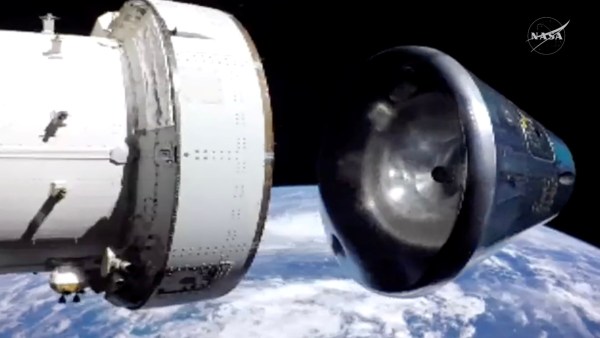 In this image from video provided by NASA, the Artemis II Orion capsule, right, separates from the service module above the Earth in preparation for splash down in the Pacific Ocean. (NASA via AP)
Once inside, the Orion spacecraft, like any other spacecraft, was made to decelerate quickly. The first set of parachutes to slow down the spacecraft were deployed at an altitude of about 6 km, and another set was unfurled when the spacecraft was about 2 km from the surface.
By this time, the spacecraft had been slowed down to a speed of about 200 km per hour. At the time of splashdown, the spacecraft was travelling at barely 30 km an hour. Teams from NASA and the US military were deployed at multiple locations near the site of the landing in the Pacific Ocean to extract the crew after the splashdown, and fly them to a ship placed nearby.
Story continues below this ad
“The splashdown of Artemis II marks the successful validation of humanity’s next-generation deep-space capabilities. Unlike earlier missions, this was not about landing on the Moon, but about rigorously testing the Orion spacecraft and its life-support, communication, and control systems in real conditions. The use of a free-return trajectory, the far-side lunar flyby, the slingshot orbit powered by gravity, and the carefully executed scientific observations during the communication blackout demonstrate both the precision of modern space engineering and the resilience of human exploration,” Ashoka University vice-chancellor Somak Raychaudhury, one of India’s best-known astrophysicists, said.
“Every element of this mission has advanced our readiness for a sustained human presence beyond Earth. As the crew returns to the Pacific, they bring back invaluable data and experience, reminding us that the Artemis II is not the destination; it is the beginning of a new era of exploration,” he said.
What Artemis II’s success means for space travel
The success of the Artemis II mission clears the deck for the first human Moon landing in more than five decades, tentatively scheduled for 2028 right now.
Artemis II was the first crewed mission of the Artemis programme of NASA that seeks to get human beings back on the Moon, more than five decades after the Apollo programme got 12 astronauts, in six different historic missions, to walk on the Moon.
Story continues below this ad
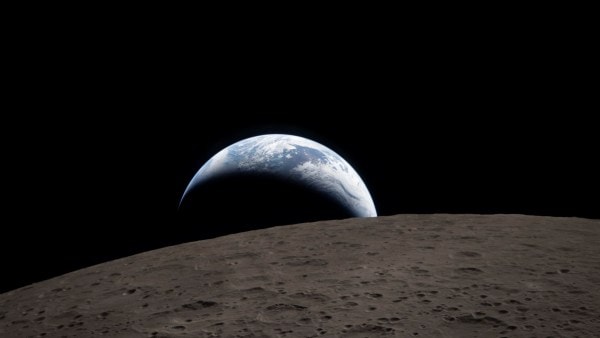 This image released by NASA shows Earth setting beyond the lunar horizon as seen from the Orion spacecraft during the Artemis II mission.
The six Apollo missions had happened barely 12 years after the beginning of the space age, and while these marked a dream technology leap, the space technology ecosystem at that time was too nascent to capitalise on these to make further progress. So, the Moon landings became standalone successes.
When humans started probing the Moon again, in the early 2000s, they began not from where they had left off in 1972 but from scratch: by sending Orbiters. This current phase oflunar explorationhas progressed incrementally and fresh human landings, expected in a couple of years, are going to serve as stepping stones to a greater and closer engagement with the Moon, and possibly use it as a launchpad for going further into space.
The first mission of the Artemis programme, in 2022, was an uncrewed spacecraft that went around the Moon and came back. Artemis II successfully completed the dress rehearsal for the actual Moon landing mission in 2028. The Artemis programme marks the beginning of a new era in human spaceflight that is aiming at creating a permanent settlement on the Moon, and frequent travels by humans to the lunar surface.
Such a facility will take time to be built, requiring several Moon missions: carrying humans, robots, equipment and fuel that can exploit and utilise locally-available resources to create a habitat that can sustain human presence over prolonged periods of time.

