

Budget 2026-27 signals a transition away from pandemic-era crisis management to what is now a borrowing-heavy doctrine for financing growth and capital expenditure (capex) spending.
By guiding fiscal deficit to 4.3% of GDP and scaling public capital expenditure to ₹12.2 lakh crore, the government aims to project a broader infra-capex enabled vision of a ‘Viksit Bharat’ while giving a necessary push to MSMEs in manufacturing this time. That public infrastructure and MSME growth are no longer framed as areas of temporary stimulus, but part of the structural backbone of the economy is reassuring.
And yet, beneath the veneer of macro-economic stability, the fiscal math, as projected by the Finance Minister, masks a more precarious reality. As manufacturing scales in strategic frontiers like MSMEs, semiconductors, and biopharma, the mechanism connecting this massive capital expansion to actual employment outcomes has become increasingly tenuous. While capital formation successfully drives headline GDP, absorption of labour is stalled. This suggests that India is perfecting a growth model designed to function with clinical efficiency, while quietly leaving its vast labour force behind.
Towards a growth doctrine
For much of India’s fiscal history, capex played a secondary role. It expanded when revenues permitted and was restrained when deficits widened. That changed after the pandemic. From 2020-21 onwards, capex expenditure ceased to function as a counter-cyclical instrument and instead became the organising principle of fiscal policy.
The data capture this shift. Capex expenditure as a share of total expenditure rose from roughly 12% in 2020-21 to over 22% in recent estimates. The underlying logic is well established. Public infrastructure spending is expected to crowd in private investment, raise productivity, and generate employment. Yet, the labour indicators running alongside this expansion reveal a disconnect. The youth NEET rate (share of people who are not in education, employment, or training) for ages 15-29 remains in the 23%-25% range, materially higher than several peer economies. Nearly one in four young Indians is structurally outside employment, education, or training even as public investment accelerates.
A structural U-turn
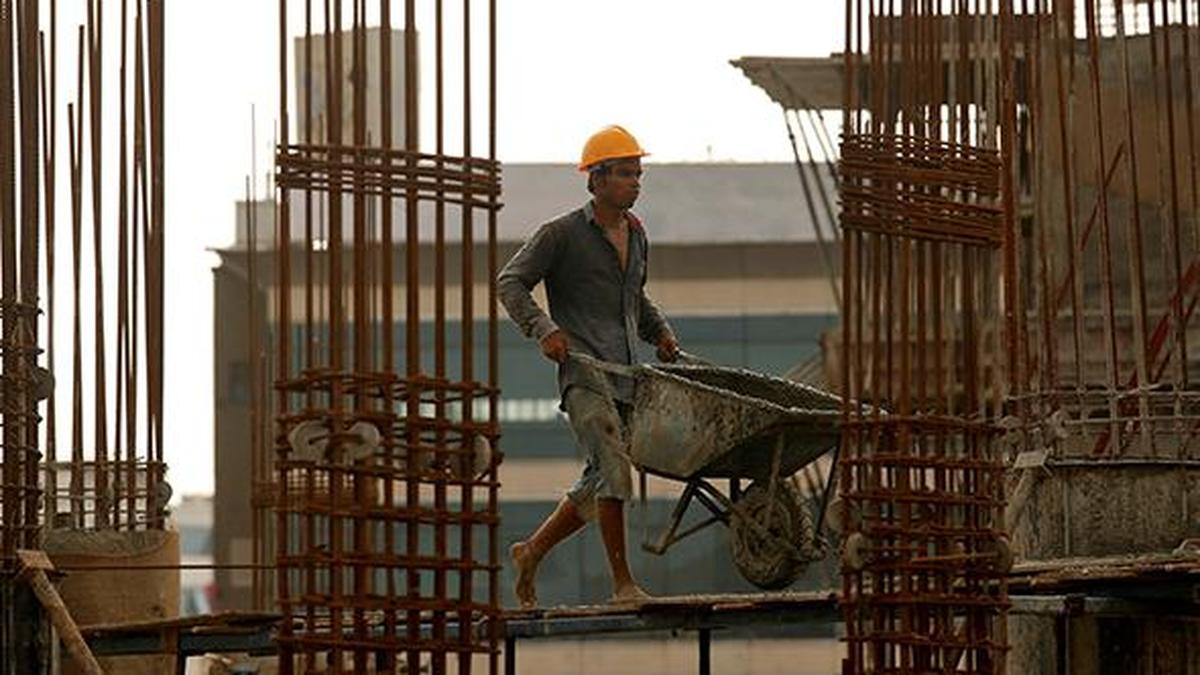
Construction reflects the sector most directly fuelled by public investment in the post-2015 infrastructure push. Agriculture reflects the sector a developing economy typically sheds labour from as productivity rises elsewhere. The trajectories of the two have moved in directions opposite to what development theory would anticipate across periods.
Construction’s employment elasticity declined from 0.59 in the pre-COVID period of 2011-12 to 2019-20 to 0.42 in the post-COVID years of 2021-22 to 2023-24. This occurred when infrastructure spending was at record levels. The implication is stark: each additional unit of capex is now associated with fewer construction jobs than before.
Agriculture is the more troubling story. Employment elasticity rose sharply from 0.04 during 2011-12 to 2019-20 to 1.51 during 2021-22 to 2023-24. Rather than releasing labour, the sector has been reabsorbing it. This reflects distress-driven fallback into low-productivity activity. Taken together, the pattern resembles a structural U-turn. India is modernising its physical asset base while its workforce is being pulled back towards subsistence.
The weak employment is rooted in the kind of production structure the capex turn reinforces. Public investment, as currently configured, systematically favours capital intensity. This is visible in the widening gap between productivity and wages. Net value added per worker has risen sharply, while average emoluments remain far lower. The divergence suggests that efficiency gains enabled by infrastructure are being captured largely as profits rather than transmitted as labour income.
The industrial structure compounds this bias. The Annual Survey of Industries shows that a large majority of factories remain small, employing fewer than 100 workers, yet contribute modestly to output. Large firms, capable of integrating into new logistics and infrastructure networks, dominate value creation while remaining relatively labour light. Labour-intensive MSMEs struggle to scale, automate, or compete.
The result is a dual economy: a capital-intensive upper layer drives headline GDP growth with limited employment generation, while a vast lower layer absorbs labour through informality and self-employment with low productivity and weak income growth.
A new economic citizen?
Read together, fiscal strategy and labour outcomes point to an implicit reordering of priorities. Employment no longer appears as a variable that must be directly engineered and the state is quite incapacitated in doing that at this point. It is treated as an eventual by-product of growth rather than a co-equal objective.
Official projections reinforce this orientation. Formal skills, urban location, and compatibility with automation determine inclusion. Those outside this profile adjust downward, into informal work, own-account activity, or agriculture. Even within the organised sector, wage growth remains subdued.
The economy does not stall. It simply advances without requiring broad-based labour absorption.
Deepanshu Mohan, Professor and Dean, O.P. Jindal Global University; Ankur Singh, Research Analyst with the Centre for New Economics Studies
Published – February 03, 2026 01:39 am IST

