


COP30 left many questions unanswered. The withdrawal of the US from the Paris Agreement meant that the world’s largest economy, and the second-largest polluter, is no longer part of the global effort to combat climate change. Developing countries had consistently said that the amount of external assistance promised at $300 billion per year by 2035 was inadequate. But that number at least emerged from COP29, when the US was part of the negotiations. With the exit of the US and many developed countries announcing cuts in external assistance because of fiscal constraints, there is little confidence about what level of international climate finance would be available.
In this two-part article, we argue that despite these negative developments, India should stay firmly committed to net zero by 2070. There are two good reasons for this stance.

One, decarbonisation need not conflict with growth. It is sometimes argued that the net-zero objective involves high costs and, therefore, any action should only be undertaken if large external assistance is available on highly concessional terms. This view ignores the fact that continuing on a fossil fuel-based trajectory also generates environmental costs. The health hazards of air pollution — which are especially severe in Indian cities — provide a compelling reason to shift out of fossil fuels as fast as possible.
Furthermore, technology has now brought us to a point where decarbonisation can be pursued in some major sectors without incurring substantial additional costs. Failure to make an early start on decarbonisation will only lead to continued investments in conventional fossil fuel-based infrastructure, which will lead to unproductive stranded assets down the line. The alternative of shifting to green energy will unlock new opportunities for economic growth and employment generation in manufacturing, with a potential for exports.
The scope for achieving high growth in India, while also reducing emissions, has been explored by many different quantitative models of the Indian economy. These models rely on the fact that the emissions associated with any given growth rate can be significantly reduced by (i) relentless pursuit of energy efficiency, which is dependent upon technological progress; (ii) electrification of all economically and technically viable end-uses so that fossil fuels used can be substituted by electricity, and (iii) combining this with shifting away from fossil fuels for electricity generation to renewables.
One such model is the REMIND-India model developed by one of us (Utkarsh Patel) in collaboration with the Potsdam Institute (Germany). The results in terms of alternative emissions trajectories are summarised in Figure 1. The projected GDP growth in both scenarios averages 6.25 per cent p.a. for the period 2025-2050, with higher growth in the earlier years.
Figure 1:
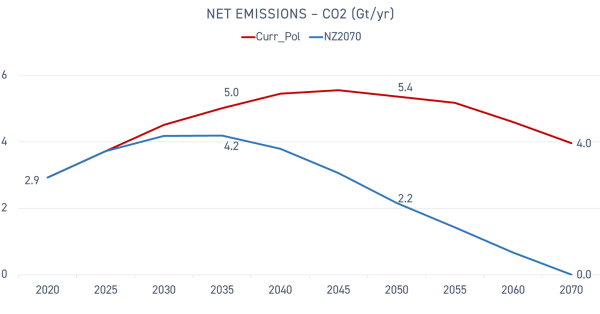
The red curve shows the emissions trajectory on a “business-as-usual” (BAU) basis, which assumes continuation of policies currently in place, notably the 2030 NDC targets and continuation of the existing trend in emission intensity reduction. It is evident that in the BAU scenario, total emissions will continue to rise and start to decline only from 2045 onwards, but remain much above the current absolute level of emissions even in 2070. The blue curve indicates the trajectory of total emissions if a combination of policies is implemented, which will decarbonise the economy by 2070. Even in this trajectory, the important point to note is that emissions will continue to rise for the next 10 years, but they can then be bent downwards after 2035, provided the right policies are followed.
Two, should the lack of external assistance dissuade us? The uncertainty about international public flows being provided on the scale that developing countries wanted does not mean that India will not be able to finance a transition towards net zero. This is because COP discussions have focused on the financial needs of all developing countries, and in this context have naturally emphasised the need for concessional financing from the budgets of developed countries. Such funds are very scarce, and they are most likely to be prioritised for the least developed countries.
Given the size of India’s economy and its growing sophistication, we will be expected to mobilise most of the additional investment needed from domestic sources. There will be a need for external financing, which could come in the form of a combination of foreign private flows (debt plus FDI) and non-concessional public flows (bilateral and multilateral development bank, or MDB, lending). There is no dearth of private capital in world markets for bankable projects. Fortunately, the Indian private sector has demonstrated its ability to develop and implement such projects. The way to increase the potential flow of capital is to undertake a range of domestic policy reforms. The most important thing is to ensure that the electricity distribution companies — the main buyers in the electricity market — are financially viable. This requires reform of the state distribution companies, combined with selective privatisation, as some states are now doing. These steps need to be supported by reform of the regulatory system to allow greater variability in pricing, at both the wholesale and consumer levels. Foreign private investors may also need a legal framework in which state-investor disputes can be resolved quickly. This is an issue that is relevant for FDI flows in general, and it is one of the key items on the FTA negotiations’ agenda.
We conclude that India’s ability to transform its energy system does not depend on the availability of large volumes of external concessional finance. What is more important is for the established MDBs to expand the availability of long-term lending and perhaps also redirect more of it to support a much larger inflow of private capital through various forms of risk sharing and credit enhancement mechanisms.
COP meetings have typically underplayed the importance of MDBs in climate-related flows. Admittedly, the relevant forum for MDB-related issues is the G20. The recent G20 summit in South Africa did not do much. US President Donald Trump did not attend, and the other developed country members were content to adopt a low profile. However, the next G20 summit will be hosted by the US. We should try to use that meeting to provide appropriate signals to the MDBs to leverage larger volumes of private capital to support the energy transition.
This is part one of a two-part series on India’s decarbonisation strategy post-COP30. Part two will be published on Thursday, December 4
Ahluwalia is former deputy chairman of the erstwhile Planning Commission, and distinguished fellow at the Centre for Social & Economic Progress (CSEP). Patel is fellow at CSEP. Views are personal

