

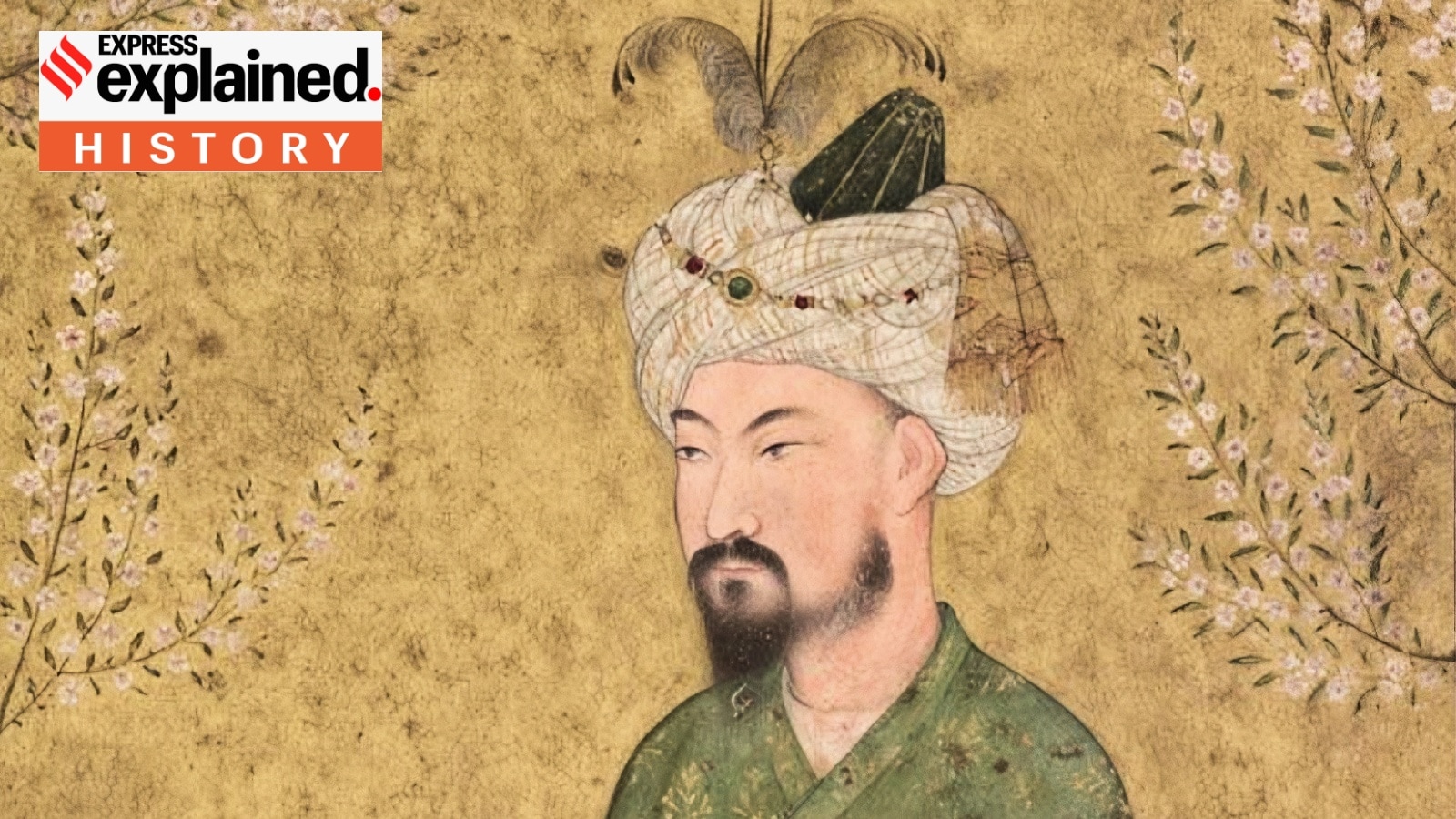
On this day (April 21), exactly 500 years ago, a small, isolated army of 12,000 men defeated the vast forces of Ibrahim Lodi on the plains of Panipat (in present-day Haryana). The victor, Zahir-ud-din Muhammad Babur, is often celebrated as the founder of the Mughal Empire.
Yet, while commemorating this anniversary, it is vital to strip away romanticism and confront a historical paradox: Babur prevailed despite commanding almost no local support, facing a deeply hostile Muslim population, and wielding a technology that was not entirely new to India. How, then, did he win? The answer lies not in firepower alone, but in the revolutionary application of that firepower and a tactical brilliance that turned every handicap into a strategic asset.

A hostile land
Contrary to older narratives such as those of Rushbrooke Williams, which suggest the Indian Muslim populace welcomed Babur as a co-religionist, the evidence points overwhelmingly to rejection. The Lataif-i Quddusi reveals that the eminent Sufi, Abdul Quddus Gangohi, and his circle were deeply apprehensive of Babur. The ashraf of Karnal abandoned their homes to take refuge behind the Lodi army.
After Panipat, Abdul Quddus himself was captured and cruelly dragged behind a horse to Delhi. Babur’s forces reportedly attacked a dargah and burned a library. For at least two centuries before 1526, the Mughals had been identified in Hindustan as uncouth, barbarian outsiders. Babur thus stood isolated, not only from Hindus but from the very Muslim society he sought to rule.
Compounding this was his numerical weakness. His total troops numbered merely 10,000-12,000, with barely 125 experienced nobles. Such a force, surrounded by a hostile population, should have been crushed within weeks. Instead, Babur pacified territory up to Bihar in an astonishingly short time.
The firearms myth
It is tempting to credit the tufang (matchlock) and cannon as the decisive factors. But Prof. Iqtidar Alam Khan’s meticulous research dispels the myth that Babur introduced gunpowder weapons to India. The Portuguese writer Duarte Barbosa (1515-18) witnessed an infantry wielding the arquebus (a form of long gun used in Europe and the Ottoman Empire during the 15th century) in Gujarat and the Bahmani Kingdom. Faria de Souza (c. 1506) recorded that Portuguese experts found Deccani artillery superior to their own.
An illustrated manuscript of the Aranyak Parvan from Sikandar Lodi’s reign (1498-1516) clearly depicts cannons on ramparts. The Ma’asir-i Mahmudshahi describes the kamān-i ra’d (thunderbolt bow) firing round stone balls — a clear reference to primitive cannon in 15th-century Malwa.
Story continues below this ad
What, then, was Babur’s innovation? Three things: First, he brought handguns (arquebuses) into open-field battles. Before 1526, Indian powers used cannon for sieges or as fixed shore batteries. Second, his handgun-equipped infantry fought on foot, not from elephant-back, a crucial advance in accuracy and rate of fire. Third, and most importantly, he devised a defensive-offensive formation that protected his gunners from cavalry charges, the perennial weakness of early artillery.
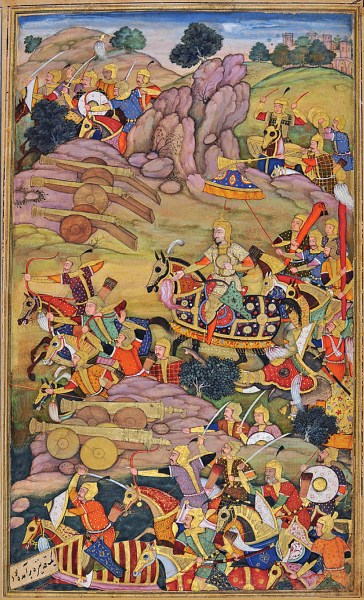 Mughal artillery and troops in action during the First Battle of Panipat (1526). Photo: Wikimedia Commons
At Panipat, Babur deployed ordinary carts tied with rawhide, creating a mobile barricade. Between each cart column, he left gaps wide enough for 100 troopers to pass in single file. Behind the carts, he placed turah (mantlets) to shield individual matchlock men. On one flank stood heavy bronze mortars (farangi), on the other light artillery (zarb-wa-zan). Behind these, he arrayed his wings (maimana and maisara) and the central reserve, with Babur himself in the centre. On the flanks of the reserve were “turning parties”, units designed to wheel away from the enemy, then charge into their flanks.
This was the Tulughma formation, borrowed from the Ottomans (the “ghazis of Rum”) who had shattered the Safavids at Chaldiran in 1514. Babur had first used it at Qandahar in 1507. At Panipat, he anchored three sides of his camp, two with ditches, one against the town of Panipat itself.
The only approach left for Ibrahim Lodi was a frontal charge into the cart-and-gun line. Ibrahim, young and inexperienced, compressed his massive army into a dense, unmaneuverable mass. As they reached close range, Babur’s artillery and matchlocks slaughtered them. They could neither advance nor retreat.
Story continues below this ad
Not a clash of civilisations
However, any accurate commemoration must also address two facts that are often deliberately erased in popular retellings. First, Babur did not invade India out of religious fervour. He came because he was invited by Daulat Khan Lodi, the governor of Punjab, and Alam Khan, another Lodi noble, who were rebelling against Ibrahim Lodi’s tyranny. This was a dynastic struggle within the Delhi Sultanate’s ruling class. Daulat Khan even sent his son to Babur’s court as a gesture of alliance. Had Ibrahim been a just ruler, his own nobles would not have summoned a foreign invader. The battle of Panipat was a political coup, not a clash of civilisations.
Second, this was never a Hindu-versus-Muslim conflict. At Panipat, Ibrahim Lodi’s army contained Hindu Rajput chiefs serving the Sultanate, just as Babur’s army contained Muslim soldiers from Central Asia.
More tellingly, at the Battle of Khanwa (1527), where Babur faced Rana Sanga of Mewar, the Rana’s coalition included prominent Muslim chieftains. Hasan Khan Mewati, the Muslim ruler of Mewat, fought and died alongside Sanga. Mahmud Lodi, Ibrahim’s brother, also joined the Rajput confederacy against Babur. Many Muslim soldiers served under the Rana’s banner. Conversely, Babur’s own forces included Hindu allies. The lines were drawn by political allegiance, not religious identity.
To frame Panipat or Khanwa as a “Muslim invader versus Hindu king” narrative is a modern anachronism, often weaponised by communal historians. The 16th century did not operate on 21st-century identity politics. Babur’s own memoirs, the Baburnama, never once describe his campaign as a jihad against infidels. He was a fugitive prince from Ferghana, desperate for a new kingdom, and he took the opportunity that Daulat Khan Lodi offered him.
Victory of technique over terrain
Story continues below this ad
Babur’s triumph at Panipat was not the victory of a civilised invader over a backward sultan, nor of Islam over another faith, nor of a foreigner over a native. It was the victory of a desperate, outnumbered outsider who understood that military revolution is not about owning new toys but about reimagining their use. He faced a population that despised him, a Muslim elite that fled from him, and a technological landscape where guns were already known. Yet within two years, he conquered North India up to Bihar.
The First Battle of Panipat should be remembered as a case study in tactical genius overcoming political isolation, and, just as importantly, as a political conflict between competing noble factions, not a religious war. The Mughal Empire that followed would be defined not by iconoclasm but by syncretism, administration, and cultural flowering. That is the real anniversary worth commemorating.
The author teaches medieval Indian history at the Department of History, Aligarh Muslim University.

