

In August 2021, three months after being sworn in as Finance Minister of Tamil Nadu under the newly elected DMK government, P Thiaga Rajan released a White Paper on the state’s finances which said the fiscal situation was “dire” and there were “no buffers left” due to structural flaws in governance. That was after 10 years of AIADMK being in power.
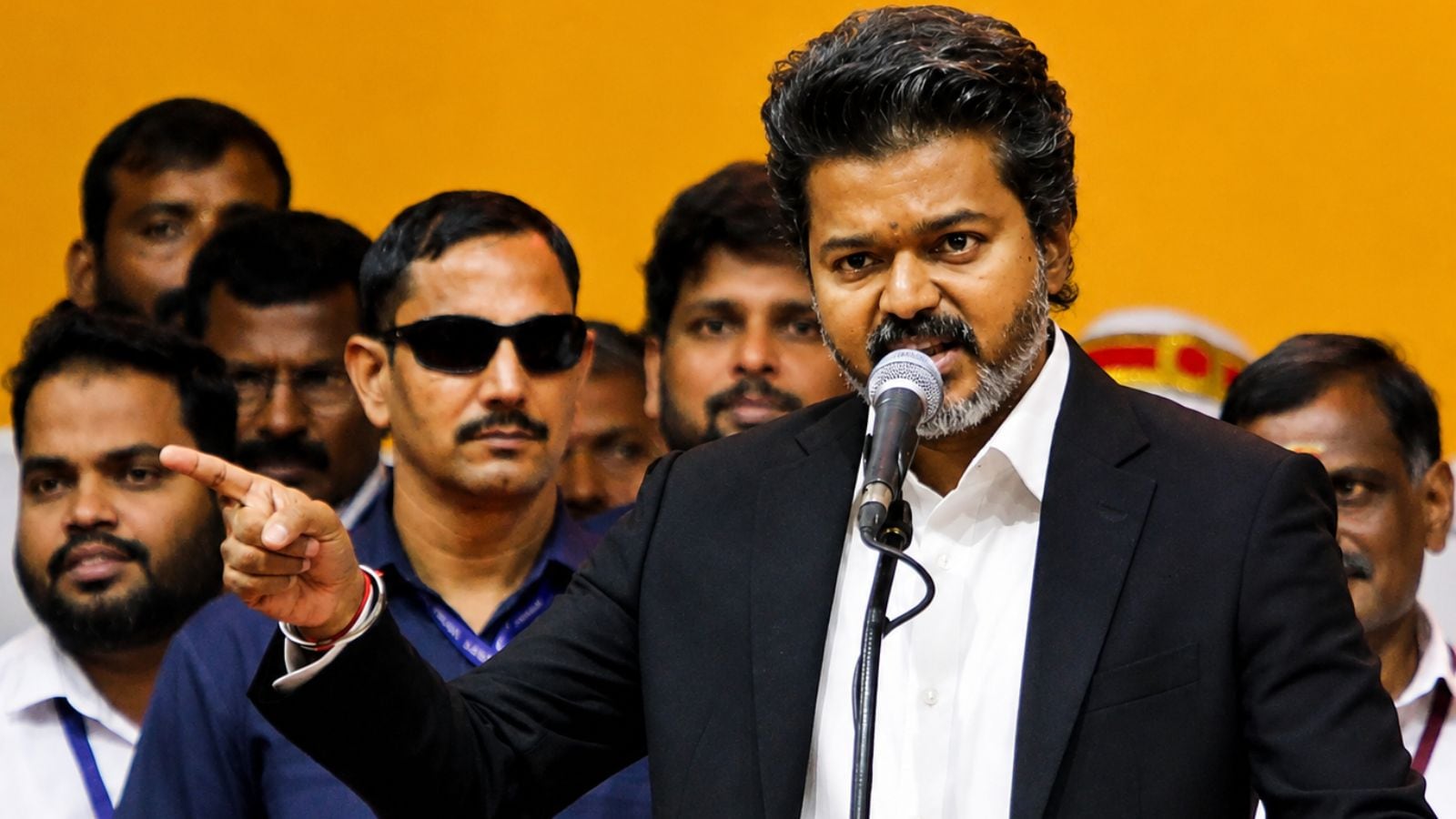
Five years later, after being sworn in as Chief Minister, TVK founder C Joseph Vijay on Sunday said he would soon release a White Paper on Tamil Nadu’s finances, accusing the DMK of leaving the state “in a bad shape” with a debt of Rs 10 lakh crore. At the same time, Vijay announced 200 units of free electricity every two months for domestic consumers — at a cost to the government of Rs 1,730 crore per year, according to an order by the state’s Energy department.

Vijay’s predecessor M K Stalin responded sharply, rejecting the suggestion that the state treasury had been emptied. In a pointed line directed at the new Chief Minister, Stalin wrote in a social media post: “You, who came to power saying, ‘I will only give promises that are practically feasible,’ are now just stepping into government administration. I believe that, just like us, you too will surely learn soon the nuances of how to fulfil the promises made to the people.”
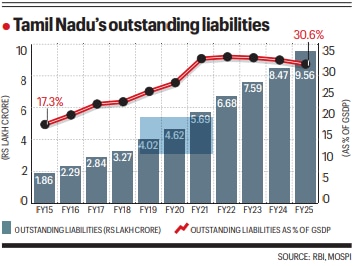
Tamil Nadu’s finances are far from ideal, according to latest RBI data. The state’s outstanding liabilities stood at Rs 9.56 lakh crore at the end of FY25 — the highest of any state. At the same time, Tamil Nadu is the fastest-growing state in the country, posting a real growth rate of 10.8% in FY26 on top of 11.2% in FY25 as per the old GDP series with 2011-12 as the base year.
States that grow faster have room to take on more debt as they have a higher ability to pay back the debt. While Tamil Nadu’s outstanding liabilities as a percentage of the state’s GDP stood at 30.6% in FY25, they have declined for three years in a row, starting from 32.2% in FY22 after having jumped sharply in FY21 to 31.8% from 26.5% in FY20 due to the coronavirus pandemic.
Even the DMK’s own White Paper from 2021 had recognised the precarious situation Tamil Nadu’s finances were in, noting that the state had the “dubious distinction” of being the largest borrower from markets among all states.
As such, the Rs 10 lakh crore debt that Vijay spoke of is not the doing of just the previous government but also those that came before. This was seemingly pointed out by the 16th Finance Commission in its recent report: from recording the second-lowest debt-to-Gross State Domestic Product ratio among the non-North Eastern and Hilly states in FY12, the ratio “increased steadily” to 24.7% in FY20 before spiking to 31% in FY21.
A key reason for the state’s debt, apart from the Covid-related expenses that pushed up debt ratios for all states as well as the Centre, is its committed expenditure, or money that it must spend every year without failure: salaries, pensions, and interest on past debt.
According to an October 2025 study of state finances by PRS Legislative Research, Tamil Nadu, at 62%, was one of five states that had budgeted in FY26 to spend more than 60% of its revenue receipts on salaries, pension, and interest. The others were Assam (61%), Himachal Pradesh (83%), Kerala (69%), and Punjab (74%). The more a government spends on these committed expenditures, the less it can spend on developmental subjects such as health and education, among others.
Vijay’s promise of 200 units of free electricity every two months assumes significance in this context.
In 2025-26, Tamil Nadu had budgeted to spend Rs 72,434 crore on subsidies – 16% more than on capital expenditure and 15% of its total expenditure. Latest data shows that by February, the state’s subsidy bill stood at Rs 67,936 crore. Meanwhile, the full-year capital expenditure target was missed by 19%.
It’s not just free electricity.
The Indian Express reported on May 6 that fulfilling all the promises made in TVK’s manifesto — from Rs 2,500 every month to women heads of households to six free LPG cylinders per household every year and, a grant of Rs 4,000 per month for 10 lakh unemployed graduates — would result in the new government’s projected annual expenditure on welfare spending alone reaching close to Rs 1 lakh crore. This would mark an increase of over 52% from the Rs 65,000 crore spent by the previous DMK government on welfare schemes and subsidies in 2025-26.
Improving the state’s finances is particularly crucial for Tamil Nadu as its population is ageing. The RBI, in its study of states’ 2025-26 budgets, had noted earlier this year in January that by 2026, Kerala and Tamil Nadu are expected to enter a so-called ‘ageing category’ when more than 15% of a state’s population is above the age of 60.
“Ageing states are facing high old-age dependency ratios and rising social sector expenditure obligations,” the RBI had said, adding that addressing the “mounting fiscal pressures stemming from population ageing and safeguarding public finance sustainability requires a comprehensive policy strategy”.

