

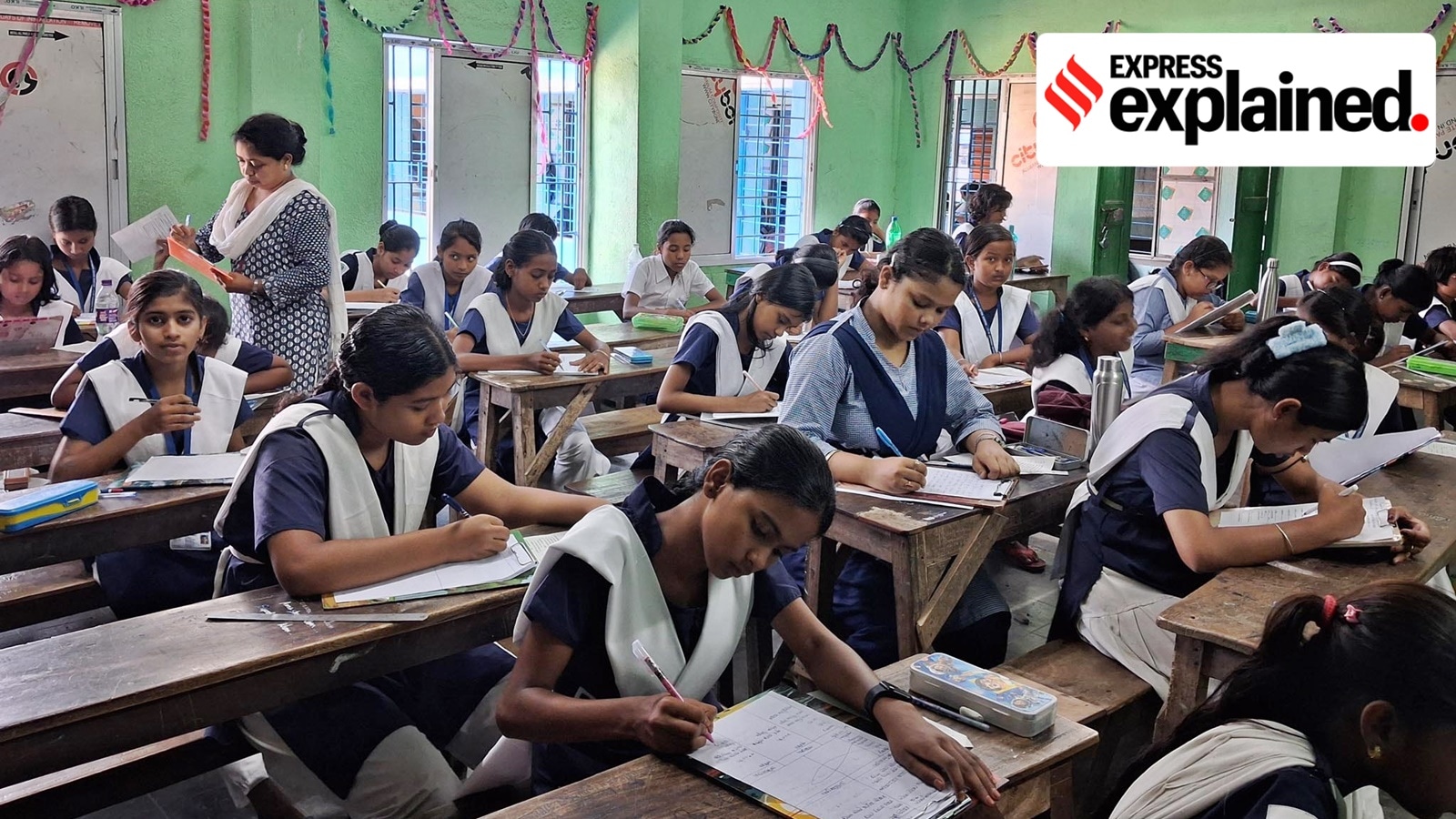
The Central Board of Secondary Education (CBSE), the national school board with over 30,000 affiliated schools, is, for the first time, gearing up to give students the option of writing their class 10 board exam twice from the 2026 exam onwards, albeit with a few caveats.
The Board released a tentative date sheet this week for the two exams, the first set to be held between mid-February and March 9, and the second, between mid-May and June 1. The new policy gives students only a day or two between two exam papers, unlike the system so far which could accommodate longer gaps between subjects.

Eventually, the two-exam scheme is likely to be extended to class 12.
Why has a two-exam policy been introduced?
For the Board, offering two exams means it ticks an item off on the checklist of National Education Policy (NEP) 2020 goals. The NEP, a framework which governs education-related policy making for the country, calls for reforms in board exams to eliminate their “high-stakes” nature.
Possibilities that the NEP suggested include allowing students to take the exams on two occasions during a school year; semester, or modular exams (a test taken after a course or module is completed in school); exams at two levels — a standard one and a higher one; and allowing students to choose subjects in which they take board exams, based on interest.
Of these recommendations, the two-exam policy is one. The way it is set to be implemented, however, is slightly different from what the CBSE had initially proposed.
Why is the final policy different from the CBSE’s first draft?
Students will have to mandatorily appear for the first set of exams. They can then improve their performance in the second set of exams, but only in three subjects out of Science, Math, Social Science, and the two languages they study.
Story continues below this ad
A student typically takes five subjects in class 10. The CBSE already had a system of allowing students to write improvement exams in two papers. The new policy essentially takes that number up to three.
When the CBSE released a draft of the policy earlier this year and invited feedback, it had not made the first set of exams mandatory, and did not limit the number of exams a student could take in the second round. The final version, however, introduced these changes.
An official in the Board acknowledged that the final policy is a more “restricted” one. Among reasons for this was the logistics — two exams will have to be conducted without cutting into summer vacations, or keeping teachers occupied for a long time.
When two exams are later offered for class 12, the second exam will have to be completed and marks issued before college sessions begin.
Story continues below this ad
What is the two-exam policy expected to achieve?
Calls for reforms in how school students are assessed are long and wide, stemming from the need to do away with rote learning, and take the focus away from a single grade or final mark and rank.
Other countries too have assessments that are perceived as crucial for a school child to excel in, and these countries have also grappled with exam-related reforms. China, for instance, has the Zhongkao that students take at around the same age as a class 10 student in India, and determines entry into higher grades.
Finland, on the other hand, doesn’t have any national tests for 7-16-year-olds. It instead has teachers assess students. At around age 18, students can take a matriculation exam that determines admission to higher education institutions.
Educationists say the CBSE’s two-exam policy isn’t a step in the direction towards reforming assessments.
Story continues below this ad
Anita Rampal, former dean, Faculty of Education, Delhi University, said: “The problem is how we’re doing assessments. Assessments are to be organically linked to pedagogy. Assessment has to be a continuous process, tied to the process of learning. An exam should never be competitive. The stakes are coming from the way the system is constructed – assessment and examination.”
“Just taking two exams in a year makes no sense. You’ve not changed the exam. You’ve made it twice in the year so you can do it again…assuming that you may not do it well, you do it again. You want to get that rank, that mark, that result. That doesn’t make you a better learner, or build understanding or confidence,” she said, adding, “Exams are the bottleneck of our system. Even if teachers try to teach differently, try to address diversity in classrooms, different ways of understanding…the exam throttles all that.”
Ameeta Mulla Wattal, Chairperson and Executive Director, DLF Foundation Schools, said: “Do we need to have these kind of exams in grade 10? What are we achieving? You’re making it rote anyway. The moment you’re preparing for a paper like this, you’re cramming. With two exams, we’re stilling mining students for marks.”

