


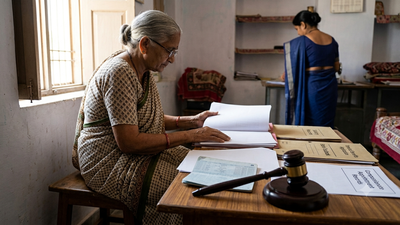
NEW DELHI: The Rajasthan high court has directed Ajmer Vidyut Vitran Nigam Limited to deduct 25 percent of the monthly salary of a woman appointed on compassionate grounds after her husband’s death and credit it to her elderly mother-in-law. The court also ordered that half of the deceased employee’s terminal benefits be paid to the mother, in a judgment passed on September 17, 2026.Why did the mother approach the high court?According to the court order, the woman’s husband, Subhash Chand Verma, was working as a technical helper with Ajmer Vidyut Vitran Nigam Limited when he died on March 24, 2017. He was the sole bread earner of the family.His widow, applied for compassionate appointment with the no-objection of her in-laws and was appointed as a lower division clerk on August 30, 2017. She had also given an undertaking that she would maintain the other family members.The petitioners later alleged that after getting the job, the wife left the matrimonial home, remarried and stopped maintaining them. They sought a share of her salary and equal division of the terminal benefits.The petition was initially filed by the deceased employee’s parents, but the father died during its pendency and only the mother remained.What did the court observed?Justice Anand Sharma noted that compassionate appointment is intended to provide financial assistance to the family after the sudden death of its sole bread earner. It said the family does not consist only of the widow but also includes parents and other members covered by the applicable rules.The court noted that the widow had given an undertaking to maintain the other family members while seeking the appointment.“The respondent No.3 submitted an undertaking in the form of affidavit that she would also maintain the other family members. However, conduct of respondent No.3 shows that after getting appointment, she has left the petitioners to face financial crisis as well as other deeds of life. She has moved out and has also remarried with some other person. Having availed the benefit of compassionate appointment after giving aforesaid undertaking, she cannot completely disassociate herself from the obligation, which formed the very basis of the compassionate appointment,” the court noted.The court also referred to an earlier Rajasthan high court judgment which held that compassionate appointment carries responsibilities towards other surviving dependants of the deceased employee.“In the case of Bhagwan Singh (supra), this court categorically held that compassionate appointments confer moral responsibilities upon the appointee to maintain other family members and the beneficiaries of compassionate appointment cannot neglect the other dependents,” it further noted.The court said it agreed with the earlier judgment and held that the widow’s failure to maintain the petitioner was contrary to the purpose of the compassionate appointment scheme.“In the instant case, admittedly while making application for compassionate appointment, the respondent No.3 submitted an undertaking in the form of affidavit that she would also maintain the other family members. However, conduct of respondent No.3 shows that after getting appointment, she has left the petitioners to face financial crisis as well as other deeds of life,” the court added.The high court allowed the writ petition and issued directions to secure the elderly mother’s subsistence.It directed Ajmer Vidyut Vitran Nigam Limited to deduct 25 percent of the widow’s regular monthly salary and directly credit it to the mother’s bank account. The arrangement will continue for the mother’s lifetime.The corporation was also directed to release the terminal benefits of the deceased employee within 30 days and divide them equally between the mother and his widow. The mother’s 50 percent share will be credited to her bank account.

