


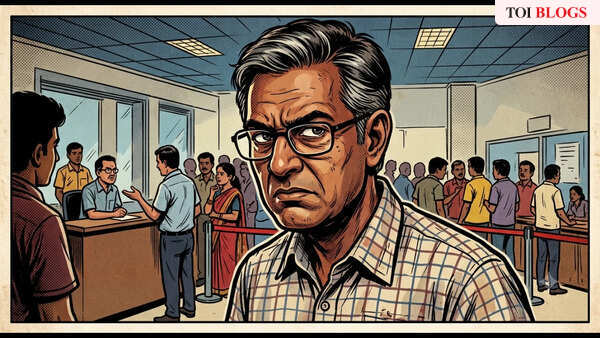
There is a new character loose in India’s public conversation: Naraz Fufa (the annoyed uncle). He isn’t a real person, he’s a composite, the voice of India’s aspirational middle class, irritated in a very particular way. This character has a salaried job or a small business, children in school or college, and pays his taxes, owns smartphone, uses UPI, and flies once in a while. He might live in a metro, a state capital, or a fast-growing Tier-2 town, with more choices than his parents ever had, and much higher expectations to match.And he is increasingly annoyed. It feels that almost everywhere it goes, there is a queue. The good school has a waitlist. The good hospital has a corridor doubling as a ward. The good airport has security lines that eat an hour. The good hill station is a traffic jam with a view. Naraz Fufa’s voice is worth taking seriously because the economic shift underneath it is real. His income, education, and digital fluency have grown faster than the quality of the services he depends on. This gap has a name, or rather, three names, and combining them tells us more about India’s next decade than any headline.
The tax nobody collects
None of this queueing shows up on a tax return. All of it has a cost, paid in time, fuel and stress rather than rupees. Call it the congestion tax. It bites harder now because Naraz Fufa’s time has become more valuable; a generation ago, losing half a day to a PDS line was just how things worked. His expectations have moved. The queue hasn’t.There’s a paradox behind this: growth itself produces the crowd. More people can now afford private healthcare, better schools, a car, a flight, and when supply doesn’t expand at the same pace, prosperity is exactly what jams the road and fills the waiting list. A richer India can feel more crowded precisely because it’s richer. That isn’t evidence of failure. It’s no comfort to the person standing in the line either.
Wagner explains the expanding state
The nineteenth-century economist Adolph Wagner argued that as societies get richer, they demand more from their governments, more education, healthcare, infrastructure, regulation. India has followed that trajectory closely. But Wagner’s Law never promised that a bigger state becomes a more capable one. A government can build another hospital without instantly producing the doctors needed to staff it, or open another university without producing the faculty to teach in it. The physical state can expand faster than its own competence, and Naraz Fufa experiences that gap simply as bad service.
Playing the sitar in the age of the semiconductor
Here is where economics has a more unsettling answer, and it has a name: Baumol’s cost disease. The logic is deceptively simple. In manufacturing and technology, productivity keeps rising, a factory that once needed a hundred workers now needs ten, a task that took a programmer a week now takes an afternoon or an hour. Wages in these sectors rise accordingly, because output per worker rises. But in human-heavy services, for instance, teaching, nursing, medicine, the performing arts, there is no equivalent leap. It took two musicians thirty minutes to play Raag Bhairavi a century ago. It takes two musicians thirty minutes to play it today. No app, no algorithm, has found a way to compress it. The same is true of a nurse helping a mother through labour, a teacher explaining a fraction to a ten-year-old, a doctor examining a patient. These are acts that resist acceleration.Yet the people who do this work still live in the same economy as the software engineer and the investment banker. To keep teachers from leaving for better-paying jobs, to keep doctors from emigrating, wages in these “unscalable” professions must rise roughly in line with the rest of the economy, even though their output per hour has not. The result, inevitably, is that the cost of health, education, and public services rises faster than general inflation, year after year, with no productivity gain to show for it.Now consider that so much of what government does, teaching, healing, policing, judging, administering, is not manufacturing a car. It is playing the sitar. It is precisely the kind of labour Baumol’s disease preys upon. The state is not merely bloated, as critics claim, or virtuous but underfunded, as defenders claim. It is running a sector where costs rise structurally, almost by economic law, regardless of who is in charge.
You can build the kitchen. The chef is harder.
India has become genuinely good at building physical capacity, new universities, medical colleges, airports, highways. But institutions aren’t buildings, which is where the economist John List’s idea of the voltage effect earns its keep: an intervention that works beautifully in one setting loses power the moment it’s scaled, because the people and culture around it don’t scale with it. You can open a medical college by fiat. You cannot manufacture experienced doctors overnight. Naraz Fufa has noticed that two institutions with identical buildings deliver entirely different experiences.
The smartphone moved the benchmark
The sharpest shift here may be technological. UPI taught Indians that money moves in seconds; retail apps taught them a delivery can be tracked block by block. Then they walk into a government office and ask the obvious question: why can I track a parcel but wait weeks for a certificate? Naraz Fufa is no longer comparing today’s government to yesterday’s, he’s comparing it to the best private service he used an hour ago. That’s a far harder bar to clear.
What Naraz Fufa actually wants
It would be a mistake to read this as anti-government sentiment. He may well want more government, better schools, safer cities, faster courts. What he objects to is paying twice, in money and time, for delivery that matches neither. His demand is less ideological than economic: value for money, and value for time.The answer isn’t automatically a smaller state, or a larger one. It’s a more productive one — measuring waiting times, cutting unnecessary procedure, digitising routine administration, deploying technology around doctors, teachers and judges instead of pretending it can replace them, and building human capital as deliberately as physical infrastructure. Before scaling any successful pilot, it’s worth asking what made it work, and whether that can actually travel.
A symptom of development
The most interesting thing about Naraz Fufa may be that his irritation is itself a kind of evidence. He has more information and more alternatives than his parents did, and he now knows what good service looks like. The poor ask whether a service exists. The emerging middle class asks whether it works. The affluent ask whether it’s excellent. As India gets richer, the bar keeps climbing to meet it.Wagner explains why citizens keep demanding more from the state. Baumol explains why some of what they’re demanding will stay stubbornly expensive. List explains why scaling an institution is harder than scaling a building. Put together, Naraz Fufa stops being a punchline and becomes a useful economic character. His complaint was never that the state is too big. It’s that the state hasn’t become productive enough for the economy it now serves — which leaves India’s next development question sounding almost too simple to be the right one: can we make the queue move?
Disclaimer: Views expressed above are the author’s own.

