


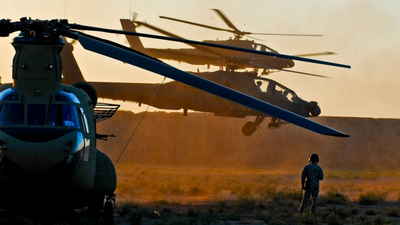
The AH-64 Apache helicopter is seen as the most advanced and the most lethal helicopter on the battlefield. The helicopter has a stellar combat record spread across decades. The chopper first saw action in 1989 during Operation Just Cause, the invasion of Panama. In 1991, the helicopter was the tip of the spear for the coalition that liberated Kuwait, with the Apache helicopters taking out several Iraqi air defence radars opening the window for the largest air defence blitz after the end of the Cold War. The helicopter’s sensors that can see both in the day and more importantly, at night, paired with its long-range missiles, make it a formidable battlefield asset. The helicopter is operated by nineteen different nations, including India. The helicopter has been deployed in all types of terrain ranging from equatorial rainforests to the high Himalayas, where the chopper was deployed by the Indian Air Force during the face-off with China during the build-up post the Galwan incident.
Apache: the killer helicopter
Although the helicopter has earned its reputation as a machine of war, this image is also taking a hit due to the repeated number of incidents that the aircraft is increasingly involved in. As per the Flight Safety Foundation, since 1980 the attack helicopter has been involved in as many as 193 crashes and incidents with the vast majority of them leading in the loss of the aircraft. Nearly a 120 aircrew, with the vast majority of them being Americans, have lost their lives in these incidents. The latest incident, which took place in Texas on Thursday has claimed the lives of both aircrew and started a fire that spread over 100 acres.In US Army’s service the aircraft has had a much higher crash rate than any other aircraft currently in service. From 2020 to 2024, the US Army had reported a 4.41 Class-A mishaps per 1,00,000 flight hours, or incidents in which the aircraft is either lost or cost to repair is over $2.5 million. By contrast, the US Army’s Black Hawk fleet only experienced 1.23 Class-A incidents per 1,00,000 flight hours in the same time frame. A spate of accidents took place in that time frame.
What makes the Apache dangerous
The Apache is a attack helicopter, with a crew of two that consists of a pilot and a co-pilot/gunner. The aircraft has to fly low to optimally perform its role as a tank hunter. The helicopter was designed from the outset as an ambush predator. The aircraft flies very low to the ground in what is called nap of the earth flying. This method is used by air crew to avoid detection by radar and by sight. The helicopter as it approaches the target area gains altitude only long enough to detect and strike a target by long range missiles such as the Hellfire missile or in the Israeli case, it is also armed with the Spike missile, which increased the range of the helicopter even further. The helicopter is now also in the late stages of being armed with loitering munitions.
When the strength becomes weakness
It is this operational philosophy of flying low to the ground that has become the greatest Achilles heel of the helicopter. Flying this low to the ground reduces themargin of error for the air crew. Flying at the speed of a few hundreds of kilometers per hour just a few feet of the ground. This is made even more difficult at night when pilots have to fly at low or no light conditions, in this regime depth perception reduces, which increases the chances of what is called controlled flight into terrain.Both the IAF and the army operate the Apache helicopter. The air force has had two incidents involving the Apache, one of the incidents took place in Indora in Punjab and the other incident took place near North Pullu in Ladakh in 2024. Both the incidents were precautionary landings, but the one in Ladakh led to damages to the aircraft. Considerable effort took place to recover the aircraft.

