

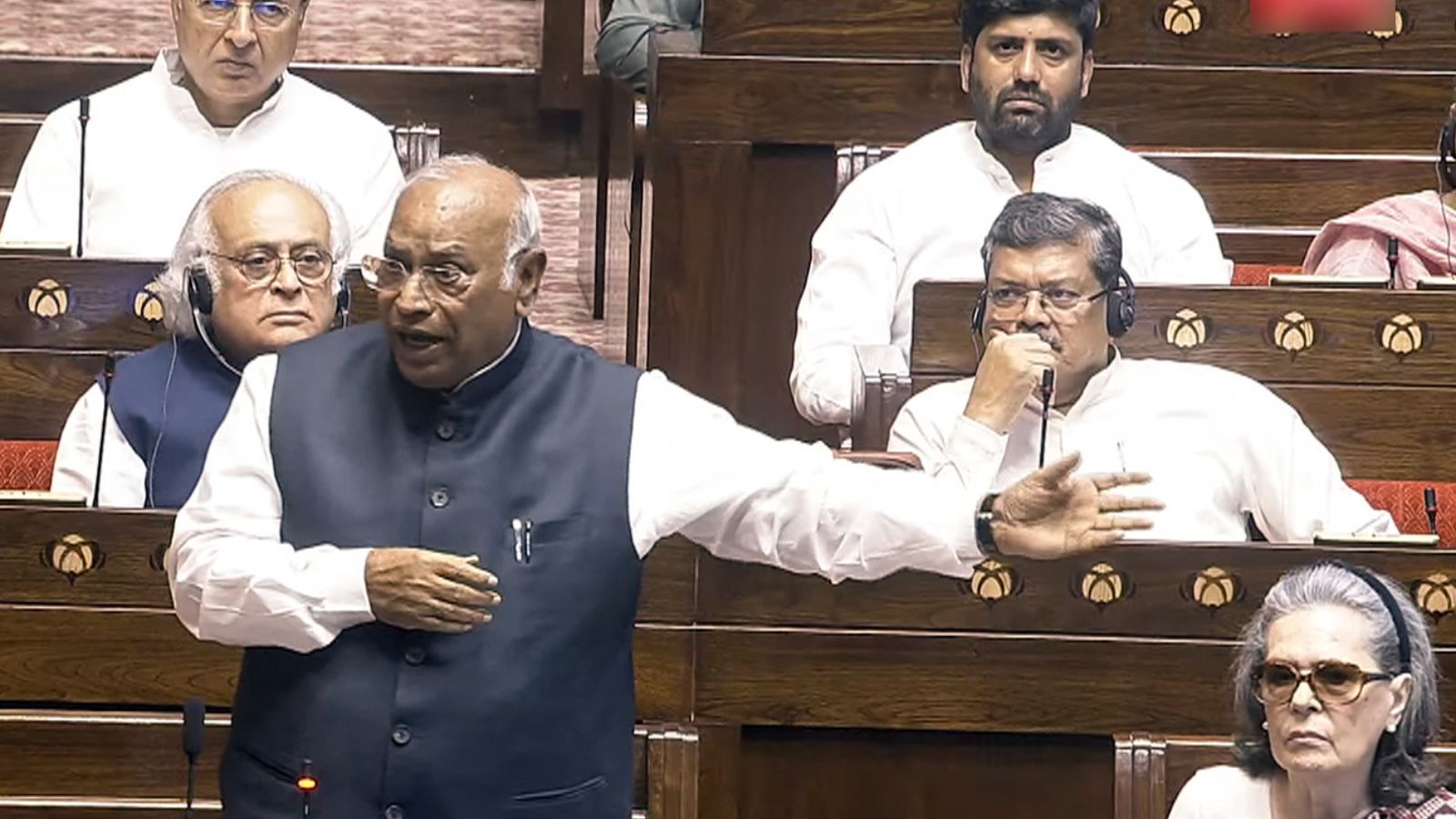
 Mallikarjun Kharge in Rajya Sabha on Thursday. (Source: ANI screengrab)
The Public Examinations (Prevention of Unfair Means) Amendment Bill, 2026 has been passed in the Rajya Sabha soon after the Opposition staged a walkout.
Congress leader Mallikarjun Kharge demanded that Union Home Minister Amit Shah explain who ordered the use of tear gas and police action against student protesters in Delhi. Stating that accountability rests with the Home Minister, Kharge said, “If he can’t answer, he should resign. Or PM should remove him.” He also alleged that the revised Bill contains no effective provisions to prevent paper leaks and claimed its sole purpose was to pacify public anger following the student protests over the NEET paper leak.

Story continues below this ad
Union Minister Jitendra Singh on Thursday introduced the Public Examinations (Prevention of Unfair Means) Amendment Bill 2026 for consideration and passage in the Rajya Sabha after the House resumed for the second time. Reiterating the government’s “zero tolerance for paper leaks” policy, Singh said the Bill seeks to strengthen the legal framework against paper leaks. The proposed amendments mandate time-bound investigations and fast-track trials, while prescribing stricter penalties, including imprisonment of up to 10 years and fines of up to Rs 10 crore for organised paper leak racket. The Bill was passed by the Lok Sabha on Wednesday. Meanwhile, Lok Sabha adjourned for the second time till 3pm today.
Parliament Agenda: On the ninth day of the Monsoon Session, the Lok Sabha is scheduled to take up the Supreme Court (Number of Judges) Amendment Bill, 2026, for consideration and passing on Thursday. The Bill, to be moved by Law and Justice Minister Arjun Ram Meghwal, seeks to amend the Supreme Court (Number of Judges) Act, 1956, to increase the sanctioned strength of the apex court from 34 to 38 judges. At present, the Act provides for a maximum of 33 judges, excluding the Chief Justice of India. Under the existing law, the apex court can have a maximum of 33 judges, excluding the CJI. The Cabinet had approved the proposal in May. The Rajya Sabha is set to consider and pass the exam leak bill on Thursday. The Upper House will also consider the Micro, Small and Medium Enterprises Development (Amendment) Bill 2026, which proposes changes to the MSME Development Act 2006, to improve payment systems, make compliance easier and speed up the resolution of disputes involving micro, small and medium enterprises.
Anti-paper leak Bill: The Lok Sabha on Wednesday passed the Public Examination (Prevention of Unfair Means) Amendment Bill, 2026, bringing in stricter measures to curb exam paper leaks. A voice vote passed the legislation after a two-day debate, which saw repeated disruptions and multiple adjournments. The Opposition accused the government of ordering police brutality during the July 20 police action against students. This led to stormy scenes on the floor and protests from the treasury benches. One of the words used by Opposition leader Rahul Gandhi during his speech on Wednesday was later expunged from the House records. Later, the government hailed the passage of the Bill.
© IE Online Media Services Pvt Ltd

