

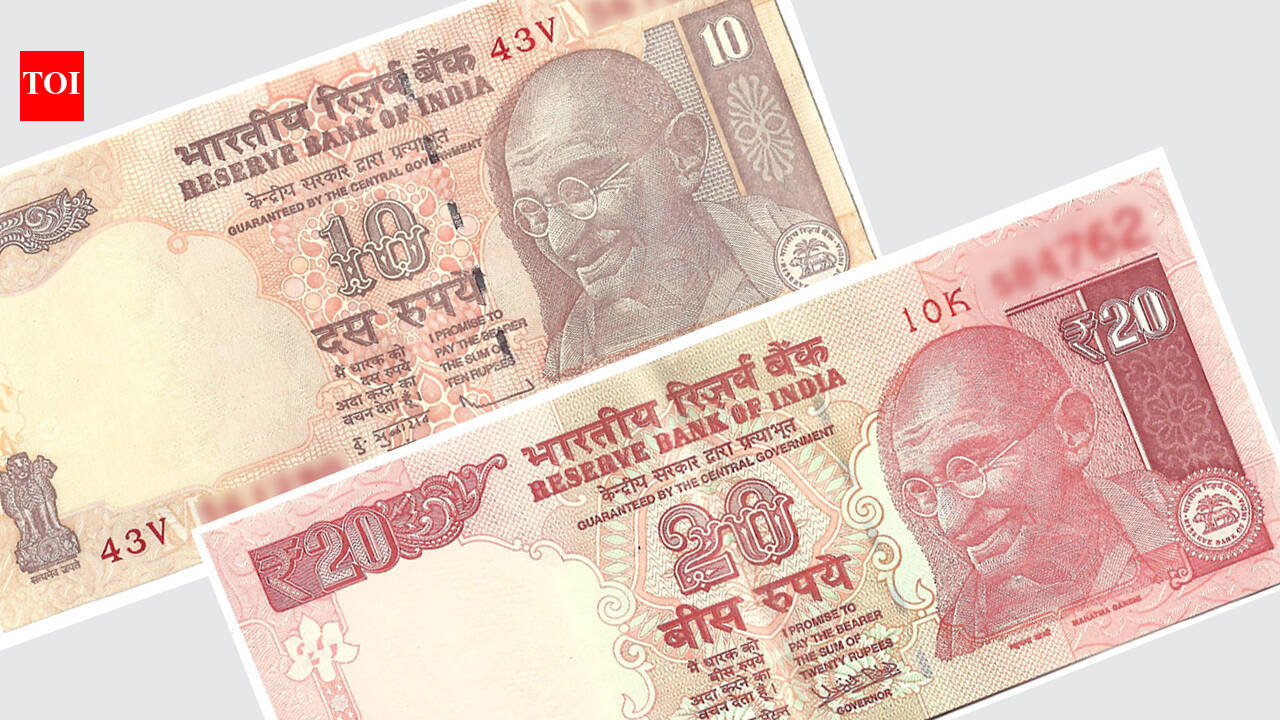
Soon you may be using plastic or polymer currency notes! The government has authorised the Reserve Bank of India (RBI) to print an initial batch of 2 billion polymer banknotes for field trials, the government informed Parliament on Monday.The RBI has recently floated a tender to procure material for polymer banknotes, reviving a proposal that has been under consideration for nearly two decades.Minister of State for Finance Pankaj Chaudhary told the Lok Sabha that the RBI will print one billion Rs 10 notes and one billion Rs 20 notes. These denominations are often in short supply. He also clarified that there is no proposal to replace paper currency entirely with polymer banknotes, and that both types of currency will continue to circulate together.If implemented, the move would mark the first use of polymer banknotes in India, where currency has been printed on specialised paper for almost a century.
RBI’s plastic notes: All you need to know
Polymer notes, which are produced using durable plastic film instead of paper, generally have a longer lifespan and require replacement less frequently because they are more resistant to wear and tear. Polymer banknotes are printed on a non-fibrous, non-porous plastic substrate instead of the specialised paper currently used for Indian currency.
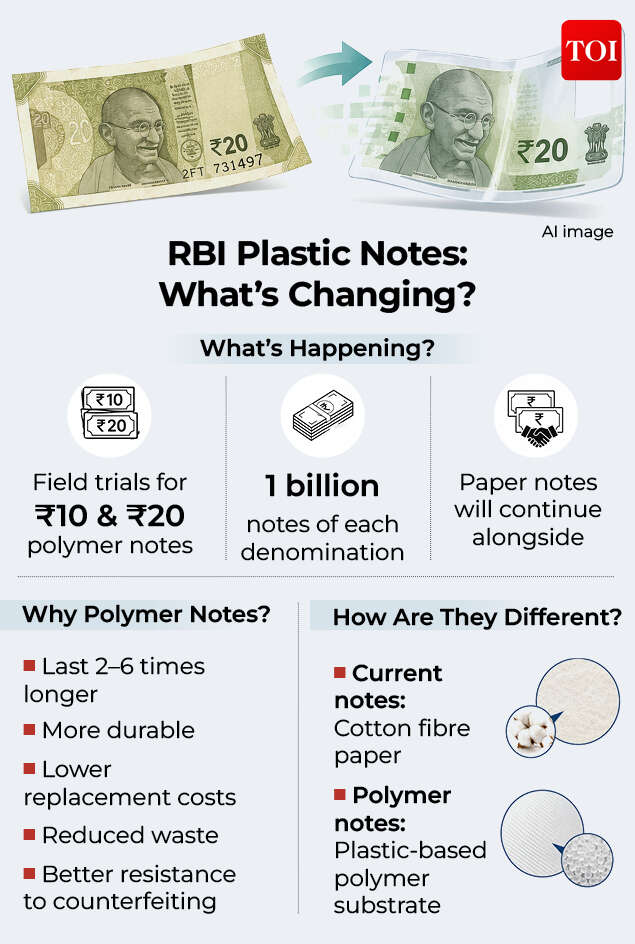
RBI plastic notes: What’s changing?
The new notes will first be used for field trials before being introduced into regular circulation. The plan was approved alongside an expansion of the country’s currency printing infrastructure, which had been facing capacity limitations. “RBI has informed that as per international studies, the life span of polymer banknotes is significantly higher than that of paper banknotes. The introduction of polymer banknotes is currently in a preliminary phase,” Chaudhary told Parliament.Officials have indicated that the rollout could take several months, as both the government and the RBI want to ensure that security standards are fully met and that the material used has no connection with supplies made to countries such as China and Pakistan.In recent years, the RBI has also encouraged greater use of Rs 10 and Rs 20 coins. According to central bank data, these two denominations together accounted for nearly one-fourth of the total number of banknotes in circulation at the end of the last financial year, although their combined share by value stood at just 1.4%.The initiative comes at a time when the RBI’s spending on printing currency has fallen. According to the central bank’s annual report, note printing expenditure declined by nearly one-fourth to Rs 4,875 crore in 2025-26 compared with the previous year, primarily because fewer banknotes were printed.This reduction in printing costs came even as the total value of currency in circulation increased 12% to Rs 41.23 lakh crore at the end of March 2026, up from Rs 36.86 lakh crore a year earlier, reflecting continued demand for cash.
Which countries use plastic notes?
Despite being among the world’s five largest economies, India is still assessing the introduction of polymer currency, almost three decades after Australia rolled out a full series of plastic banknotes. Today, polymer notes are used in some form by around 60 countries.The government’s latest decision revives a proposal first announced in 2012. A Press Information Bureau (PIB) release dated December 13, 2012, stated that the RBI, in consultation with the Centre, had examined several alternatives, including the use of polymer substrate for printing banknotes. At the time, it was decided to introduce one billion Rs 10 polymer notes on a pilot basis across five cities.Several countries, including Australia, the United Kingdom and Canada, have switched to polymer banknotes made from durable plastic film. Compared with conventional paper notes, polymer currency lasts significantly longer, withstands wear and tear better, and helps lower replacement costs over time.Australia became the first country to introduce polymer banknotes in 1988. Among advanced economies, polymer notes have been adopted by the UK, Canada and New Zealand. In Asia, countries such as Thailand, Vietnam, Malaysia and Singapore also use polymer banknotes, though not necessarily across all denominations.The Bank of Canada began transitioning to polymer currency in 2011 after assessing the environmental impact of producing both paper and plastic banknotes.
RBI’s strict tender guidelines
Bharatiya Reserve Bank Note Mudran Pvt Ltd (BRBNMPL) has asked eligible manufacturers to submit bids by August 18. The tender is aimed at identifying suppliers capable of producing opacified polymer substrate sheets incorporating the required security features for banknotes.The tender includes strict national security safeguards. Prospective suppliers will be required to obtain security clearance from the government, isolate any operations in China or Pakistan from work related to the India contract, ensure that raw materials sourced for India’s polymer banknote substrate do not originate from either of those countries, and commit that the India-specific substrate will not be supplied to any third country.To be eligible, bidders must have supplied polymer banknote substrate with embedded security features to central banks or banknote printing organisations for at least the last three years.Suppliers must also prove they can deliver at least 20,400 reams, which is 30% of the estimated requirement. BRBNMPL has indicated an initial demand of 68,000 reams, which is approximately 34,000 reams for each of two denominations. But, it clarified that this requirement is only for the first phase, with larger orders likely after successful field trials.

