

It is 2015. I am in Old Delhi’s Sadar Bazar two days before Holi, speaking to a seller for a story. As the dense crowd kicks up dust, I lean in to listen to my interviewee better. A hand gropes me from behind. I turn around. It happens again, this time from the front. I feel disoriented, lose the thread of conversation with the seller and start walking towards the metro.
In the metro, I grab a seat and once the coach is empty enough, call up a friend to share what happened. He suggests I speak to a senior female editor. It may make me feel better. I think, and decide against it.

I was 22. Barely one year into the profession, and less than two months into that particular job. Talking felt like making a bigger deal out of it than it actually was. Did it even qualify as harassment? What if it was all just in my head?
It was in my head, all right. For over a decade. I just didn’t know.
What I knew was I avoided crowded places. It wasn’t simply discomfort. My body physically stiffened up. A few years later, I was assigned another story in a heavily populated neighbourhood. My first instinct was to say ‘no’. I didn’t, but for the four hours I was reporting there, I felt like I couldn’t breathe.
The irony is not lost on me. I am a culture journalist and yet, have avoided going to cultural hotspots that are often crowded, for as long as I can remember — with friends, on food walks, to historical sites. That was my way of managing what Ihad come to understand as a fear of crowded places.
I had it under control until December 2019, when I was at the Singhu border covering the farmers’ protest. I had successfully managed to spend the entire day reporting. That was a victory. As I was making my way back from one end of the site to the other, the crowd began moving to make arrangements for the night. Nothing untoward happened, but I suddenly struggled to breathe and fell to the ground in tears. I wanted to tell my editors I didn’t want to go back but decided against it. I returned several times afterwards, incident-free, yet I always remained on edge.
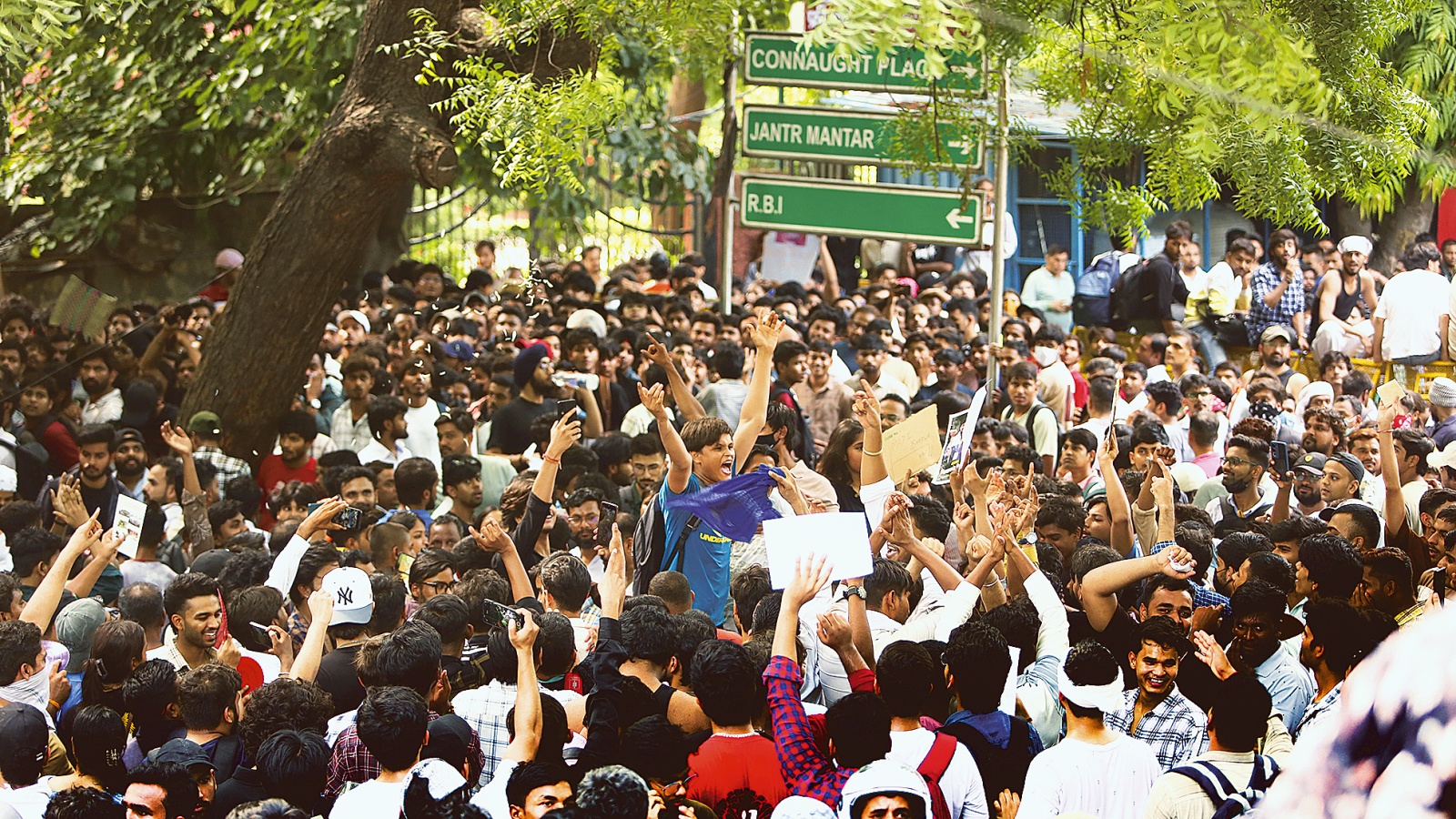
Cut to this past week. The news of the young students protesting at Jantar Mantar had taken over my Instagram feed and my mind. I knew I wanted to visit the site but needed to keep the exit flexible, so I didn’t pitch a story. But it happened anyway, and on the muggy morning of July 21, I found myself walking down the Jantar Mantar road looking for a story. As I saw people walking ahead and behind me, the crowd only swelling with every step, I felt my limbs tightening. If it wasn’t for the story, I would have turned around and left. The serpentine queue, protesters sloganeering, journalists reporting, the police standing guard with their lathis — all became a dizzying blur. I planted myself into the line that moved at a tedious pace. People, quite literally, were pressed against each other and yet, somehow there was space. I moved forward with the queue’s flow. It felt like I was being crowd-surfed at a concert, instead of being forcefully dragged. And I breathed — a full breath. I moved around the site, spoke to people, did my job and left. For the first time, I did not escapea crowd.
A day later, I was telling a colleague about the protest, “It was packed, and yet I felt so safe.” Even as the words left my mouth, like an epiphany, the afternoon at Sadar Bazar flashed in front of my eyes like a ghost I had been trying to outrun. I realised that while I remembered being afraid of crowded places, I couldn’t pinpoint the moment it all began.
That was a breakthrough moment. The fear that had shaped my every outing in the past decade suddenly made sense. It also made me understand the idea of ‘safe space’. It can be a person, a relationship, a location, but what makes it ‘safe’ is the choice it offers. Unlike other crowded places, where I felt a frantic urge to leave, the protest at Jantar Mantar made me feel secure enough to stay for as long as I wanted, leave at my own will, and then return. It was a luxury that, until recently, I thought I couldn’t afford.
It’s not that I am no longer afraid of crowds. It’s just that I, perhaps, won’t mind taking a chance, hoping the nextcrowd will pleasantly surprise me. And for that hope, I am thankful to the protesters at Jantar Mantar.
The writer is Associate Editor, The Indian Express

