

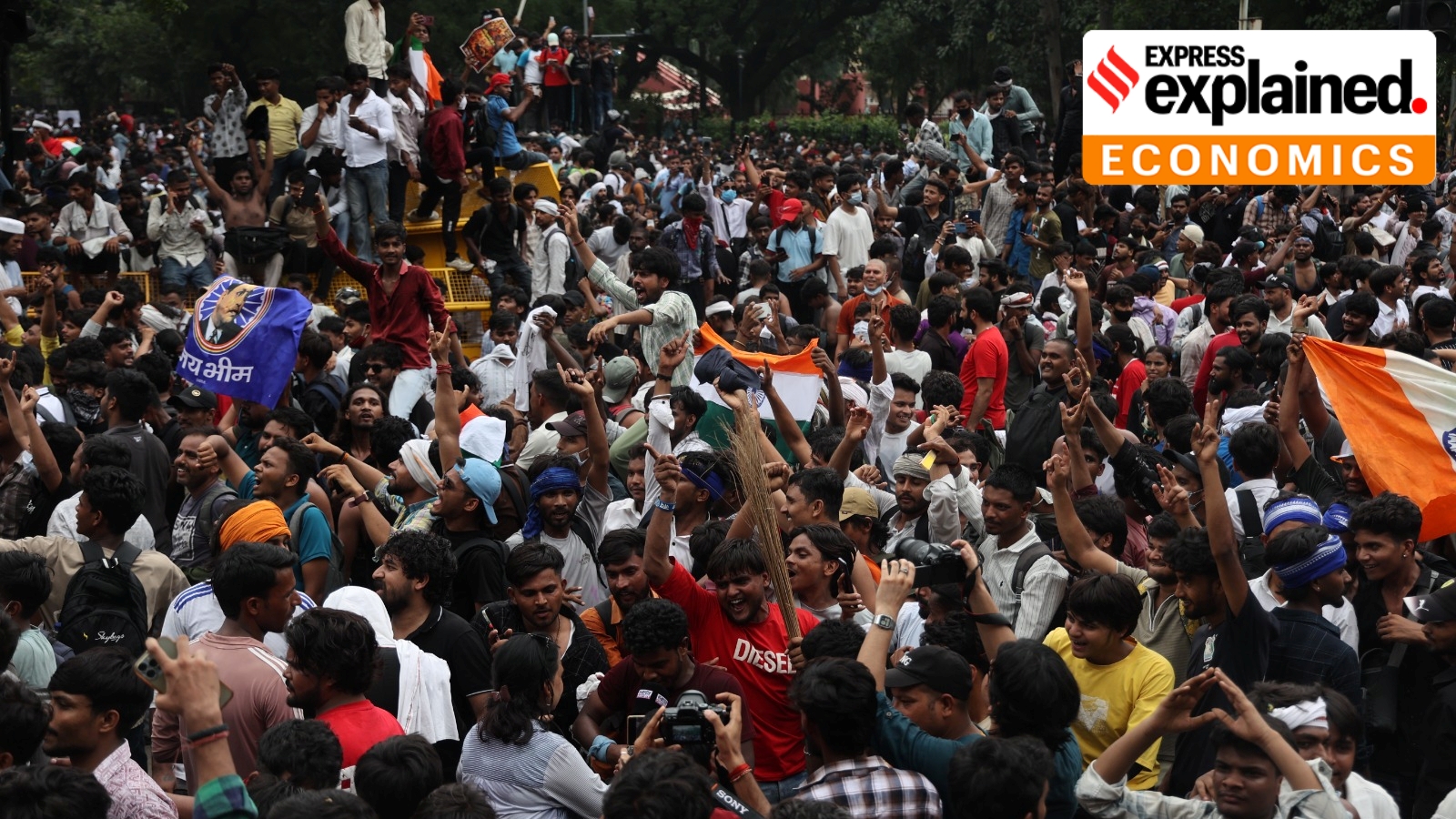
The immediate cause for the rise of the Cockroach Janata Party (CJP) and the nationwide protests may be the leak of the National Eligibility-cum-Entrance Test (NEET) question paper. And while Dharmendra Pradhan has resigned as Education Minister, it does nothing to solve a crucial underlying problem: jobs.
According to Alexandra Hermann Prasa, Lead Economist at Oxford Economics, while the student protests don’t pose much of a risk to the larger Indian economy, they do “expose a deeper jobs problem”.

The government’s flagship employment survey, the Periodic Labour Force Survey (PLFS), shows that the unemployment among Indian youth — those in the 15-29 age bracket — rose to 16.2% in June, as per data released earlier this month. This is the highest on record, although it must be said that monthly PLFS data only goes back until April 2025, when it stood at 13.8%.
To be sure, there might be reasons why the monthly data is volatile. The Ministry of Statistics and Programme Implementation (MoSPI) had cautioned last year that a rise in the unemployment rate did not necessarily reflect “secular trends” as changes were to be expected in the monthly data on account of increased frequency of the survey and seasonal, academic, and labour market factors.
However, this rise in youth unemployment needs to be seen in the context of two other trends.
One, the unemployment rate has increased across all six youth categories for the 15 months for which data is available: males and females at an all-India level, in urban areas, and in rural areas.
Two, youth unemployment has risen despite the Labour Force Participation Rate (LFPR) declining over the same period in all but one category. Only urban males have seen their LFPR rise, standing at 60.1% in June, up 1 percentage point from April 2025.
The overall youth LFPR has fallen to 40.3% from 42.7% over the same period.
To put all these numbers in perspective, the all-India unemployment rate for ages 15 years and above was 5.5% in June as against 5.6% in April 2025. The corresponding LFPR was 54.4%, up from 54.2%.
Why does it matter that the youth unemployment rate has risen while the LFPR has declined?
The LFPR measures the percentage of the population that is looking for work, including those that are employed. So, when the LFPR falls – or when fewer people are looking for jobs – it should ideally result in a lower unemployment rate even if no new jobs are added. But that hasn’t happened.
A long-term problem
While monthly PLFS data only goes back 15 months, annual numbers are available for longer. And they tell a similar story.
Of the 36 states and Union Territories (UTs), the youth unemployment in 2025 was higher than in 2022 for 13 of them. These 13 states and UTs included major regions such as Andhra Pradesh (16.2% from 15.1%), Delhi (14.4% from 5.9%), Telangana (18.1% from 12.6%), and West Bengal (10.6% from 8.4%).
For young women, it has been even more difficult: 16 states and UTs saw an increase in unemployment from 2022 to 2025.
The monthly data is based on the Current Weekly Status (CWS) approach, under which the job status of a person is measured for the seven days preceding the date of survey. Meanwhile, the annual figures are as per the ‘usual status’ approach, which measures the job status for the 365 days preceding the survey.
Even the informal sector is creating fewer jobs now: 74.5 lakh in 2025 compared to 1.1 crore in the 12 months ended September 2024, as per MoSPI’s latest Annual Survey of Unincorporated Sector Enterprises (ASUSE). Wage growth shrunk to 3.9% from 13%.
The education link
It has been ingrained in our psyche that better education leads to better jobs; which is why the youth studies for three more years after 12th to graduate, another couple of years for post-graduation, and so on. But less than 7% of male Indian graduates manage to find a permanent salaried job within a year, according to Azim Premji University’s (APU) State of Working India 2026 report released in March this year.
The figure is an even lower 3.7% when it comes to white-collar jobs. Using data from the PLFS and its predecessor, the Employment Unemployment Survey (EUS), the APU report estimated that 1.1 crore out of 6.3 crore graduates in the 20-29 age bracket were unemployed in 2023.
Of course, graduate youth unemployment is nothing new, with the APU report’s analysis revealing that it stood at 39.33% in 2023, up from 35.02% in 1983, for those less than 25 years of age.
However, what has changed since 1983 is that India is not getting younger anymore – the country’s median age is around 29 years and is expected to increase to 38 by 2050. Now is when those joining the workforce earn and not just prepare safety nets for their own future but drive national economic growth.
“By the 2040s, the dependency ratio will rise, fiscal space will tighten, and each worker will carry greater economic and welfare burdens. Demography will no longer drive growth. Without rapid gains in productivity, innovation, and institutional capacity, progress could begin to stall. India’s growth model must now evolve to secure long-term momentum after its population peaks,” an Observer Research Foundation paper said in March.

