

The Donald Trump administration has announced a fresh set of tariffs as its Section 122 duties expire on July 24. The new tariffs, imposed under the Section 301 probe, see India being levied a reduced tariff rate of 10% as against the proposed 12.5% earlier and are effective immediately.The 10% tariff rate also extends to 16 other economies, including India’s neighbours Bangladesh and Pakistan, and some developed economies like Canada and the United Kingdom. US Trade Representative Jamieson Greer announced the revised tariffs on 60 economies on Thursday, one day before the expiry of the temporary additional 10% duties that had been imposed on imports from all countries.A total of 60 economies were being probed by the Donald Trump administration under the Section 301 probe and a majority of them will now see a 12.5% tariff rate. What is the Section 301 probe? Why was India’s tariff rate reduced from 12.5% to 10% and what does it mean for various sectors? We take a look:
What’s the Section 301 probe?
Section 301 allows the US to investigate imports of goods that have been made using what it defines as ‘forced labour’ and impose tariffs on such goods. When the proposed tariffs were first announced on June 3 under Section 301 of the Trade Act, India had been placed in the category facing a 12.5% levy.
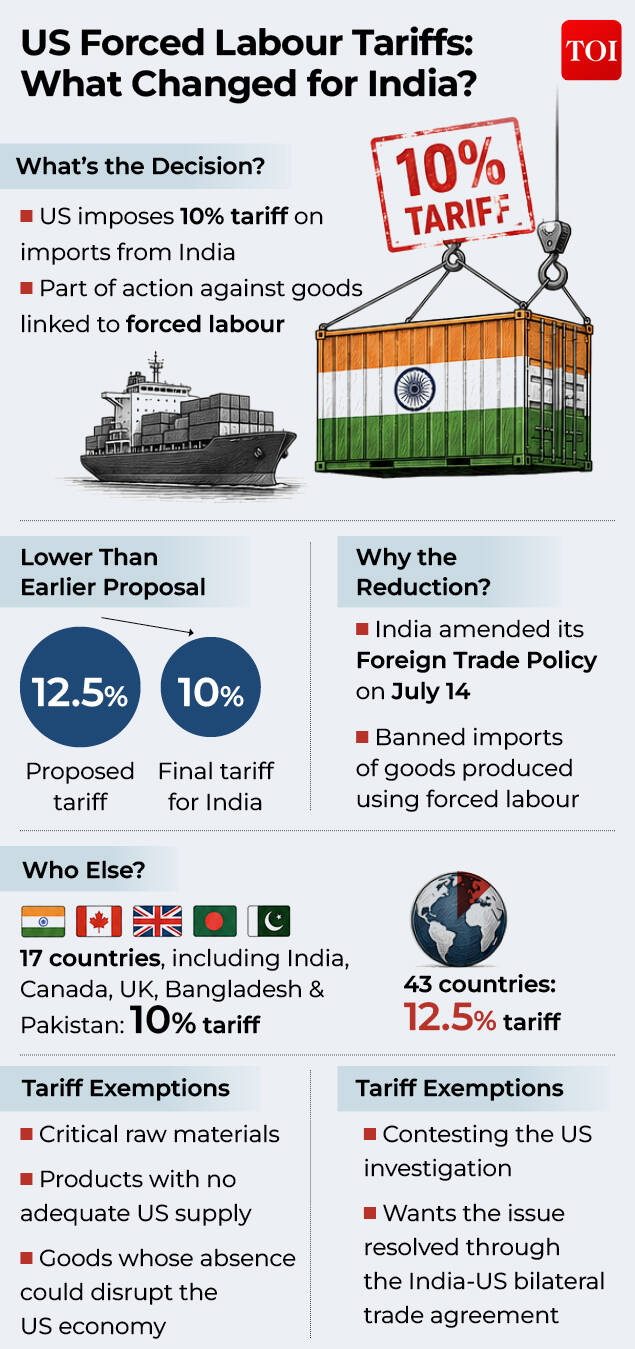
US Forced Labour Tariffs – What Changed for India
Countries that do not have legal provisions banning the import of goods produced using forced labour—including China and Japan—will instead face a tariff of 12.5%.There are some exemptions to the tariffs: They do not apply to raw materials and agricultural inputs that cannot be produced in adequate quantities within the United States. They also exclude products whose taxation could trigger inflationary pressures or disrupt domestic supply chains.Some industrial inputs such as specified plastic resins, metal products and medical supplies, goods that are already covered under Section 232 tariffs, and informational or humanitarian items including books, personal baggage and charitable donations have also been exempted.For imports originating from the European Union, Japan, South Korea, Taiwan and Switzerland, the Section 301 tariff will be calculated on a net-of-MFN basis. This ensures that the combined tariff reaches the prescribed rate instead of adding the entire Section 301 duty on top of the existing Most Favoured Nation (MFN) tariff.
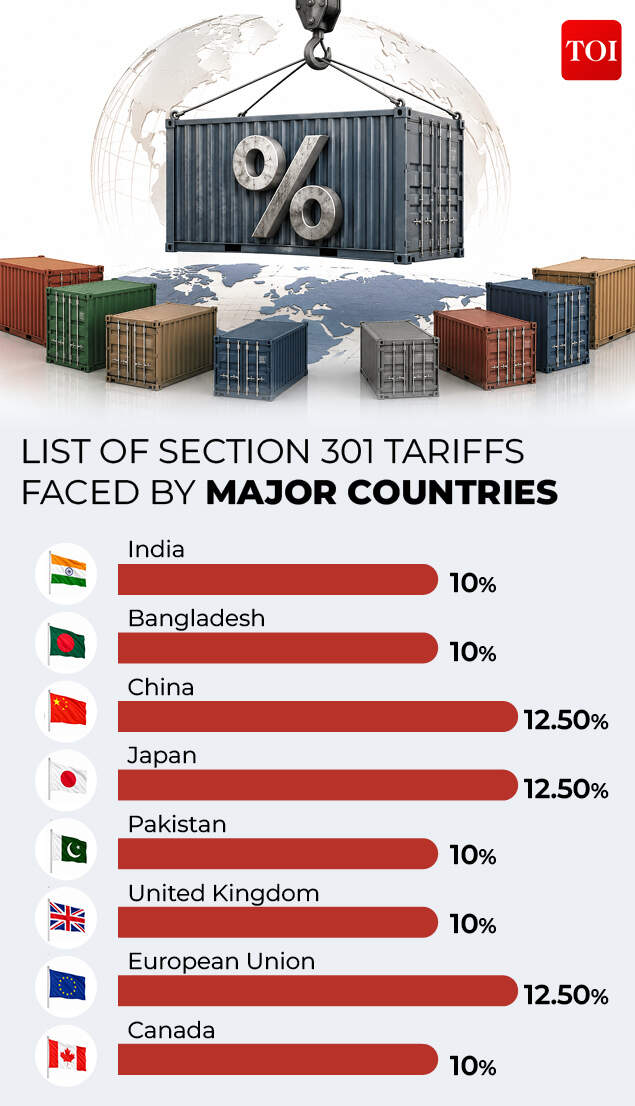
List of Section 301 tariffs faced by major countries
For instance, if an imported product from the European Union already attracts a 3% MFN duty, only an additional 7% Section 301 tariff will be imposed so that the total duty reaches 10%, rather than applying a fresh 10% on top of the existing tariff.Following the latest decision, US tariffs on Indian exports broadly fall into three categories.
- Products covered by Section 232: This includes steel, aluminium, copper, auto components and certain derivative products. According to GTRI, they account for about 8% of India’s exports. They face 25% or 50% tariffs in addition to the normal US MFN duty, says GTRI.
- Second, a limited set of exempted products continues to pay only the normal MFN tariff.
- Third, about 70% of India’s exports – which includes engineering goods, chemicals, machinery, plastics, leather products, gems and jewellery, furniture and most other manufactured goods – these are subject to the 10% Section 301 forced-labour tariff in addition to the applicable MFN duty.
GTRI also notes one important exception: India has not received the textile and apparel tariff-rate quota (TRQ) exemption under the new US Section 301 forced-labour tariff. The exemption applies to specified volumes of textile and apparel exports from Bangladesh, Cambodia, Indonesia, and Malaysia that use US-origin cotton and fiber. These qualifying exports are exempt from the new Section 301 duties.
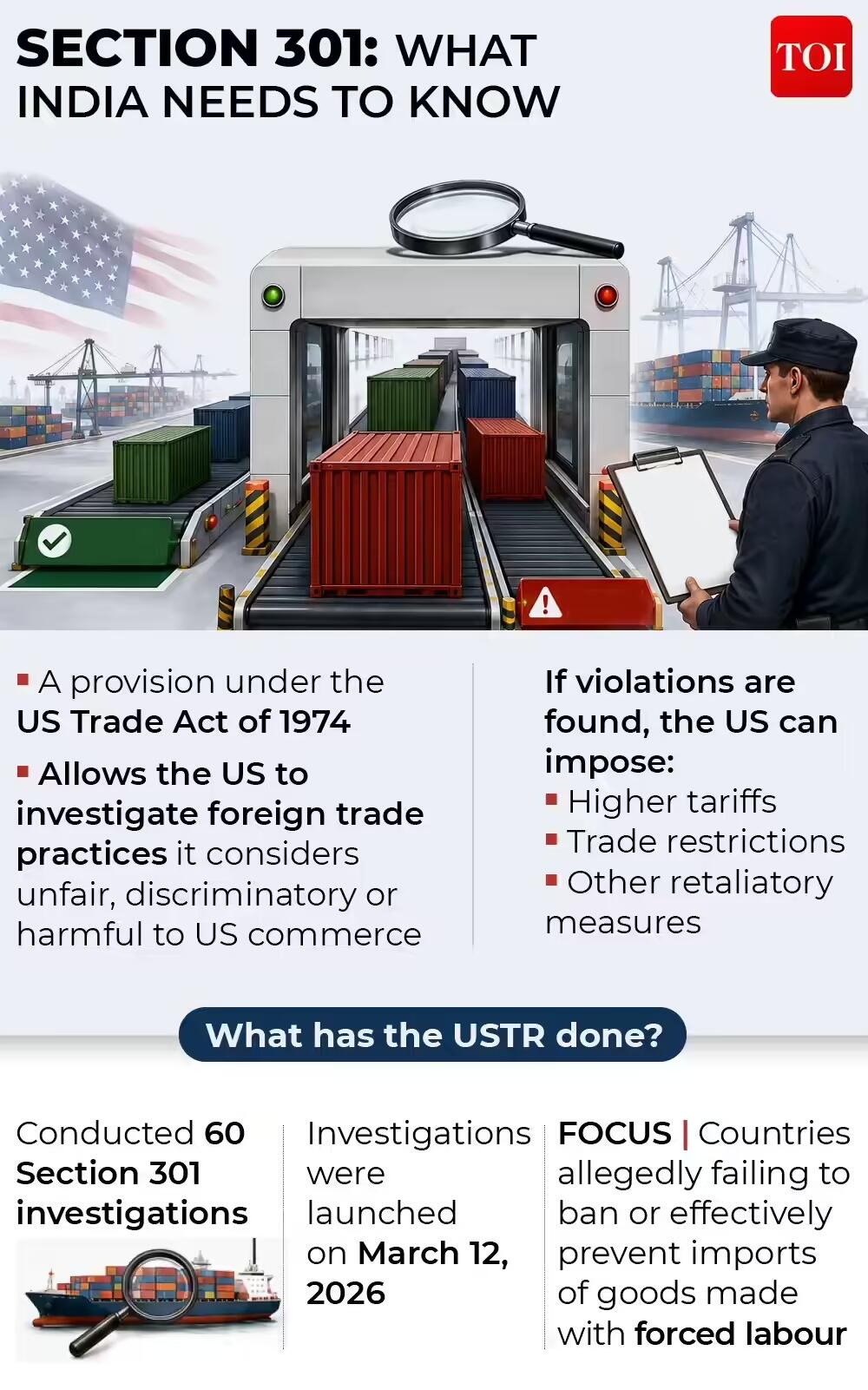
What is Section 301 probe?
Why did the US reduce tariffs on India?
According to an ANI report, the lower tariff rate was secured after productive discussions were held between the two sides on labour practises.Officials told ANI that India had originally been placed in the 12.5% tariff category, but after constructive engagement with the United States on labour practices, the rate was reduced to 10%.A few weeks ago India announced that it has moved to ban imports of goods made with forced labour.According to the US Trade Representative notification: 10 percent is the appropriate rate of Section 301 duties for investigated economies that(i) impose a forced labor import prohibition;(ii) have committed to impose and enforce such a prohibition through an Agreement on Reciprocal Trade;or (iii) have imposed a partial regime with the effect of preventing the importation of certain forced labor goods.GTRI is of the view that India’s notification signalled that it is strengthening its domestic legal framework in line with international standards. The step may have helped strengthen its position in future trade negotiations and market-access discussions.
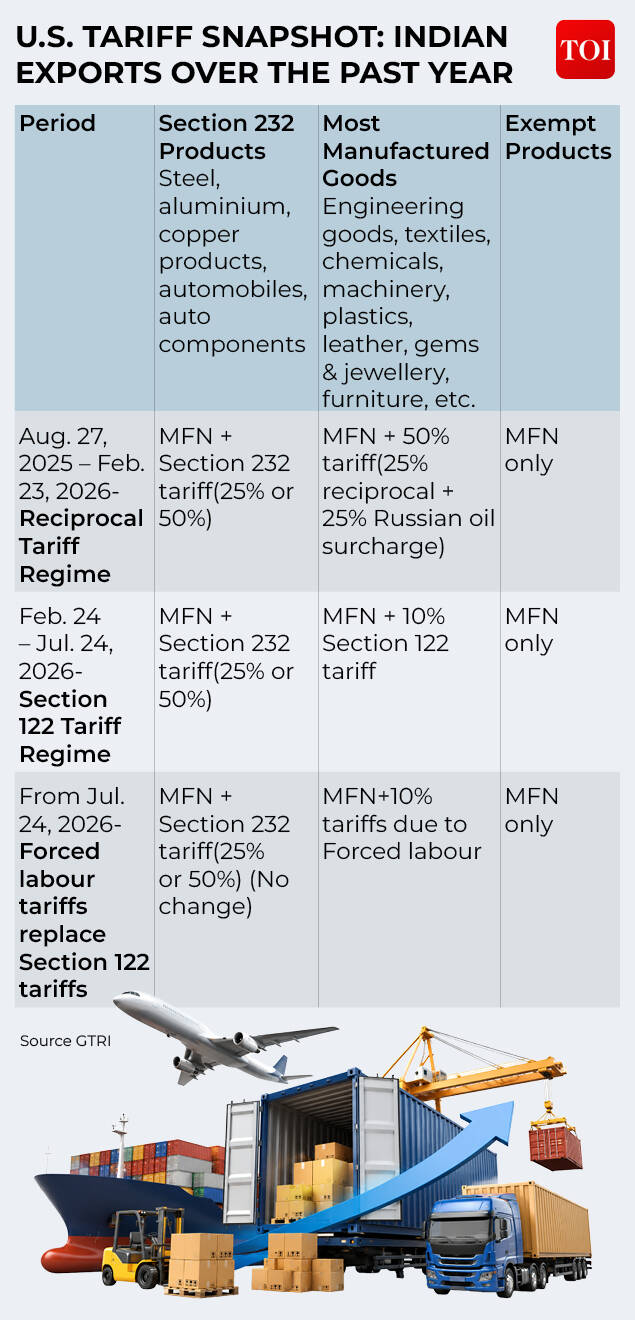
US Tariff Snapshot- Indian Exports Over the Past Year
What do the tariffs mean and which sectors will be impacted?
Experts see limited impact on India due to Trump’s fresh tariffs, and some even expect India to enjoy a relative advantage compared to developed economies which now face 12.5% tariffs.Manoj Mishra, Partner and Tax Controversy Management Leader, Grant Thornton Bharat tells TOI, “The US Section 301 tariffs come into effect as the temporary Section 122 emergency tariffs expire, with India retaining a 10% tariff rate. This places India on par with competing Asian exporters such as Bangladesh, Sri Lanka, Malaysia, Indonesia and Pakistan, while several advanced manufacturing economies including Japan, South Korea, Switzerland, and certain products from the European Union and Taiwan as well as key export competitors such as Vietnam, Thailand and Singapore face an effective tariff of up to 12.5%.”“This relative tariff advantage could enhance India’s competitiveness in sectors such as engineering goods, auto components, electronics, specialty chemicals, pharmaceuticals, medical devices, and textiles and apparel, where even a modest tariff differential can influence sourcing decisions by global manufacturers, retailers and brands,” Mishra explains.“While the additional tariff continues to increase export costs, India’s improved relative position presents an opportunity for businesses to strengthen their presence in global supply chains while reinforcing compliance with evolving labour and ESG standards,” he adds.Ajay Srivastava, founder, Global Trade Research Initiative (GTRI) is of the view that the 10% US tariff on Indian exports under the forced-labour investigation lacks a credible factual basis.“The United States has not produced evidence that India imports goods made with forced labour. In response to US concerns, India has already amended its Foreign Trade Policy to ban the import of goods produced using forced or compulsory labour. Indian law also prohibits forced labour in domestic production through constitutional guarantees and labour statutes,” he says. Srivastava believes that the tariff appears to serve primarily as a mechanism to preserve the Trump administration’s tariff wall after the expiry of the temporary Section 122 tariffs, rather than as a targeted response to a proven forced-labour problem involving India.The GTRI expert also warned that more tariffs could be imposed. “The Trump administration is expected to announce the results of another Section 301 investigation into excess manufacturing capacity, which could lead to additional tariffs on a wide range of industrial products. Washington has also increasingly imposed country-specific tariffs, recently targeting Brazil and Canada. Similar measures could eventually be extended to India citing purchases of Russian oil, or broader geopolitical considerations,” he cautions.

