



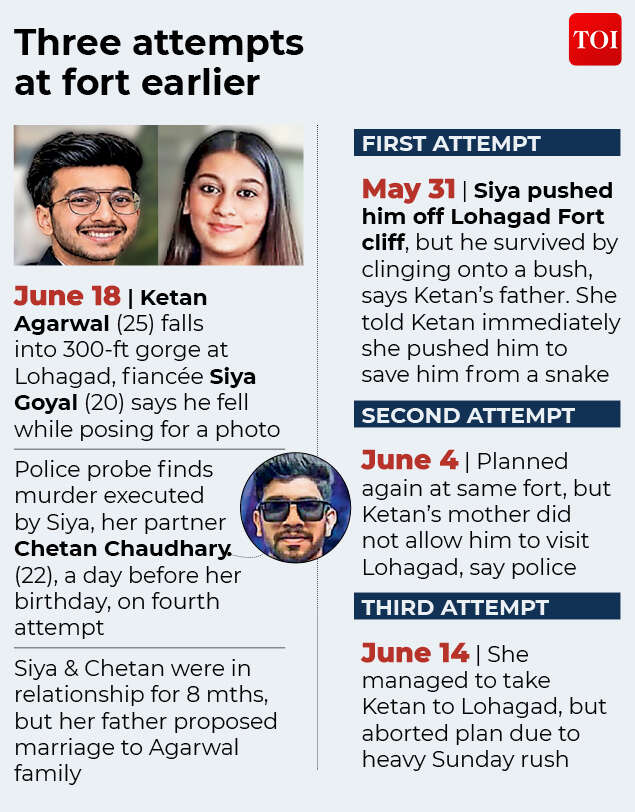
“Innocent until proven guilty”NEW DELHI/PUNE: A young man is dead. His fiancée and her alleged lover are behind bars. Police say it was a carefully planned murder at the edge of a cliff but the allegations remain unproven.As investigators piece together what happened at Lohagad Fort on June 18, the case is shaping up to be a test of one of the oldest principles of Indian criminal law: whether an unbroken chain of circumstantial evidence can prove guilt beyond reasonable doubt.Police have alleged, 20-year-old Siya Goyal and her alleged lover, 22-year-old Chetan Chaudhary, conspired to kill her fiancé, 26-year-old Ketan Agarwal.Both Goyal and Chaudhary are in judicial custody until July 15. A death that became a murder investigationKetan Agarwal, a realtor from Pune, died after falling from Lohagad Fort during what initially appeared to be a trekking accident.According to police, Goyal was unhappy with an arranged marriage and was in a relationship with Chaudhary.Police allege the pair met several times at cafés, rehearsed the crime and even made one unsuccessful attempt before allegedly carrying out the killing.
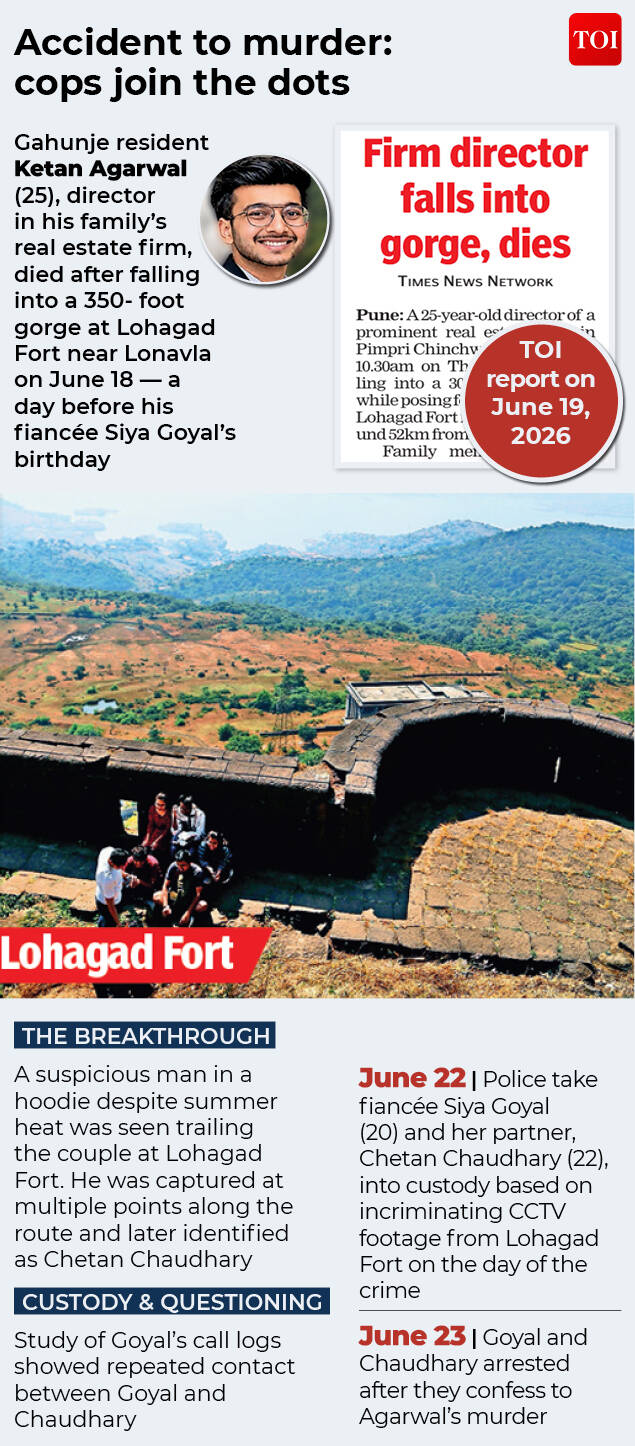
Police have also claimed that Goyal told them during interrogation that killing Agarwal seemed “easier” than telling her family she did not want to marry him.Cops further allege she said she disliked him because he wore a wig and did not want to upset her parents by calling off the wedding.These statements were made during interrogation.Under Indian law, however, a confession made to police is generally not admissible as evidence against an accused person.Unless it leads to the discovery of new evidence or is voluntarily recorded before a magistrate, it cannot by itself form the basis of a conviction.That means investigators must rely on independent evidence to prove their case.
The legal hurdleUnlike cases involving eyewitnesses or direct forensic proof, the Lohagad investigation appears to rest largely on circumstantial evidence.That evidence may include mobile phone records, CCTV footage, location data, digital communication, clothing, forensic findings and the conduct of the accused before and after Agarwal’s death.But courts have repeatedly held that suspicion, however strong, cannot replace proof.Instead, prosecutors must satisfy what courts often describe as the “Panchsheel” or the five golden principles governing convictions based solely on circumstantial evidence.These principles, laid down by the Supreme Court in Sharad Birdhichand Sarda v. State of Maharashtra (1984), require that:
- Every incriminating circumstance must be fully established.
- The proved facts must point only to the guilt of the accused.
- The circumstances must be conclusive in nature.
- Every reasonable alternative explanation consistent with innocence must be excluded.
- The chain of evidence must be complete, leaving no reasonable doubt that the accused committed the offence.
In practical terms, investigators must prove not only that Goyal and Chaudhary had a motive, but also that they planned the crime, were present at the scene, had the opportunity to commit it and that Agarwal’s death could not reasonably have occurred through an accident or any other explanation.The ‘chain’
- Police have spoken about alleged planning meetings, phone records and rehearsals.
- Each of those claims, however, will need to be supported by admissible evidence.
- A relationship may establish motive, but motive alone does not prove murder.
- Location data may place suspects together, but that alone does not establish conspiracy.
- Similarly, CCTV footage or digital chats may strengthen the prosecution’s case only if they collectively point towards one conclusion—that Agarwal was intentionally pushed rather than slipping, jumping or losing his balance.
- The precise location from which Agarwal fell could therefore become a crucial part of the trial.
- If forensic experts conclude that the terrain, injuries and physical evidence are inconsistent with an accidental fall, it could significantly strengthen the prosecution’s case.
- If reasonable doubt remains, the chain may be considered incomplete.
Lesson from the Aarushi Talwar caseFew criminal cases illustrate the importance of circumstantial evidence more dramatically than the 2008 Aarushi Talwar-Hemraj double murder.Thirteen-year-old Aarushi Talwar was found dead in her bedroom in Noida on 16 May 2008. The following day, the body of the family’s domestic worker, Hemraj Banjade, was discovered on the terrace of the same house.The investigation quickly became one of India’s most scrutinised criminal cases.The Central Bureau of Investigation (CBI) eventually accused Aarushi’s parents, Rajesh and Nupur Talwar, arguing that they had killed both victims inside their home and attempted to destroy evidence.The case was based almost entirely on circumstantial evidence.In 2013, a trial court convicted the Talwars and sentenced them to life imprisonment. Four years later, the Allahabad high court overturned the conviction.The high court held that the prosecution had failed to establish a complete and unbroken chain of circumstances.It found significant gaps in the investigation, criticised several assumptions made by investigators and concluded that multiple circumstances relied upon by the prosecution had not been proved beyond reasonable doubt.What happens nextFor Pune Rural Police, the challenge now extends beyond making allegations.Investigators will have to translate every claim into evidence capable of surviving judicial scrutiny.If the prosecution argues that Siya Goyal was unhappy with the marriage, it must prove that dissatisfaction formed part of a murder conspiracy.If it alleges planning through meetings and rehearsals, those claims will require corroboration through witnesses, digital records or other admissible evidence.Phone records, chats, CCTV footage, forensic analysis and expert testimony will all need to fit together into a single, uninterrupted narrative.Ultimately, the trial may come down to whether prosecutors can eliminate every reasonable possibility except one: that Ketan Agarwal did not accidentally fall from Lohagad Fort but was deliberately pushed.Until then, the allegations remain just that—allegations awaiting proof in court.

