

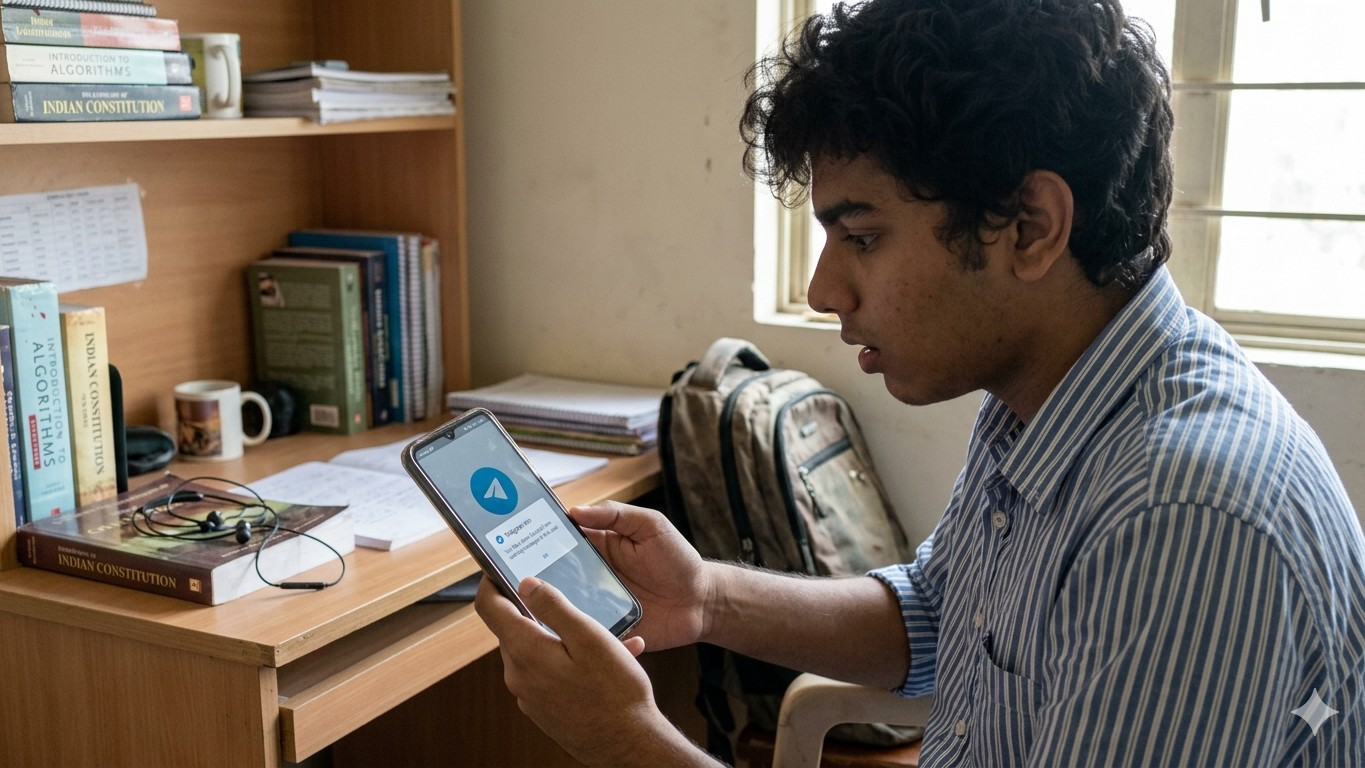
The Ministry of Electronics and Information Technology has blocked messaging app Telegram in India till June 22, and a direction has been issued to the platform to disable the message editing feature in India till June 30. The move is on account of the NEET-UG 2026 retest that will be held on June 21.
Welcoming the action against Telegram, NTA said in its statement: “The directions, issued on recommendations of NTA are calibrated and bounded in time: (a) a direction under Section 69 A of the Information Technology Act, 2000, restricting access to the Telegram platform in India for a defined and limited period ending 22 June 2026, covering the day of the NEET (UG) 2026 re-examination and its immediate aftermath; and (b) a direction requiring the platform to disable, in India, the message-editing feature in respect of messages already posted, for a defined period ending 30 June 2026, addressing the specific structural feature through which the platform has been used to fabricate after-the-event ‘paper leak’ evidence in respect of national examinations.”
The NTA added that the move will go a long way in helping the Agency to conduct a safe and secure exam on June 21.
“Throughout the period leading up to the present action, the Indian Cyber Crime Coordination Centre (I4C), under the Ministry of Home Affairs, has served as the principal nodal agency coordinating the operational response to the Telegram-based fraud and misinformation targeting NEET (UG) 2026 candidates. Acting on inputs received continuously from NTA, from State law-enforcement agencies including the police forces of Bihar, Gujarat and Rajasthan, and from its own continuous monitoring of public channels and platforms, I4C has secured the prompt take-down of a substantial number of Telegram channels, groups and bots whose names and content openly advertised their fraudulent and misleading purpose,” the NTA added.
Story continues below this ad
Also Read | NTA grants extra time, more space for rough work in booklet
The NTA referred to the directions issued as “a measure of last resort, taken only after intermediate remedies, including the take-down action coordinated by I4C, had been pursued and had not produced, at the platform level, the response required to protect candidates in the run-up to the examination.”
Channels on Telegram have been operating under names like- “PAPER LEAKED NEET”, “Re-NEET 2026”, “Private Mafia”, “REE NEET MAFIAA” — and have “demanded sums ranging from a few thousand to several lakhs of rupees from candidates and their families, in exchange for purported access to the re-examination paper”, the NTA statement said, adding that these sort of promises are “in every instance, a fraud”.
Channels operating under self-descriptive names openly solicited desperate students and their families, demanding sums ranging from a few thousand to several lakh rupees in exchange for purported access to the re-examination question paper.
Story continues below this ad
NTA has categorically stated that no such paper exists outside the secured examination chain, and that every such promise is, without exception, a fraud designed to extort money from anxious aspirants.
The fake paper leak trick
The modus operandi, as documented by NTA, works as follows: a channel administrator posts an innocuous message before the exam. After the exam is conducted and the actual question paper becomes publicly available, the administrator edits that old message to insert the real question paper — crucially, while retaining the original timestamp. The fabricated chat is then circulated virally as “proof” that the paper was leaked before the exam, causing public panic and undermining the credibility of the examination process.
The MeitY direction to disable the editing feature is designed to close this post-examination window of fabrication.
NTA acknowledged in statement that the access restriction will affect lakhs of ordinary citizens who use Telegram for legitimate personal, educational, and professional purposes. The agency clarified that the block is strictly temporary, ending the day after the exam on June 22. The feature-level direction on message editing, which extends to June 30, does not affect the ability to send or receive new messages on the platform.

