


UPSC Essentials brings to you its initiative for the practice of Mains answer writing. It covers essential topics from both the static and dynamic portions of the UPSC Civil Services syllabus across various GS papers. The questions are carefully selected on the basis of their relevance to the UPSC examination and current developments, helping aspirants focus on themes that matter most for Mains. This answer-writing practice is designed as a value addition to your UPSC CSE Mains preparation. Attempt today’s GS-1 questions and check your progress.
🚨Click Hereto read the UPSC Essentials magazine forMay 2026.Share your views and suggestions in the comment box or at manas.srivastava@indianexpress.com🚨

QUESTION 1
What were the key provisions of the June 3 Declaration (Mountbatten Plan)? Why was it accepted by both the Indian National Congress and the Muslim League?
QUESTION 2
Cloudbursts have emerged as a recurring climate-related hazard in India’s mountainous regions. What are cloudbursts? Explain why they occur predominantly in mountainous regions. Discuss their impact and suggest measures to reduce disaster risks associated with them.

QUESTION 1: What were the key provisions of the June 3 Declaration (Mountbatten Plan)? Why was it accepted by both the Indian National Congress and the Muslim League?
Relevance: The June 3 Declaration was a crucial milestone in India’s transition from colonial rule to independence and Partition. It provides insight into constitutional developments, communal politics, and the process of decolonisation in Modern Indian History.
Note:This is not a model UPSC answer. It only provides you with a thought process which you may incorporate into the answers.
Introduction:
Story continues below this ad
— When Lord Mountbatten arrived in Delhi on March 22, 1947, to assume office as Viceroy, he carried a clear mandate from British Prime Minister Clement Attlee: power was to be transferred to Indian hands no later than June 30, 1948.
— He entered a country already gripped by escalating communal violence. The Calcutta killings of August 1946 had been followed by riots in Noakhali and Bihar, while tensions had spread to Bombay and other parts of the country. Punjab was also descending into conflict, with major outbreaks of violence in Amritsar, Taxila, and Rawalpindi.
Body:
You may incorporate some of the following points in your answer:
The June 3 Declaration (Mountbatten Plan), issued on June 3, 1947, laid the groundwork for the partition of British India and the transition of power away from British administration. Its key provisions were:
Story continues below this ad
— The proposal recognised the division of British India and cleared the path for the formation of two separate states: India and Pakistan.
— The Legislative Assemblies of Punjab and Bengal were to vote on whether their provinces should remain united or be divided.
— The Sindh Legislative Assembly was granted the authority to decide whether Sindh should join India or Pakistan.
— Referendums were scheduled for the North-West Frontier Province (NWFP) and the Sylhet region to determine their future membership.
Story continues below this ad
— If Punjab and Bengal were partitioned, a Boundary Commission would be formed to define the borders of the two new dominions.
— The plan called for the establishment of two independent dominions: India and Pakistan, each with its own Constituent Assembly.
— The princely states were obliged to join either India or Pakistan.
— The transfer of power, which was originally scheduled for June 1948, was moved to August 15, 1947.
How did the rival parties agree?
Story continues below this ad
— Several factors led the Indian National Congress to accept the June 3 Plan. The desire to contain the spiralling communal violence that had engulfed large parts of the country. Congress leaders believed that only a swift transfer of power to an Indian government could restore order and halt bloodshed.
— Congress was also determined to avoid the fragmentation envisaged in Mountbatten’s earlier “Plan Balkan”, whereby each province of India could opt to join the existing constituent assembly, group to form a new one or stand apart from either.
— For the Muslim League, conversely, acceptance of the June 3 Plan guaranteed the creation of Pakistan, the fulfilment of its central political objective. Led by Jinnah, the League feared that Muslims would be politically marginalised in a united, Hindu-majority India. Partition, therefore, offered what it saw as a clear and definitive path to political self-determination.
Conclusion:
— While the decision to partition India had become final, several crucial questions remained unresolved, including whether people would be required to migrate, where the borders would be drawn, and which districts would be allocated to Pakistan or remain with India.
Story continues below this ad
— In the days following the announcement, journalists repeatedly questioned Lord Mountbatten about the possibility of large-scale migration resulting from the plan. When asked whether he foresaw a mass transfer of population, Mountbatten replied that he personally did not anticipate such an outcome.
— However, the tragic consequences of Partition soon became evident. In the weeks that followed, large parts of the subcontinent were engulfed in violence, leading to one of the largest mass migrations in human history.
(Source: Mountbatten Plan at 79: How the June 3 Declaration redrew the subcontinent)
Points to Ponder
How did the Mountbatten Plan differ from earlier constitutional proposals, such as the Cabinet Mission Plan?
What provisions were made regarding the division of provinces and princely states?
Related Previous Year Question
“In many ways, Lord Dalhousie was the founder of modern India.” Elaborate. (2013)
QUESTION 2: Cloudbursts have emerged as a recurring climate-related hazard in India’s mountainous regions. What are cloudbursts? Explain why they occur predominantly in mountainous regions. Discuss their impact and suggest measures to reduce disaster risks associated with them.
Relevance: Cloudbursts are increasingly linked to extreme weather events, disaster vulnerability, and climate change impacts in India. Recent incidents in the Himalayas and Western Ghats have highlighted the need for resilient infrastructure and disaster preparedness.
Note:This is not a model UPSC answer. It only provides you with a thought process which you may incorporate into the answers.
Introduction:
— A cloudburst is a localised but intense rainfall activity. It is a short-term extreme precipitation that takes place over a small area; it is not, as is sometimes understood, the breaking open of a cloud resulting in the release of huge amounts of water.
— The India Meteorological Department (IMD) defines cloudburst as unexpected precipitation exceeding 100mm (or 10 cm) per hour over a geographical region of approximately 20 to 30 square km. Significant amounts of rainfall such as this can result in floods.
— Recently, multiple cloudbursts in Jammu and other hilly states led to loss of lives, hours-long traffic blockages and disrupted normal life, prompting the administration to sound an alert.
Body:
You may incorporate some of the following points in your answer:
— Cloudbursts do occur on plains, but they are more likely to occur in mountainous areas, owing to three major factors: the wind pattern, the height of the mountains, and the degree of moisture and humidity in the air.
— Cloudbursts are more common in mountainous places due to a phenomena known as ‘orographic lift’, which is simply warm air rising up the side of a mountain. Warm air ‘climbs’ a mountain and expands due to low pressure at higher altitudes. The expanding air cools, releasing the moisture it had stored as rain.
How do cloudbursts trigger flash floods?
— In the mountains, the formation of low-pressure areas at the summit attracts clouds with great intensity, exacerbating the buildup. Additionally, when air from the opposite direction collides with the mountain, it can cause a torrential downpour. This is why the height of the mountain is important in this case. The air cannot pass through the mountain.
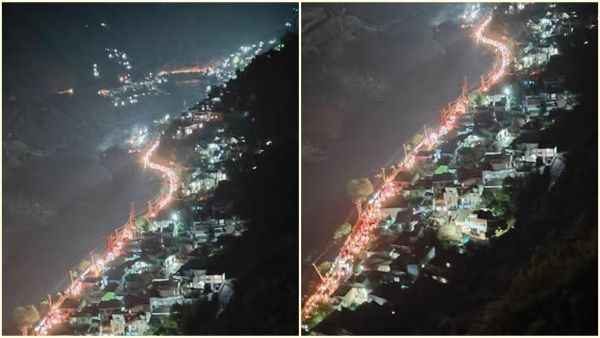 A massive traffic jam at the Thathri area on Tuesday night following a cloudburst.
— In India, flash flooding is frequently related with cloudbursts. Cloudbursts occur in specific places and are difficult to accurately record. The abrupt rain produced by a cloudburst can swiftly overwhelm drainage systems, resulting in flash floods and landslides.
— Flash floods are frequently accompanied by landslides, which are abrupt movements of rock, boulders, earth, or debris down a slope. It is frequent in mountainous areas where the soil, rock, geology, and slope are conducive to it. Himalayan states also face the difficulty of overflowing glacial lakes caused by glacier melting, the number of which has been increasing in recent years.
Conclusion:
— The India Meteorological Department (IMD) is reportedly stepping up initiatives to fill information gaps as well as make maximum use of data.
— The task of shielding people from the effects of extreme rainfall is, however, too enormous to be left to the IMD. Saving lives in fragile ecosystems will require coordination between the met office, scientists, planners, and local, state, and national-level authorities. For starters, detailed maps of cloudburst-prone zones that use historical data and satellite imagery could guide land-use plans. They could ensure construction and developmental activities are carefully regulated and climate-proofed in high-risk areas. It’s an imperative that cannot be postponed.
— In the mountains, land-use planning must prioritise the preservation of forests and natural buffers that minimise landslides and stabilise slopes. Reforestation and afforestation programs should be expanded, especially in areas prone to erosion. These measures increase the resilience of local ecosystems and communities, helping them withstand climate change shocks.
(Source: Hours-long traffic jams, muddy water in houses: Cloudbursts put 2 Jammu and Kashmir districts on alert, UPSC Issue at a Glance | Uttarkashi Cloudburst: What UPSC aspirants must-know for Prelims and Mains)
Points to Ponder
What measures can reduce the impact of cloudburst-induced disasters in vulnerable regions?
What is the relationship between cloudbursts, flash floods, and landslides?
Related Previous Year Questions
What are Tsunamis? How and where are they formed? What are their consequences? Explain with examples. (2025)
What is the phenomenon of ‘Cloudbursts’? Explain. (2024)
Previous Mains Answer Practice
UPSC Essentials: Mains answer practice — GS 3 (Week 156)
UPSC Essentials: Mains answer practice — GS 3 (Week 157)
UPSC Essentials: Mains answer practice — GS 2 (Week 156)
UPSC Essentials: Mains answer practice — GS 2 (Week 157)
UPSC Essentials: Mains answer practice — GS 1 (Week 156)
UPSC Essentials: Mains answer practice — GS 1 (Week 155)
Subscribeto ourUPSC newsletterand stay updated with the news cues from the past week.
Stay updatedwith the latestUPSC articlesby joining ourTelegram channel–IndianExpressUPSC Hub, and follow us onInstagramandX.

