

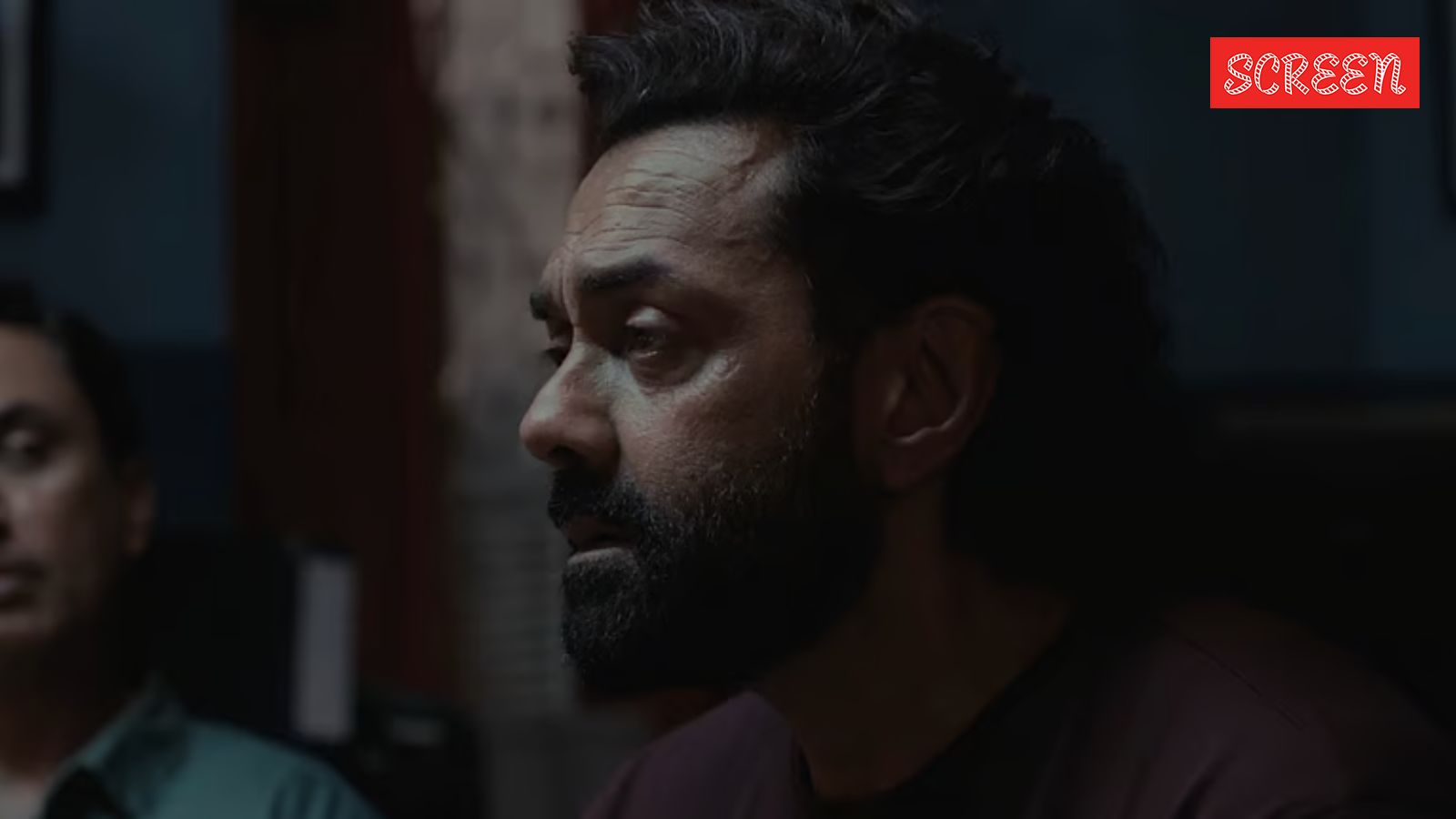
Few filmmakers have pursued the question of masculinity with the persistence of Anurag Kashyap. Across his body of work, manhood is not necessarily a settled condition but more so a site of conflict. His cinema is drawn less to masculine authority than to its insecurities, less to its performance than to the cracks that threaten to undo it. He has repeatedly, urgently, and, rather angrily, traced the uneasy relationship between manhood and power. His protagonists may possess the physicality for battle, yet they often find themselves defeated by institutions far larger than themselves. In Dev.D, he dismantles the vanity and self-mythologising of a privileged man consumed by his own image. In Gulaal, a timid law student becomes the vessel through which wounded masculinity is weaponised. In Mukkabaaz, a lower-caste boxer enters the ring not in pursuit of victory but in defence of his dignity. And, now, with Bandar, starring Bobby Deol in the titular role, Kashyap, once again, returns to a terrain he knows intimately.
So, we meet Samar, (Deol), a man suspended between adulthood and adolescence. He is, to put rather simply, a man-child. He is ageing, yet emotionally juvenile. He is moving through time, but unable to leave the past behind. He lives under the care of a caretaker (who refers to him as baba). He lacks the maturity to handle relationships like an adult. Once a television star, he now moves through the trash of faded fame, endlessly swiping through dating apps in search of some validation. Samar’s broken spine functions as more than a physical ailment. It becomes a metaphor for a man whose sense of self has collapsed under the burden of his own contradictions. But he continues to perform masculinity with determination, wandering around in his superman boxers, shirtless, photographing his biceps for prospective dates, clinging to a version of himself that no longer exists or ever even existed. From the very moment he appears on screen, there is a sense of inevitability to his decline.

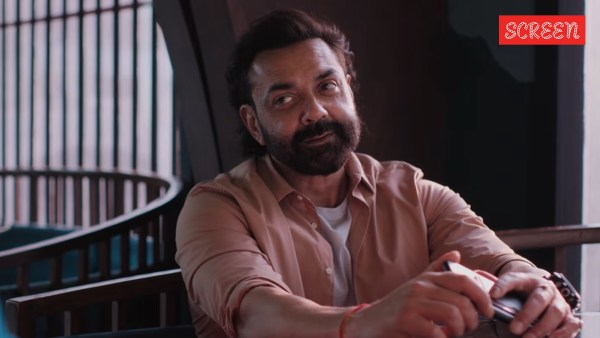 Bobby Deol in a still from Anurag Kashyap’s Bandar.
And what a fall. He quite literally becomes a monkey in a cage, reduced to a spectacle and forced to dance to the whims of those who wield power. One of the film’s most intriguing moments arrives when, suffocating beneath a black mask, Samar recalls an earlier moment when he had fantasised about choking his partner during sex. The juxtaposition is telling. What is more telling, however, is the altar at which Samar’s downfall is staged. By the time Bandar ends, it wants us to look at him not simply as a fool or a victim of his own making, but with a great degree of sympathy. Yet that sympathy is built on a narrative choice that remains difficult to ignore: Samar’s descent begins with a false rape accusation. The question is not one of plausibility but of representation.
In a world which is still negotiating the meanings of consent, of sexual violence, why must a woman’s accusation become the vehicle through which a man’s tragedy is articulated? The discomfort lies in the symbolic economy of the film: female agency enters the narrative primarily as the condition for male victimhood. As a consequence, the film’s exploration of masculine vulnerability acquires a troubling asymmetry. It grants Samar psychological depth while relegating the politics of sexual violence to a simple narrative device. In fact, after a point, a film that begins as an entry point into the architecture of male entitlement gradually becomes a story about the humiliations men endure once accused of rape, within the violence of the prison system and in the social world beyond it. There is nothing inherently problematic about such a turn. The issue again lies in the terms on which it is achieved.
Also Read | In Kennedy, Anurag Kashyap returns to the existential interior, creating his most personal film since Ugly
The complainant is dismissed as a “stalker,” who is supposedly incapable of reconciling herself to rejection. Her subjectivity is not examined so much as explained away. What could have been a complex moral encounter is ultimately resolved through a far simpler binary. In this regard, one is reminded of Assi by Anubhav Sinha, a film that attempted to inhabit conflicting positions without rushing towards moral certainty, allowing contradiction and discomfort to coexist. One expects a similar intellectual rigor from Kashyap and from screenwriters Sudip Sharma and Abhishek Banerjee. One expects them to resist constructing one subjectivity at the expense of another, to recognise that complexity is not a finite resource to be allocated selectively.
But that promise remains unrealised. While Samar is forced to face the consequences of undermining a woman’s self-respect, the tonality, however, quickly descends into self-pity. So, as the film unfolds, the thornier questions of power, consent and perception slowly fades into the background. What remains is, in essence, a prison drama (alongside a coming-of-age of Samar), sporadically compelling, one that occasionally evokes Michel Foucault and his observations on modern systems of punishment. In Discipline and Punish, Foucault argued that contemporary power no longer seeks to discipline the body; it instead seeks to inhabit the soul. Punishment becomes less a spectacle of physical suffering than a condition of existence. It is difficult not to think of this while watching Samar navigate prison alongside other men accused of rape, occupying a peculiar rung within the carceral hierarchy, themselves vulnerable to the authority of those convicted of murder. Their guilt or innocence becomes peripheral.
Story continues below this ad
Watch the full episode of Cult Comebacks with Anurag Kashyap here:
In these moments, the prison begins to resemble an allegory for contemporary forms of public condemnation, of cancel culture, where judgment often arrives long before certainty. This is Anurag Kashyap’s anti-establishment impulse at its most recognisable. (The film finds one of its strongest moments in the second half with Pinjara, an electrifyingly picturised song that finds Amit Trivedi at the top of his game. Moreover, the casting of Aamir Aziz as a jail inmate, who previously collaborated with Kashyap on Kennedy, adds an intriguing subtextual layer, perhaps serving as an allegory for political prisoners who find themselves wrongfully incarcerated.) Yet the old question continues to persist: why must all these arguments be staged through the terrain of a false rape accusation? Why must a subject already so politically and ethically fraught become the scaffolding for a broader argument about punishment and exclusion? One cannot help but wonder if the film, in its determination to provoke, gradually slips into a kind of paranoia. In seeking to expose the cage, it ends up trapped within one of its own making. Like the monkey of its title, it rattles furiously against the bars, only to remain imprisoned by the parochialism it never quite transcends.

