

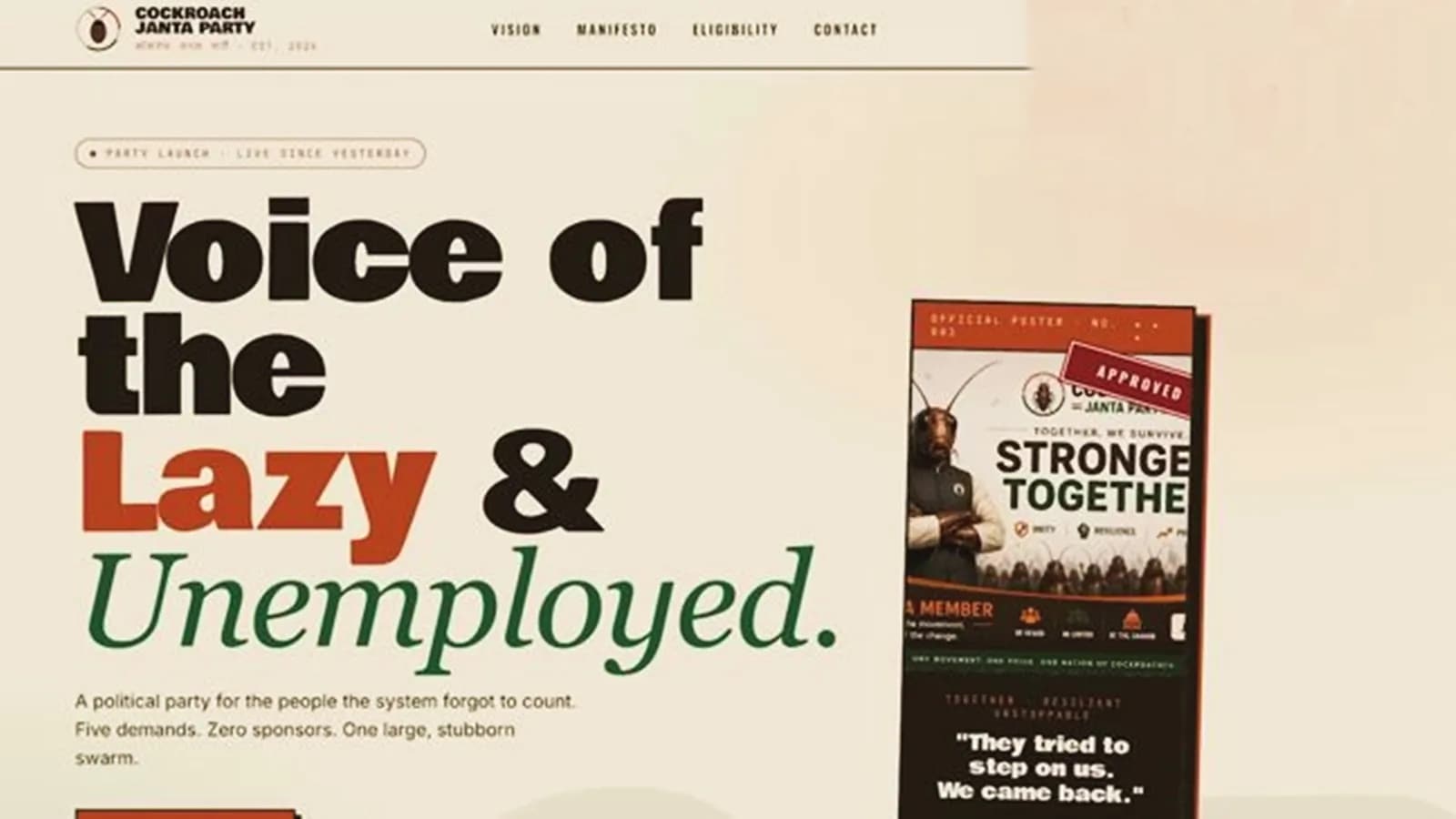
In today’s India, an Instagram account can become politically influential faster than a political movement can cross a district on foot or bicycle. A meme can travel farther than a manifesto. A reel can reach more people in an hour than months of ground mobilisation. That contrast says something important about the political culture we are entering.
Last February, in the eastern Uttar Pradesh district of Deoria, a Gen Z youth named Jai Maurya was cycling across villages for MGNREGA workers. Now, social media is flooded with discussions around the Cockroach Janta Party, an online phenomenon that rapidly gained visibility among young Indians. Its follower count grew at an astonishing speed. Citing national-security concerns, the Intelligence Bureau has got its account on X withheld in India. The two developments belong to different worlds. One emerged from the internet, the other from the road. Yet placing them side by side reveals an important shift in how politics is increasingly experienced by young Indians.

When I later watched Jai’s video, something stayed with me. The veins in his neck were stretched with exhaustion. His breathing was uneven. There was no dramatic soundtrack, no carefully edited frame, no influencer-like performance. He was not acting for a screen. He was carrying politics on his body.
That difference feels significant today.
The concern is not that young people are angry. India faces unemployment, expensive education, rising living costs and growing uncertainty about the future. Political frustration among the youth is neither surprising nor illegitimate. The more important question is what forms this anger now takes, what ideological direction it acquires, and whether digital politics is encouraging participation or merely visibility.
Jai belongs to the first educated generation in his family. His father is a welder. His mother ran a small general store to pay his fees. Jai would return from school and help at the family shop. This is also the story of caste, class and inherited privilege. Some inherit confidence, language and networks. Others inherit labour and responsibility.
Jai was not alone. Fifteen young people, all university graduates and all part of Gen Z, led this month-long cycle yatra. You may not know that economist Jean Drèze cycled with them for part of the route. You may not know that these young people travelled nearly 1,200 kilometres across eastern UP between January and February 2026, moving through Chauri Chaura, Gorakhpur, Deoria, Ballia, Mau, Ghazipur and finally Varanasi. Every day, they cycled between 25 and 35 kilometres and spoke to workers in several villages. Local political workers often arranged food. They sat in chaupals, discussed migration, delayed wages and rural employment. Their yatra also had an Instagram account. In one month, it gained barely 500 followers. But the participants did not seem especially disturbed by that.
And perhaps that is the larger political question of our time: Has the algorithm become the final judge of political relevance? Does a struggle stop mattering because it does not trend? Is a movement unsuccessful because it cannot become a reel?
The German philosopher Theodor Adorno once warned that modern media could gradually transform politics into entertainment. That observation feels unexpectedly contemporary.
Every political emotion now has to adapt to the logic of the screen. A slogan must become visual. A protest must become instantly shareable. Social-media platforms reward outrage and speed. The problem is not technology itself. The problem is when politics becomes entirely shaped by the logic of visibility.
Following an account begins to feel like political participation. But democracy requires more than watching, liking and sharing. It requires involvement. It requires discomfort. Sometimes it even requires sacrifice. A few days after this yatra ended, 14 Gen Z students from JNU were sent to Tihar Jail after taking out a march demanding a safer campus. They were later released after court intervention.
What connects these young people is not just anger. It is ideology. This is where inequality becomes important. Can the son of an agricultural labourer spend hours online building a digital movement? He may not have stable internet, free time or confidence in English-speaking online spaces. He may be working in the fields while someone else makes reels. Only those who can remain visible online are seen. But huge parts of India remain invisible, in fields, factories, railway stations, brick kilns, coaching centres and rented rooms.
Much of today’s anti-establishment politics depends on giant corporate platforms like Instagram, Meta and X. Political emotion is shaped through systems driven by engagement and profit.
This is why difficult political questions often disappear beneath digital excitement. What does a movement think about caste? About labour rights? About economic inequality? About minorities?
India is too unequal and too socially complex for democracy to survive only online. The internet can spread information and connect people, but it cannot replace roads, village meetings, workers’ gatherings and public conversations.
Because democracy is still built through physical effort. It is still built through walking, listening, arguing and organising. The road still matters in politics.
The writer is producer, Indian Express Hindi. shashwat.upadhyay@indianexpress.com

