

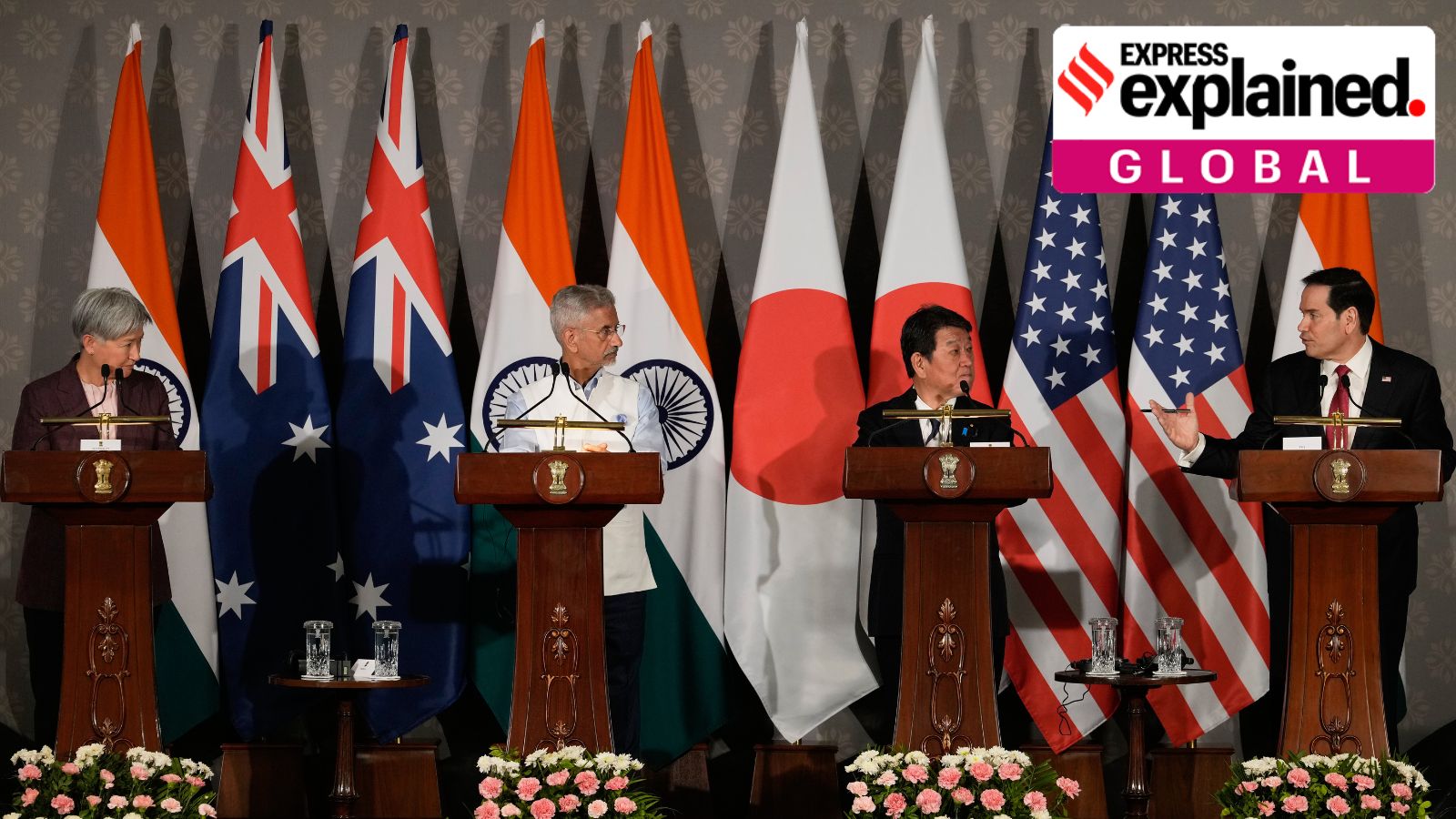
The foreign ministers of the Quad grouping will meet on Tuesday (May 26), marking the 11th time these diplomatic gatherings have taken place.
External Affairs Minister S Jaishankar will host Australia’s Foreign Minister Penny Wong, Japan’s Foreign Minister Toshimitsu Motegi, and United States Secretary of State Marco Rubio for the meeting at Hyderabad House. They are expected to discuss critical minerals, maritime and energy security, sources told The Indian Express.
According to sources, the fallout on maritime and energy security due to the war in West Asia will be one of the key concerns likely to feature prominently during the meeting.
Quad Foreign Ministers Meeting Live Updates: Quad delivers joint press statement
What is Quad?
Following the Indian Ocean tsunami of December 2004, India, Japan, Australia, and the US came together in an informal arrangement to coordinate disaster relief operations. In 2007, then Japanese Prime Minister Shinzo Abe gave political shape to the grouping through the Quadrilateral Security Dialogue, commonly known as the Quad.
But this nascent group was hampered by a lack of cohesion amongst members and accusations that the Quad was nothing more than an anti-China bloc. As strategic priorities diverged among member states, the grouping gradually lost momentum after its initial phase. In 2017, faced again with the rising Chinese challenge, the four countries revived the Quad and broadened its objectives.
How is it different from traditional alliances?
The Quad is not structured like a typical multilateral organisation and lacks a secretariat and any permanent decision-making body (like the EU or UN). Instead, it has focused on expanding existing agreements between member countries and highlighting their shared values. Additionally, unlike NATO, the Quad does not include provisions for collective defence, with member states instead relying on coordination, strategic dialogue, and joint military exercises to demonstrate alignment.
Story continues below this ad
Analysts have also questioned its long-term strategic coherence, even as member countries balance economic ties with China with security concerns in the Indo-Pacific. While the Quad was revived during Trump’s first term in 2017, changes in political leadership across member countries and debates over burden-sharing have periodically fuelled uncertainty over the grouping’s future direction. That has increased the importance of countries like India, Japan, and Australia in sustaining the grouping’s momentum.
What are Quad’s objectives?
In 2020, the trilateral India-US-Japan Malabar naval exercises expanded to include Australia, marking the first official grouping of the Quad since its resurgence in 2017, and the first joint military exercises among the four countries in over a decade. In March 2021, the Quad leaders met virtually and later released a joint statement titled ‘The Spirit of the Quad,’ which outlined the group’s approach and objectives. The first in-person meeting was held in Washington DC later that year.
Since then, the Quad’s agenda has expanded beyond maritime security to include critical and emerging technologies, resilient supply chains, cybersecurity, semiconductor cooperation, critical minerals, and energy security. Recent geopolitical disruptions, including the wars in Ukraine and West Asia, as well as supply chain vulnerabilities exposed during the Covid pandemic, have further sharpened the grouping’s focus on economic resilience and strategic coordination.
Maritime security nevertheless remains central to the Quad’s outlook, especially given the growing tensions in the Indo-Pacific, concerns over freedom of navigation, and anxieties among member states over China’s expanding military and maritime presence in the region. The four countries have also coordinated on disaster relief, climate resilience, and health security initiatives.
Story continues below this ad
Even as security concerns about China have grown, Quad members have avoided turning the grouping into a formal military alliance like NATO. That flexibility has also helped the grouping navigate political transitions within member states, including the return of Donald Trump to the White House.
Quad members have also indicated a willingness to expand the partnership through a so-called Quad Plus that would include South Korea, New Zealand, and Vietnam, amongst others.

