

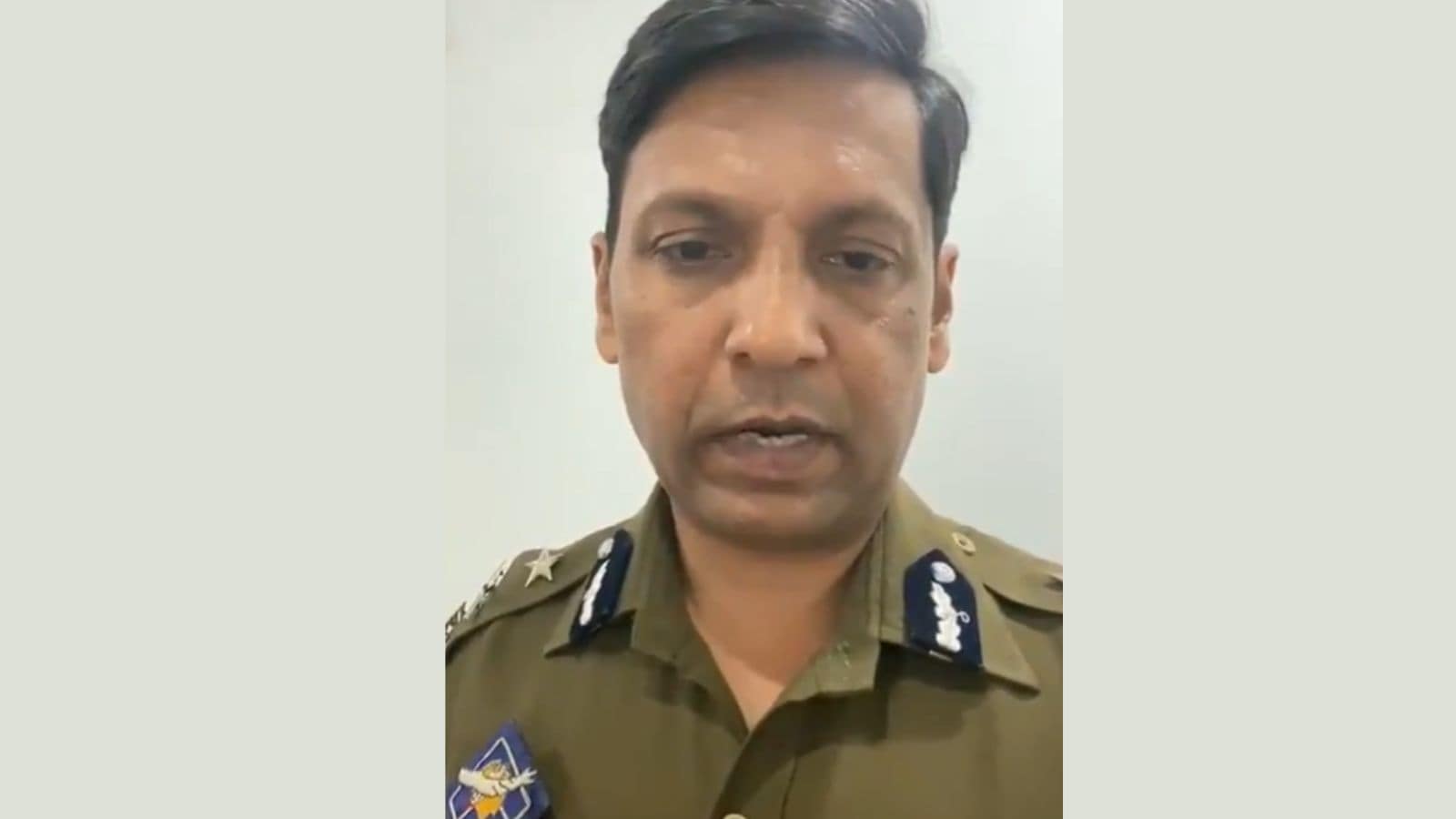
When Mukesh Singh, an IIT-Delhi graduate who later joined the police services, reported for his first posting in Poonch’s Mendhar in the late 1990s, India and Pakistan were exchanging mortar fire across the LoC as the Kargil war unfolded in the mountains above. For a young IPS officer, it was an unforgiving initiation into policing in conflict zones.
The wars never really left him after that.
Over the next three decades, Singh’s career would trace the geography of almost every major internal security crisis India confronted — militancy in Kashmir, counter-insurgency operations in Pir Panjal, 26/11 attack that led to the birth of the NIA, terror investigations stretching from Delhi to Hyderabad, and the renewed militant violence in Jammu’s mountains.
Now, as Manipur battles a deepening ethnic conflict between Nagas and Kukis, the Centre has once again turned to an officer shaped by insurgencies.
A 1996-batch IPS officer of the AGMUT cadre, Mukesh Singh will take charge as Manipur’s Director General of Police (DGP) on May 30 after the Centre approved his inter-cadre deputation as a “special case in public interest”. This comes at a time when Manipur’s security architecture remains deeply strained — by ethnic violence, armed militias, cross-border insurgent movements, narcotics trafficking and an enduring trust deficit in the police.
For New Delhi, Singh appears to represent a familiar template: The battle-hardened counter-insurgency officer with long experience in intelligence-led policing and multi-agency security operations.
That reputation was forged early.
After his baptism by fire in Mendhar, Singh was posted as SP City Srinagar in 2002, when militancy in the Valley was at its peak and fidayeen attacks had become a recurring threat. He would then move to Poonch during Operation Sarp Vinash, the Indian Army’s massive counter-insurgency offensive aimed at flushing out heavily armed militants entrenched in the forests of the Pir Panjal range.
It was one of the bloodiest periods of militancy in the region. During one year of his tenure there, more than 230 militants were killed.
Story continues below this ad
Over the following years, Singh served in some of J&K’s most challenging districts — Reasi, Pulwama and Jammu, steadily building a reputation as a field-oriented counter-insurgency officer comfortable operating alongside the Army and central forces.
But the defining turn in his career came after the 26/11 Mumbai terror attacks.
As the Union government created the NIA to build a specialised federal counter-terror apparatus, Singh became part of the founding team that helped establish the agency. His first case at the NIA took him to the Northeast, where he investigated an insurgent group operating in the North Cachar Hills.
Over the next several years, he would go on to handle some of the country’s most high-profile terror cases, including investigations into the 2011 Delhi High Court blast, besides the Mecca Masjid blast and the Samjhauta Express bombing (both in 2007).
Story continues below this ad
Colleagues describe Singh as a low-profile but methodical investigator. Seniors call him a “balanced officer” who is “system-compatible”.
Singh returned to J&K in 2014 before moving back to the NIA in late 2015, just as India entered another phase of high-profile terror attacks. During his second stint with the agency, he was associated with investigations into the 2016 Pathankot, Uri and Nagrota attacks; the Sunjuwan military station attack (2018); and the 2019 Pulwama suicide bombing.
By then, his career had come to straddle both worlds of Indian internal security — the field commander and the terror investigator.
That dual experience would become of essence during his posting as Inspector General and later Additional DGP, Jammu Zone.
Story continues below this ad
Within a year of his posting, and nearly two decades after Operation Sarp Vinash had broken the back of insurgent infrastructure in the Pir Panjal belt, the Jammu region began witnessing a resurgence of militancy. Highly trained militants began targeting Army patrols in the dense mountain ranges of Rajouri, Poonch, Kathua, Kishtwar and Doda.
In a span of roughly 18 months, close to 50 security personnel — including officers and para commandos — were killed in ambushes and gunfights.
“That was a difficult time. We were suffering reverses. But the Jammu police at the time had generated considerably good intelligence. It had led security forces close to the terrorists on multiple occasions,” a senior officer who served in Jammu during Singh’s tenure recalled.
Security officials say that by the time Singh exited the Jammu Zone, the security establishment had begun regaining operational control. A combination of tighter coordination between the Army and police, better jungle warfare adaptation, deeper deployment into upper mountain reaches, and sustained intelligence operations gradually led to a series of militant killings and disruption of infiltration networks.
Story continues below this ad
Yet, officers who worked with Singh say his role was not restricted to counter-terror operations alone.
An Intelligence Bureau officer who served in J&K said Singh also played an important role in maintaining communal peace in the Jammu region at a time when tensions had begun rising between Gujjars and Hindus in some parts.
“He made sure to visit all areas where there was tension and spoke to all stakeholders, bringing them to an understanding that peace was of utmost importance. At times, he would even impress upon the L-G to stop certain political parties and organisations from holding events or rallies that could disturb peace,” the officer said.
The assessment is significant because Manipur’s challenge today is not merely insurgency, but also deep ethnic polarisation and institutional distrust.
Story continues below this ad
A civil engineering graduate, Singh has written extensively on counter-terror policing and police encounters. In 2023, he also published a counter-terror thriller, Curse of the Pir, inspired by militancy operations in J&K.
Singh, who belongs to Begusarai in Bihar, is a recipient of three police medals for gallantry besides a Sher-e-Kashmir medal for gallantry. Two of his police medals came in 2001 and 2003, during the peak years of militancy in J&K, while the third came in 2021.
After his Jammu tenure, Singh moved to the Indo-Tibetan Border Police, where he was deputed along the Sino-Indian frontier in Arunachal Pradesh before being appointed DGP of Ladakh earlier this year.
His transfer to Manipur now places him in another conflict theatre — though one fundamentally different from Kashmir.
Story continues below this ad
Unlike the insurgency in J&K, Manipur’s present crisis is rooted in ethnic fragmentation, competing territorial claims, armed civilian militias, and collapsing social trust between communities. The state’s police force itself faces allegations of bias from rival ethnic groups.
For supporters within the security establishment, he is precisely the kind of officer required to stabilise a fractured security grid — someone experienced in coordinating with the Army, intelligence agencies and central forces while handling insurgency-linked violence.
Critics, however, worry that importing a “Kashmir model” into Manipur could deepen militarisation in a state already scarred by violence and displacement.

