

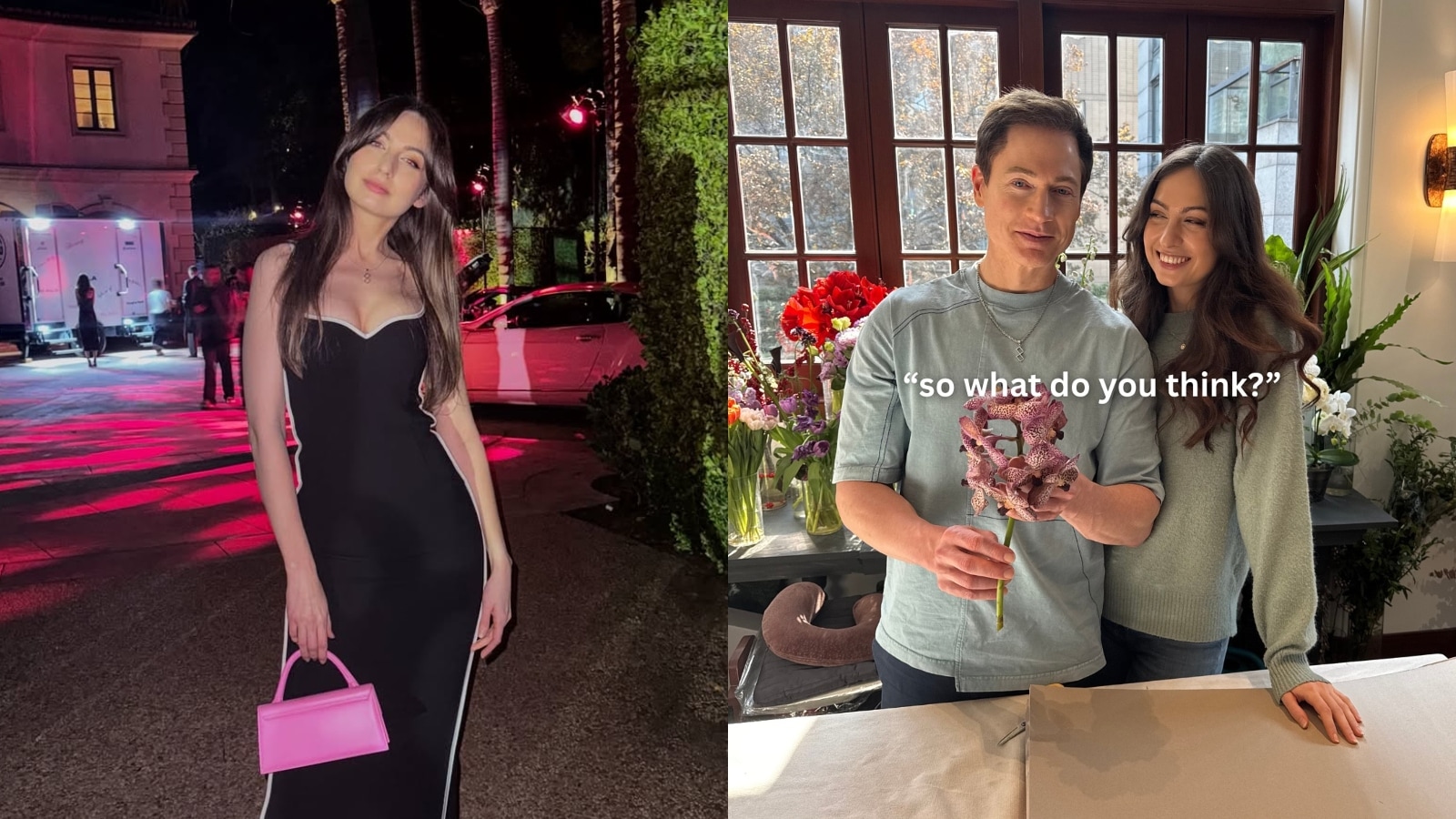
For years, the internet’s fascination with biohackers has mostly revolved around men attempting to slow ageing through extreme routines, constant monitoring, and expensive experiments. At the centre of that world is Bryan Johnson — the tech entrepreneur known for tracking every possible biomarker, spending millions on anti-ageing treatments, and treating his body like a live science project. But now, a woman is stepping into that spotlight too.
Meet Kate Tolo, Johnson’s partner in both business and life, who is quickly becoming one of the most talked-about names in the longevity space.
In a recent post on X, Johnson introduced Tolo to his followers as the “female Bryan Johnson”, adding, “She will become the most measured female in history.”
The couple plans to spend over $2 million every year building what they describe as the first deeply detailed, female-focused longevity protocol. Their goal is to collect more than 1.5 billion data points to study how Tolo’s body responds to Johnson’s experimental treatments and health interventions.
“It’s pretty cool to be living in a time when we may be the first generation to not die,” Johnson wrote. “I’m not suggesting immortality, but lifespans so long that we stop thinking about lifespans.”
Check out the post:
We now have a female Bryan Johnson.
It’s Kate Tolo.
She will become the most measured female in history.
+$2 million of spend per year
+ Developing a female-specific protocol
+ Sharing everything for freeTo start, she will spend 3 months mapping her baseline. Men, in… pic.twitter.com/G9hhxjg0z1
— Bryan Johnson (@bryan_johnson) May 19, 2026
So, who exactly is Kate Tolo?
Originally from Australia, Tolo is not just an entrepreneur but also an Olympian. A professional basketball player, she won a bronze medal for Australia at the 2024 Summer Olympics in Paris. She studied fashion and apparel engineering before building a career in the industry, starting as a Design Assistant and eventually becoming a Senior Manager at The North Face. In 2021, she joined Kernel, Johnson’s brain-computer interface company.
According to Johnson, Tolo played a major role in pushing him to share his longevity journey publicly. At Blueprint, she also helped shape the idea of turning his personal health tracking into a public-facing science experiment. She now continues to oversee strategy and marketing as Johnson’s audience on X has crossed 1.1 million followers.
Story continues below this ad
By 2023, Tolo had fully immersed herself in longevity research and became the first woman to try Blueprint’s anti-ageing protocol. What started as a 90-day experiment has since become a way of life.
“In many ways, this is a sacrifice for her. She is a creative person, going from a life of freedom and spontaneity to a rigid protocol,” Johnson wrote.
Her participation is also aimed at addressing a major gap in medical research — the lack of female-focused studies in health and longevity. Through Tolo’s experiments, the team hopes to explore questions that have rarely been studied in depth, including whether fertility can be improved, if women should cold plunge or fast, and how hormonal cycles affect recovery, mood, and cognition.
Johnson said the research will also examine issues such as easing PMS symptoms, understanding ideal sauna routines for women, figuring out whether nutrient requirements like iron, magnesium, or protein change during different phases of the menstrual cycle, and studying how stress affects men and women differently.
Story continues below this ad
Calling Tolo the “world’s first n=2”, Johnson said the project exists because female medical science still lacks enough practical, women-specific research. “There is not enough practical scientific literature for women to reference only RCTs. It leaves half the population without a path to know what to do,” he wrote.
“Individual science experiments give us signals that answer what to do on a day-to-day basis. This is even more important for women,” he added.
Disclaimer: The longevity and biohacking protocols discussed in this article represent experimental, individual self-studies and are not backed by standard randomized controlled trials (RCTs). The health routines, dietary changes, and clinical interventions mentioned should not be treated as medical advice, diagnosis, or a substitute for professional healthcare guidance. Always consult a qualified medical professional before attempting any extreme lifestyle changes, specialized supplements, or unverified anti-aging therapies.

