


UPSC Current Affairs Pointers brings you essential current affairs of the past week, every Monday, to aid you in your Prelims and Mains preparation of UPSC, State PCS, and other competitive examinations.
Gear up forUPSC Prelims 2026—Practice smarter, revise faster, and succeed with ourSpecial Quiz Magazine. (Click Here)
— Amid Prime Minister Narendra Modi’s visit, the Dutch government handed over the Anaimangalam Chola Copper Plates to India, a culmination of a 14-year effort to get them back.
— Known in the Netherlands as the Leiden Plates, they are among the most significant surviving records of the Chola dynasty and among the most important artefacts of Tamil heritage held anywhere outside India.
— The Anaimangalam copper plates comprise a set of 21 large plates and three smaller ones, weighing approximately 30 kg, are bound together by a bronze ring bearing the royal seal of the Chola dynasty.
— These were issued to commemorate grants made by the renowned Chola ruler Rajaraja I (985-1014 CE) to a Buddhist vihara (monastery) at the Chola port town of Nagappattinam in Tamil Nadu.
Story continues below this ad
— The vihara had been constructed by Chulamanivarman, the Sailendra ruler of Southeast Asia.
— The inscriptions on the plates are written in both Sanskrit and Tamil. As per Leiden University, the Sanskrit section traces the genealogy of the Chola dynasty, beginning with the mythical lineage linked to the Hindu god Vishnu.
—The Tamil text highlights the accomplishments of Rajaraja I, father of Rajendra I, including his donation of an entire village’s revenue to a Buddhist pagoda in the 21st year of his reign.
From Chola history to hypersonic tech — test yourself on the week’s top stories.
Q1 of 8 — Art & Culture
The Anaimangalam Copper Plates were issued by which Chola ruler to commemorate grants to a Buddhist vihara at Nagappattinam?
Fact: Rajaraja I (985–1014 CE) issued the plates recording his donation of an entire village’s revenue to the Buddhist vihara at Nagappattinam. The vihara was originally built by Chulamanivarman, the Sailendra ruler of Southeast Asia. The plates were returned by the Netherlands after a 14-year effort.
Q2 of 8 — Economy
By how much have India’s foreign exchange reserves eroded since March 2025, triggering a review of withholding tax policy on foreign bond investments?
Fact: Capital outflows driven by the West Asia conflict and a crude oil price surge have eroded India’s forex reserves by nearly $38 billion since March 2025. The government is now considering slashing the withholding tax on foreign bond investments from 20% back to the earlier 5% rate.
Q3 of 8 — Economy
What is the current withholding tax rate on government bond interest paid to non-resident foreign investors — described as one of the highest in the world?
Fact: Non-residents currently pay ~20% withholding tax on interest earned from Indian government bonds — one of the highest globally. A concessional 5% rate had expired in 2023. A return to 5% is now being considered to revive foreign capital inflows and stabilise forex reserves.
Q4 of 8 — Science & Tech
What runtime did DRDO achieve for its actively cooled scramjet combustor on 9th May 2026 at the SCPT facility in Hyderabad — a key hypersonic missile milestone?
Fact: DRDO achieved a 1,200-second runtime for its actively cooled full-scale scramjet combustor. The test used an indigenous endothermic scramjet fuel jointly developed by DRDL and industry partners, offering dual benefits of better cooling and easier ignition. A hypersonic cruise missile exceeds 5x the speed of sound.
Q5 of 8 — Health
PCOS has been renamed to better reflect its complex, multisystem endocrine nature affecting ~170 million women globally. What does the new acronym PMOS stand for?
Fact: The condition has been renamed PMOS — Polyendocrine Metabolic Ovarian Syndrome. The old name wrongly implied abnormal “cysts”; research shows these are arrested follicles that merely appear cyst-like on ultrasound. The renaming aims to reduce delayed diagnosis and ensure broader treatment.
Q6 of 8 — International
Under the new India-UAE Strategic Collaboration Agreement signed during PM Modi’s visit, how many barrels of crude oil will the UAE store in India’s Strategic Petroleum Reserves?
Fact: The ISPRL-ADNOC agreement enhances UAE’s participation in India’s Strategic Petroleum Reserves to 30 million barrels. The UAE was the first country to partner with India on SPRs — the original 2018 deal covered just over 5 million barrels at the Mangaluru facility.
Q7 of 8 — International
Which country most recently joined BRICS as a full member in January 2025, taking the bloc’s total membership to 10?
Fact: Indonesia officially joined BRICS as a full member in January 2025, taking total membership to 10. Egypt, Ethiopia, Iran, and UAE are also members of the expanded bloc. India is chairing the 18th BRICS Summit under the theme “Building for Resilience, Innovation, Cooperation and Sustainability.”
Q8 of 8 — Economy
What is the total outlay of the new Scheme for Promotion of Surface Coal/Lignite Gasification Projects, approved by the Union Cabinet on 13th May 2026?
Fact: The Cabinet approved a ₹37,500 crore scheme targeting 25 gasification projects and 75 million tonnes of coal/lignite. This is in addition to the existing ₹8,500 crore viability gap funding scheme from 2024. (₹75,000 crore is the untied component of the separate SASCI scheme.)
/ 8
correct answers How did you do? Share your score!
Report
(FYI: The data provided in these reports can be used to substantiate your Mains answer and create a broad understanding of the topic.)
Story continues below this ad
— NITI Aayog has released a report titled, ‘School Education System in India: Temporal Analysis and Policy Roadmap for Quality Enhancement.’ The analysis provides for the decade from 2014-15 to 2024-25.
— Overall, school enrolment has dropped by about 8% over the past decade: from 26.95 crore in 2014-15 to 24.69 crore in 2024-25.
— Three reasons are cited for the drop:
(i) demographic shifts, particularly falling fertility rates leading to a smaller school-age population
(ii) the effects of school consolidations or mergers
(iii) Challenges in retaining students at higher levels of education.
Story continues below this ad
— The school enrollment in government schools dropped from 54.3% in 2014-15 to 49.25% in 2024-25. In contrast, enrolment in private schools jumped from 31.7% to 38.8%. The rest are in government-aided or other schools.
— NITI Aayog has marked secondary education as the “most fragile link” in the schooling cycle. The Gross Enrollment Ratio (GER) at the secondary level has only seen a marginal rise over the past decade — from 75.68% to 78.7%. The GER in the primary and upper primary levels is over 90%.
| FYI
GER is the total enrollment at a particular level of education, expressed as a percentage of the official age-group population for that level. |
— Drop-out level: The dropout rate at the primary level has fallen to near zero: from around 4% in 2014-15 to 0.3% in 2024-25. At the upper primary stage, the figure was 3.5% in 2024-25, close to the 3.77% a decade ago.
— The secondary stage dropout rate has dropped from 17.86% to 11.5% over the decade, but the rate remains the highest at this stage of schooling.
Story continues below this ad
Event
— The Kimberley Process (KP) Intersessional Meeting 2026 was held in Mumbai from 11th May to 14th May. India is holding the chair of KP for this year.
— India’s Kimberley Process 2026 Chairship is guided by the 3Cs: Credibility, Compliance, and Consumer Confidence in the natural diamond sector.
— The Kimberley Process Certification Scheme (KPCS) is a mechanism used by KP to prevent the trade of conflict diamonds. Launched in 2003, it is enforced individually by KP Participant countries to ensure that rough diamonds in the legitimate supply chain are KP-compliant.
Story continues below this ad
— At present, the Kimberley Process has 60 participants representing 86 countries, with the European Union and its Member States participating as a single bloc.
— ‘Conflict diamonds’, also known as blood diamonds, are the rough diamonds mined and used by rebel movements or their allies to finance armed conflicts aimed at undermining legitimate governments.
Polity
— In a push to curb cyber-enabled financial frauds, the Indian Cyber Crime Coordination Centre (I4C), under the Ministry of Home Affairs, and the Reserve Bank Innovation Hub (RBIH) have signed a Memorandum of Understanding (MoU).
Story continues below this ad
— It aims to enhance fraud-risk intelligence sharing, analytical support, and operational coordination, with a particular focus on identifying and eliminating mule accounts — a key enabler of cyber fraud.
— Under the MoU, the I4C will share intelligence related to suspected mule accounts through its Suspect Registry, which will be integrated into AI-driven fraud detection systems such as MuleHunter.ai™ deployed across banks.
— The RBIH will use these datasets to train and enhance fraud-risk assessment models, enabling more proactive detection and prevention of suspicious transactions.
- SEHAT – Science Excellence for Health through Agricultural Transformation
— The Indian Council of Medical Research (ICMR) and the Indian Council of Agricultural Research (ICAR) jointly launched ‘SEHAT’.
Story continues below this ad
— It is a national mission-mode programme designed to translate agricultural advancements into tangible health outcomes for the people .
— The mission focuses on five priority areas:
1. Development and evaluation of biofortified and nutrient-dense crop varieties to address malnutrition and improve nutritional status;
2. Strengthening integrated farming systems to promote dietary diversification, enhance farm incomes, and build resilience
3. Addressing occupational health risks among agricultural workers through targeted, evidence-based interventions
4. Advancing agriculture-enabled strategies for the prevention and management of non-communicable diseases
5. Strengthening One Health preparedness through integrated surveillance, diagnostics, and research at the human–animal–environment interface
— The India Meteorological Department (IMD) has launched two advanced, Artificial Intelligence-based weather forecasting products for the core monsoon areas, which practice rain-fed agriculture.
— One is developed by the National Centre for Medium Range Weather Forecasting (NCMRWF). One forecasting product has been specifically developed for Uttar Pradesh.
— This product incorporates AI and offers a spatial resolution of up to 1 km, meaning rainfall forecasts can now be provided for every 1 km geographical area, making it a highly localised and specific forecast.
— Another AI-driven rainfall forecasting product has been developed by Pune-based Indian Institute of Tropical Meteorology (IITM).
— This forecasting system closely tracks how the monsoon will progress into various parts of the country, more specifically, every district. It is capable of generating district-level rainfall forecasts well in advance, and the updates will be made available every Wednesday.
— Contributions to the NSDF have more than halved in three years — from Rs 85.26 crore in 2023-24 to Rs 37.02 crore in 2025-26, records obtained by The Indian Express under the Right To Information (RTI) Act show.
— The NSDF was established in 1998 under the Charitable Endowments Act, 1890.
— It is funded by donations from the public and private sectors, Non-Resident Indians (NRIs), and charities or non-profits, with contributions from the Government.
— The fund is governed by a Council headed by the Union Sports Minister — currently Mansukh Mandaviya.
— The Council also includes top office-bearers from Public Sector Undertakings, industry bodies like FICCI and CII, private-sector representatives and sports ministry officials.
— Day-to-day operations and grant approvals are handled by a six-member executive committee chaired by the Sports Secretary.
Economy
India’s Withholding Tax on Foreign Investors — Explained
$38B
Forex reserves lost since March 2025
20%
Current withholding tax rate
5%
Proposed concessional rate
WHY NOW
West Asia conflict triggers forex alarm
Capital outflows driven by the West Asia conflict and a surge in crude oil prices have eroded India’s foreign exchange reserves by nearly $38 billion since March 2025. The government is now reportedly considering slashing the withholding tax on foreign bond investments from 20% back to the earlier concessional 5% rate to revive overseas inflows and stabilise reserves.
BROADER RESPONSE
WHT cut part of a wider forex defence
The government has already proposed cuts in expenditure, restrictions on foreign travel, curbs on gold imports, and limits on other non-essential spending to manage the external account. A WHT reduction would complement these outflow-curbing measures by actively attracting foreign capital back in.
FPI DEBT FLOWS
Flows have already reversed in FY27
After $2.8 billion in FPI inflows into debt in FY26, the category has seen outflows of $613 million in FY27 so far across the general limit, VRR and FAR windows. FPI investment in dated government securities had jumped 43.2% to $43.9 billion by end-March 2025 — gains that the outflow cycle now threatens to unwind.
DEFINITION
Tax collected before money leaves India
Withholding tax (WHT) is a tax deducted at the source of income — similar to TDS. Instead of waiting for a foreign investor to pay taxes at year-end, the government requires the Indian payer to deduct a portion of the income before remitting it abroad. The deducted amount is deposited directly with the government.
How it affects foreign investors
↓
Compresses post-tax yields
WHT is deducted before interest or dividend income reaches the investor, directly reducing effective returns and weakening long-term compounding power.
⏳
Creates short-term liquidity constraints
For large global investors, deductions lock up funds until tax credits or refunds are processed under Double Taxation Avoidance Agreements (DTAAs).
⚖
Increases compliance burden
FPIs face significant administrative friction in claiming DTAA relief. Higher WHT raises transaction costs, lowers risk-adjusted returns, and creates regulatory friction.
★
Applies to all passive income types
WHT covers interest on government securities and bonds, dividends, royalties, and fees for technical services — wherever income is earned by a foreign entity from India.
GLOBAL CONTEXT
India among the higher-tax jurisdictions for bond investors
Most countries tax passive income from foreign investors, but rates and exemptions vary widely. At 20%, India sits above most peer emerging markets. The proposed cut to 5% would make it competitive with China and well below Western markets.
Withholding tax on bond interest — country comparison
🇺🇸 United States
30%
🇮🇳 India (current)
20%
🇮🇳 India (proposed)
5%
“The inclusion [in Global Agg and FTSE WBGI] could imply $45–50 billion of inflows over two years… Several major nations do not tax bond investments, and even those that do, like China, gave a special dispensation to investors that entered after index inclusion.”
— Prateek Ancha, Senior Vice President, Axis Bank
POLICY EVOLUTION
Five decades of India’s withholding tax journey
India’s withholding tax regime has evolved significantly since the 1970s — from prohibitively high rates designed to protect domestic industry, to concessional rates meant to attract foreign capital and global bond index inclusion. The current 20% rate is a reversion, not a new high.
1976
WHT on royalties fixed at 40%. Fees for Technical Services (FTS) attracted a 20% levy — among the highest rates India would impose on foreign income.
1986 – 2005
Both royalties and FTS rates cut to 10%. The reductions aimed to lower technology acquisition costs for Indian companies and encourage foreign collaboration over a sustained 19-year reform period.
Section 194LD Introduced
India introduced a concessional 5% WHT rate on interest earned by FPIs from investments in government securities and certain rupee-denominated bonds under Section 194LD of the Income Tax Act.
July 2023
Concessional 5% regime expired. The Section 194LD facility was not renewed. WHT for many FPIs effectively reverted to ~20%, making India one of the relatively higher-tax jurisdictions for global bond investors. Analysts say this reduced India’s attractiveness at a time it was also seeking greater global bond index inclusion.
FY26
India included in JPMorgan Government Bond Index-EM. FPI investment in dated government securities jumped 43.2% to $43.9 billion by end-March 2025. But index peers Global Agg and FTSE WBGI still seek clarity or exemption on the tax.
May 2026 — Current
Government reportedly weighing a return to 5% WHT. With $38 billion in forex reserves eroded since March and FPI debt outflows of $613 million in FY27, the case for reviving the concessional rate — and unlocking a potential $45–50 billion from further index inclusions — is mounting.
Sources: The Indian Express · Reserve Bank of India · Axis Bank Research (Prateek Ancha) · DBS Bank (Radhika Rao) · Income Tax Act, Section 194LD
— In order to attract foreign investors’ investment inflow, the government is considering slashing the ‘withholding tax’ rate on government bonds.
— At present, non-residents pay a withholding tax of about 20% on the interest they get on the government bonds they hold — one of the highest in the world — after a concessional rate of 5% ended in 2023.
— A high withholding tax is seen as a major deterrent for foreign capital inflows at a time when India is grappling with rising external pressures, including a sharp surge in crude oil prices.
— Withholding tax, or WHT, is a tax collected at the source of income. Instead of waiting for an investor or foreign company to pay taxes at the end of the financial year, the government requires the payer to deduct a portion of the income before it is remitted to the recipient.
— The deducted amount is then directly deposited with the government. In simple terms, whenever income is earned — whether through employment, investments, royalties or other sources — the government ensures tax collection in advance through withholding tax.
— To incentivise greater clean energy adoption, the government is set to link the adoption of renewable energy to the SASCI scheme.
— The 2026-27 Union Budget allocated Rs 2 lakh crore as 50-year, interest-free capex loans for states called Special Assistance to States for Capital Investment (SASCI).
— Under this programme, while Rs 75,000 crore is ‘untied’ – or provided without any conditions – the majority is tied to the reform performance of each state across a variety of spheres ranging from power, mining, agriculture, and public finance, among others.
— As such, the better a state performs on these reform criteria, the more they can avail from the ‘tied’ component of the programme.
— The loans availed under the SASCI programme count over and above each states’ net borrowing ceiling, which is capped at 3% of their Gross State Domestic Product (GSDP), as per the Fiscal Responsibility and Budget Management (FRBM) Act.
— The Union cabinet on 13th May has approved a new scheme to promote conversion of coal and lignite into synthesis gas (syngas) through the gasification process in a move to strengthen energy security.
— With an outlay of Rs 37,500 crore, the Scheme seeks to incentivise 25 projects for production of syngas and downstream products, targeting gasification of approximately 75 million tonne (mt) of coal/lignite.
— The new scheme is an addition to the existing viability gap funding scheme worth Rs 8,500 crore approved in 2024 for incentivising coal and lignite gasification projects.
— Coal gasification is a thermochemical process of converting coal into synthesis gas (syngas), which is a mixture of fuel-rich gases like carbon monoxide (CO), carbon dioxide (CO2), hydrogen (H2), and methane (CH4).
— The syngas can be used for producing Synthetic Natural Gas (SNG), electricity generation, energy fuel (methanol and ethanol), ammonia for fertilisers, and chemicals.
— The coal gasification process involves oxidation of coal at higher temperatures and pressures to produce syngas. There are two main types of gasification: Surface gasification and Underground coal gasification (UCG).
— In surface coal gasification, coal is first mined and then converted into gas in above-ground industrial reactors using oxygen, steam and high temperatures.
— In contrast, underground coal gasification converts coal into gas while it is still buried deep underground by injecting air or oxygen into coal seams through wells and extracting the resulting gas to the surface.
— The newly approved scheme primarily focuses on surface gasification projects
— Amid inflation and future supply concern, the Directorate General of Foreign Trade (DGFT) has prohibited export of raw, white and refined sugar with immediate effect till September 30.
— The prohibition on sugar exports will not apply to the advance authorisation scheme (AAS), government-to-government exports, and consignments already in the physical export pipeline, it stated.
— As per the notification, the prohibition will also not apply to sugar exports to the European Union and the US under the preferential quota.
International Cooperation
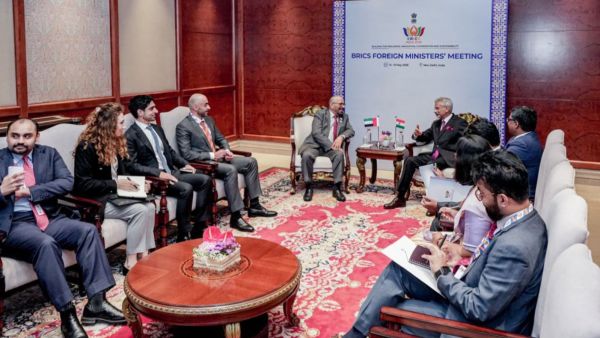 BRICS foreign ministers have issued a joint statement condemning the 2025 Pahalgam terror attack and criticizing unilateral trade tariffs. (Source: X/@DrSJaishankar)
— The BRICS Foreign Ministers’ meeting was held in India from 14 to 15 May 2026. The meeting was chaired by Dr. S. Jaishankar, External Affairs Minister.
— BRICS Foreign Ministers and Heads of Delegation from Member and Partner Countries participated in the meeting.
— BRICS stands for Brazil, Russia, India, China, and South Africa, the original five members who were large, non-Western economies.
— In January 2025, Indonesia officially joined the BRICS as a full member taking total membership to 10. Egypt, Ethiopia, Iran, and the United Arab Emirates are also part of the bloc.
— Prime Minister Narendra Modi visited the United Arab Emirates on 15 May 2026 and held discussions with UAE President Sheikh Mohamed bin Zayed Al Nahyan.
— Both the nations signed a slew of pacts including a framework for a strategic defence partnership, storage of 30 million barrels in Indian strategic petroleum reserves, supply of LPG and a ship repair cluster in Gujarat’s Vadinar.
— Strategic Collaboration Agreement was signed between Indian Strategic Petroleum Reserves Limited and Abu Dhabi National Oil Company to enhance UAE’s participation in India’s Strategic Petroleum Reserves to 30 million barrels, and work together to set up strategic gas reserves in India.
— The UAE has been the first country to partner with India in strategic petroleum reserves. In 2018, the ISPRL and ADNOC entered into an agreement for the UAE to store over 5 million barrels of crude oil reserves at ISPRL’s facility in Mangaluru.
Environment
— An environmental activist has filed a complaint to the Supreme Court-mandated Central Empowered Committee (CEC) regarding alleged illegal construction within the Kaziranga Wildlife Corridor.
— The Kaziranga National Park, which has the world’s largest population of the one-horned rhinoceros and is home to 37 species of mammals and nearly 500 species of birds, is located on the Brahmaputra floodplains in Central Assam’s Nagaon and Eastern Assam’s Golaghat districts.
Science and Technology
— On May 11, Delhi-NCR got its first and India’s second Multi-Lane Free Flow (MLFF) barrier-less tolling system on Mundka-Bakkarwala toll plaza on Urban Extension Road (UER)-II.
— Now, vehicles will not have to stop at the toll plaza for user fee or toll payment. The toll amount will be deducted with the help of high-performance Radio Frequency Identification (RFID) readers and Automatic Number Plate Recognition (ANPR) cameras mounted over the gantry.
— The RFID and ANPR cameras work and read the FASTag and Vehicle registration Number (VRN) even when vehicles being driven at a speed of 80-100 kmph pass the gate, and the required amount gets deducted.
— According to the Economic Survey 2025-26, the MLFF is projected to be implemented across national highways and expressways with four or more lanes, by March 2029.
 DRDL conducted second successful extensive long-duration test of the actively cooled full-scale scramjet combustor, achieving a run time of over 1200 seconds. (Photo: X.com/DRDO_India)
— On 9th May, the Defence Research and Development Organisation (DRDO) making a further breakthrough in hypersonic missile technology achieved a 1,200-second runtime of its actively cooled scramjet full-scale combustor,
— The test was conducted at the Scramjet Connect Pipe Test (SCPT) facility in Hyderabad.
— The hypersonic cruise missile is capable of exceeding five times the speed of sound, or over 6,100 km per hour, for extended periods.
— The speed is achieved through a cutting-edge air-breathing engine, which utilises supersonic combustion to sustain long-duration flight.
— Supersonic Combustion Ramjet or Scramjet engine efficiently operates at hypersonic speeds and allows supersonic combustion.
— The fundamental change in a scramjet is that the air does not slow down in its combustion chamber but stays supersonic throughout the engine. This makes the design, development and operation of the scramjet far more challenging.
— Scramjet combustor in this technology incorporates an innovative flame stabilisation technique that holds a continuous flame inside the combustor with an air speed of more than 1.5 km per second.
— A specialised indigenous endothermic scramjet fuel was used in this.
— The fuel was jointly developed for the first time by the DRDL and industry partners. The fuel offers dual benefits of significant cooling improvement and ease of ignition.
— Methane buildup in the cargo hold of a bulk carrier ship berthed at Kandla port, Kutch, is the likely reason for the death of three migrant workers from Uttar Pradesh on 13th May, 2026.
— Methane is a colourless, highly flammable gas which is the primary component of natural gas.
— Low level exposure of methane would not be expected to cause adverse health effects. However, exposure to high levels of methane can reduce the amount of oxygen breathed from the air. This can result in mood changes, slurred speech, vision problems, memory loss, nausea, vomiting, facial flushing and headache. This could also lead to death.
Health
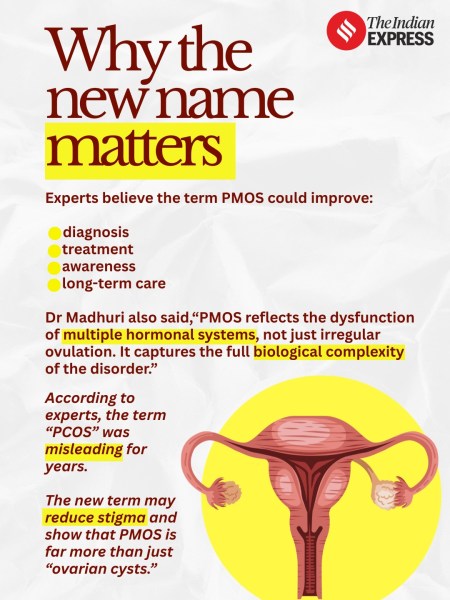
— One of the world’s most common women’s health conditions, previously known as Polycystic Ovary Syndrome (PCOS), will now be called Polyendocrine Metabolic Ovarian Syndrome (PMOS).
— It has been renamed to better reflect its complex, multisystem nature.
— What was known as PCOS affects around one in eight women globally, or more than 170 million women.
— It is associated with a wide spectrum of symptoms including irregular or absent menstrual cycles, infertility, pregnancy complications, excess hair growth, acne, anxiety, depression, weight gain, diabetes and cardiovascular disease.
— The earlier name reduced a complex, long-term endocrine disorder to a misunderstanding about ‘cysts’ and a narrow focus on the ovaries. This contributed to delayed diagnosis and inadequate treatment.
— Prof Teede, who led the renaming process, said decades of research have shown that the condition does not involve abnormal ovarian cysts. Instead, there are arrested follicles that may appear cyst-like on ultrasound.
— Pharmaceutical giant Eli Lilly has launched donanemab in the Indian market under the brand name Lormalzi.
— The once-a-month 350 mg infusion has been shown to slow the progression of the disease by dissolving the amyloid beta protein plaques in the brain — a classical sign of the neuro-degenerative disease.
— This drug is an important innovation. Dementia currently affects approximately 8.8 million people in India, with Alzheimer’s disease accounting for the majority of cases. This number is projected to nearly double to 16.9 million by 2036.
— Donanemab is a monoclonal antibody that reduces amyloid beta protein plaques in the brain to slow down cognitive decline in patients with early Alzheimer’s disease.
Awards
- National Florence Nightingale Awards 2026
— The National Florence Nightingale Awards for the year 2026 was awarded to fifteen Nursing professionals by the President to the nursing personnel, on the occasion of International Nurses Day (May 12, 2026).
— The award was instituted in 1973 by the Ministry of Health and Family Welfare as a mark of recognition for the meritorious services rendered by nursing personnel to society.
— Each award includes a Certificate of Merit, a cash prize of one lakh rupees and a medal symbolising the nation’s gratitude for the invaluable service rendered by these health warriors.
Terms making buzzEnterprise AI: It is the adoption of advanced AI technologies within large organizations. Enterprise AI includes policies, strategies, infrastructure, and technologies for widespread AI use within a large organization. |
Test Your Knowledge
(Note: The best way to remember facts for UPSC and other competitive exams is to recall them through MCQs. Try to solve the following questions on your own.)
(1) Consider the following statements about the National Sports Development Fund (NSDF):
1. Governed by a Council headed by the Union Sports Minister.
2. Established in 1998 under the Charitable Endowments Act, 1890.
Which of the statements mentioned above is/are correct?
(a) 1 only
(b) 2 only
(c) Both 1 and 2
(d) Neither 1 nor 2
(2) Syngas is a mixture of
(1) Consider the following substances:
I. Ethanol
II. Nitroglycerine
III. Urea
Coal gasification technology can be used in the production of how many of them?
(a) Only one
(b) Only two
(c) All the three
(d) None
| Prelims Answer Key |
| 1. (c) 2. (b) |
For your suggestions and feedback, write to khushboo.kumari@indianexpress.com
Subscribe to our UPSC newsletter. Stay updated with the latest UPSC articles by joining our Telegram channel – IndianExpress UPSC Hub, and follow us on Instagram and X.
🚨 Click Here to read the UPSC Essentials magazine for April 2026. Share your views and suggestions in the comment box or at manas.srivastava@indianexpress.com🚨

