

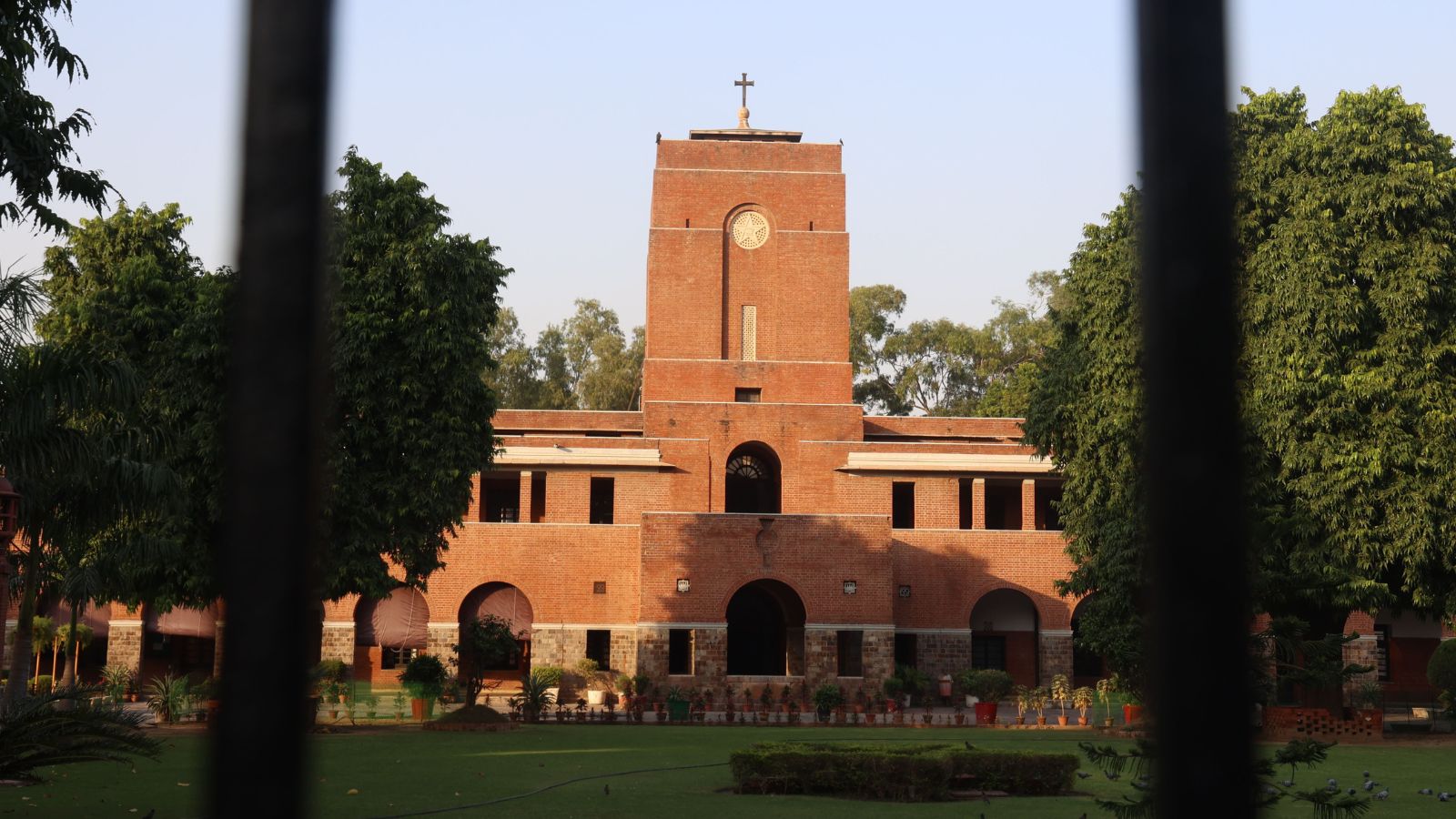
DU’s letter to St Stephen’s, sent barely two weeks before Elias was to take charge as the first woman principal in the 145-year history of the college, marked the latest flashpoint in the years-long confrontation between one of India’s most storied colleges and the university of which it is part.
Over the last four years, the relationship between St Stephen’s and DU has steadily deteriorated over a range of issues: admissions through the Common University Entrance Test (CUET), interview weightage for Christian minority students, implementation of supernumerary quotas, seat allocation disputes, postgraduate admissions, and now the appointment of the principal.
The disagreements, which essentially stem from the status of St Stephen’s as a Christian minority institution, have been litigated in the Delhi High Court and the Supreme Court, where both sides have invoked constitutional principles, university statutes and questions of minority rights.
What has triggered the latest confrontation?
On Thursday (May 14) DU Registrar Vikas Gupta wrote to St Stephen’s, directing the college to put on hold the appointment of Susan Elias as principal.
DU argued that the process of selection of the principal had violated the University Grants Commission (UGC) Regulations, 2018 because nominees of the university were allegedly not included in the selection committee.
Sub-clause VIII-A of Clause 5.1 of the Regulations describes the composition of the Selection Committee for a “College Principal and Professor”. DU’s letter to St Stephen’s has underlined that as per items (a)(iii) and (a)(vi) of this sub-clause, the vice-chancellor and the university will continue to have a role in the appointment of the principal even in the case of “colleges notified/ declared as minority educational institutions”.
Story continues below this ad
The college announced Elias’s appointment on May 12. College Chairman Paul Swarup had earlier told The Indian Express that the appointment was made after “the proper procedure” was followed, including a public advertisement, interviews, shortlisting, and candidate presentations before the selection.
The registrar’s letter, however, suggested that the university believes key procedural requirements involving university nominees and expert panels were bypassed.
Therefore, “You are requested to not proceed with appointment of new principal”, and instead “convene a meeting of the Selection Committee constituted as per the provisions of UGC Regulations 2018”, DU has told the college.
St Stephen’s is yet to respond to the letter. But over the years, it has argued in a range of issues that it has broad autonomy in matters of governance.
Story continues below this ad
What grounds does St Stephen’s claim this autonomy in its functioning?
St Stephen’s argues that it enjoys constitutional protection as a minority educational institution under Article 30(1) of the Constitution, which grants religious and linguistic minorities the right to “establish and administer educational institutions of their choice”.
The college was founded in 1881 by the Cambridge Mission, and it became one of the original constituent colleges of Delhi University in 1922. But even after affiliation, the college retained a distinct governing structure under its own constitution and governing body.
St Stephen’s has long argued that its minority character allows it to preserve independent admission practices and internal governance mechanisms. This position received judicial backing in the landmark judgment of the Supreme Court in 1992 in ‘St Stephen’s College vs University of Delhi’ case.
Story continues below this ad
A five-judge Constitution Bench of the court upheld the right of the college to maintain its minority character, and recognised its authority to devise its own admission procedures, including interviews.
The court held that while the state could regulate educational standards, it could not excessively interfere in the internal administration of minority institutions.
This 1992 judgment has remained central to nearly every legal battle the college has fought since.
How then is DU able to intervene in the affairs of the college?
Story continues below this ad
Its minority status notwithstanding, St Stephen’s remains an affiliated college of Delhi University.
DU therefore argues that the college must comply with the university’s statutory framework, admission ordinances, academic rules, and UGC regulations that are applicable to its affiliated colleges.
The university has consistently maintained that autonomy cannot mean complete exemption from common academic and administrative standards. This includes adherence to sanctioned seat matrices, university-wide admission systems like CUET, the Common University Entrance Test administered by the National Testing Agency, the scores of which are used for admission to undergraduate programs in all central universities and other participating universities across the country, reservation policies, and regulations governing appointments.
What was the CUET controversy, the last time DU and St Stephen’s locked horns on the question of autonomy?
Story continues below this ad
DU adopted CUET for undergraduate admissions in 2022, mandating that admissions across affiliated colleges would be based entirely on CUET scores. However, St Stephen’s announced in its prospectus that it would continue to give 15% weightage to interviews while assigning 85% weightage to CUET scores.
DU objected, arguing that the college could not impose interviews on all applicants once a centralised admission framework had been adopted.
The matter reached the Delhi High Court, and in September 2022, a Division Bench comprising then Chief Justice Satish Chandra Sharma and Justice Subramonium Prasad ruled that St Stephen’s could not conduct interviews for non-minority seats, and must admit general category students based solely on their CUET scores.
However, the court held that the college could continue conducting interviews for Christian minority candidates with 15% weightage.
Story continues below this ad
The ruling effectively created a dual admission structure: 100% CUET for non-minority applicants, and 85% CUET plus 15% interview for Christian minority applicants.
The college challenged parts of the ruling in the Supreme Court. Meanwhile, in December 2022, DU attempted to enforce 100% CUET even for minority seats, and the matter went to court again.
In July 2023, the Bench of Chief Justice Sharma and Justice Prasad granted interim relief to St Stephen’s and restored the 85:15 formula for Christian minority admissions.
“…As an interim measure, this Court directs that the admission policy as framed by this Court vide judgment dated 12.09.2022 shall be followed for the Academic Year 2023-24 and the St. Stephen’s College will adopt the marks secured in the CUET with 85% weightage for CUET and the College’s interview for shortlisted candidates with a weightage of 15% for Christian minority candidates,” the court said.
What was the “single girl-child quota” controversy?
Story continues below this ad
Another major confrontation erupted during the 2024 admission cycle after DU introduced a “single girl-child” supernumerary quota across colleges.
The university allocated candidates to St Stephen’s under this quota, but the college refused to admit all of them, arguing that the allocations exceeded its sanctioned intake strength.
The dispute became chaotic. Several students approached the Delhi High Court seeking admission after being denied entry despite DU allocations.
Initially, a single judge granted provisional relief to some students. But after St Stephen’s challenged the order, a Division Bench of the court temporarily restrained six students from attending classes.
In September 2024, the High Court permitted seven petitioners to attend classes provisionally while restricting DU from allocating additional students to the college without its consent. During hearings, the bench remarked on what it described as a possible “breakdown” in the admission system after extremely high allocation numbers surfaced during arguments.
St Stephen’s separately argued that the single girl-child quota lacked statutory backing and violated constitutional protections available to minority institutions. The issue remains part of ongoing litigation.
And what was the dispute over Christian minority seats?
Parallel to the quota dispute was another controversy involving admissions under Christian minority quotas.
St Stephen’s submitted lists of selected Christian minority students to DU in August 2024. DU alleged that the lists contained discrepancies, including incorrect form numbers, vacant seats in some programs and excess allocations in others.
The college accused DU of delaying validation of admissions through the Common Seat Allocation System (CSAS) portal, while DU insisted the college could not exceed approved seat limits.
Has the dispute extended beyond undergraduate admissions?
Yes. There have been disagreements with regard to postgraduate admissions as well.
In 2024, St Stephen’s approached the Delhi High Court alleging that DU had drastically reduced its postgraduate seat allocations and failed to admit candidates selected by the college.
The court recognised the college’s right as a minority institution to interview postgraduate applicants and directed DU to admit students selected through the college’s process. Subsequently, contempt proceedings were initiated after the college alleged that DU had still not fully complied with court directions.
The court criticised DU’s conduct and asked the university to explain its allocation policy.

