

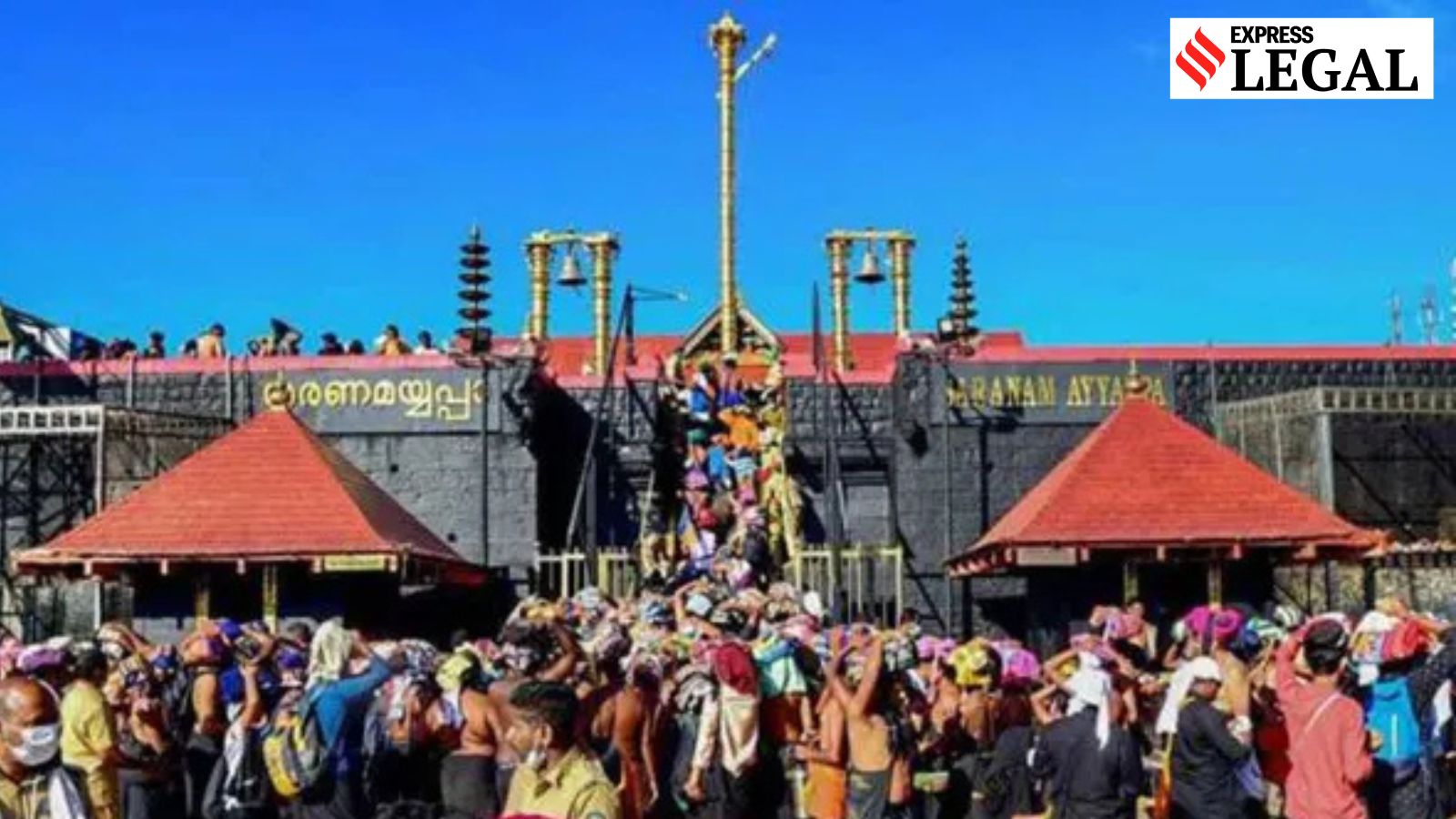
Over 16 days of hearings in the Sabarimala temple entry reference case, a nine-judge Constitution bench of the Supreme Court repeatedly grappled with a constitutional question far larger than the issue of women’s entry into the one temple.
With the bench, comprisingCJI Surya Kant, Justices B V Nagarathna, M M Sundresh, Ahsanuddin Amanullah, Aravind Kumar, Augustine George Masih, Prasanna B Varale, R Mahadevan, and Joymalya Bagchi, reserving its verdict on May 14, after a marathon hearing, it may redefine the relationship between constitutional morality, social reform, and denominational autonomy.
On Day 16 of the hearing, the Centre, represented by Solicitor General of India Tushar Mehta, argued thatArticle 25(1), which guarantees freedom of conscience and the right freely to profess, practise and propagate religion, does not itself provide for gender equality.
“Article 25(1) does not provide for gender equality for the simple reason that Articles 15 and 16 already prohibit discrimination on the grounds, inter alia, of sex,” he said.
Here’s are key takeaways from Supreme Court hearings
 Sabarimala temple case was heard by a nine-judge bench.
The bench also reflected on the role of denominations in preserving religion. Justice B V Nagarathna observed that denominations and religious organisations hold communities together around a shared philosophy and are necessary for the “perpetuation of religion” in the country.
Day 15: During the hearing, the bench observed that Articles 15, 16, 25 and 26 function on “different planes”, cautioning against conflating equality provisions with religious protections.
“If you start mixing up all like this, then there will be no religion in this country,” the court remarked.
Story continues below this ad
Justice Nagarathna also noted that Hinduism is often understood as a “way of life”, observing that a Hindu may continue to identify with the faith even without visiting a temple or performing rituals.
Chief Justice of India Surya Kant added that for many people, religion may simply mean “lighting a lamp inside their hut”, without the necessity of a formal place of worship. Justice Nagarathna further remarked that nobody could come in the way of individuals practising their faith.
Day 14: The bench raised broader constitutional questions about balancing social reform with the preservation of India’s civilisational identity while examining denominational protections under Articles 25, 26 and 30.
Justice Nagarathna observed that the framers of the Constitution were conscious of preserving India’s civilisational continuity while framing protections for religion.
Story continues below this ad
“Today, are we as a nine-judge bench going to upset the civilisation is the question,” she remarked during the hearing.
The court also reflected on the legitimacy of reform measures. Chief Justice Surya Kant observed that courts may accept social reform where it reflects the collective will of people expressed through elected representatives. However, he cautioned against reforms being “thrust” upon people in a manner that suppresses faith.
Day 13: Continuing the discussion on religion and constitutional identity, the bench questioned whether excessive judicial intervention in religious disputes could affect India’s civilisational character.
Justice Nagarathna remarked that despite India’s diversity and plurality, religion remained one of the enduring constants connecting individuals and communities.
“What is unique about India?” she asked, adding that the relationship between people and religion remained deeply intimate across society.
Story continues below this ad
Day 12: The nine-judge bench also questioned the maintainability of the original PIL challenging the Sabarimala practice.
Chief Justice Surya Kant remarked during the hearing that the PIL ought to have been “thrown outright in the dustbin”, signalling the court’s concerns over the threshold required for entertaining religious disputes through public interest litigation.
Day 11: On the role of PILs, Justice Nagarathna underscored that constitutional courts entertain such petitions only for genuine public causes.
“It is easy to get articles written for the sake of filing a PIL,” she observed, while cautioning against PILs motivated by publicity, politics or private interests.
Story continues below this ad
She added that public interest litigation had, in some cases, transformed into “private interest litigation, publicity interest litigation, paisa interest litigation and political interest litigation”.
Day 10: The Supreme Court observed that India’s diversity forms the basis of its constitutional strength and that denominational protections under Article 26 recognise and preserve that diversity.
“We are strong because we are diverse,” the bench observed, while discussing the constitutional recognition of denominations.
During arguments by senior advocate Indira Jaising on discrimination and women’s right to enter the temple, Justice Nagarathna questioned whether the claim was being raised by devotees directly connected with the temple or by individuals with no association with the denomination.
Day 9: The bench also discussed the scope of the right of religious institutions to regulate their affairs under Article 26. Justice A Amanullah observed that every religious institution necessarily requires rules governing entry, worship and administration.
Story continues below this ad
“There cannot be anarchy,” he remarked, adding that temples and dargahs require some authority to regulate practices and maintain order.
At the same time, the court observed that blanket exclusion could not ignore broader constitutional principles against discrimination, highlighting the tension between institutional autonomy and individual rights.
Day 8: One of the lighter moments during the otherwise intense constitutional hearing came when senior advocate Neeraj Kishan Kaul referred to an article written by Shashi Tharoor in The Indian Express while discussing comparative jurisprudence and openness to knowledge from different sources.
Responding to the submissions, Justice Nagarathna remarked, “But not from WhatsApp University.”
The bench also discussed what constitutes a religious denomination within Hinduism, with Justice Nagarathna referring to Shaivite and Vaishnavite traditions as examples of denominational practices protected under the Constitution.
Story continues below this ad
Day 7: The court further examined the limits of the State’s powers to introduce reforms in religious practices under Article 25(2)(b).
Chief Justice Surya Kant observed that social welfare and reform constitute a broad constitutional category and that the State cannot be considered an “alien” to such reform measures because it represents the will of the people.
However, the court noted that determining whether a reform measure genuinely falls within constitutional reform provisions or improperly interferes with religious practices would depend on the facts of each case. Justice Nagarathna also remarked during the hearing that conscience distinguishes human beings from animals, irrespective of the nature or quality of that conscience.
Day 6: The bench cautioned senior advocate J Sai Deepak against entirely questioning the judiciary’s power of judicial review while acknowledging that such powers are not without limitations. Deepak had argued that religious practices could not be challenged through writ petitions because the judiciary does not fall within the definition of “State” while exercising judicial functions.
Story continues below this ad
Responding to the argument, the court observed that while limitations on judicial review may exist, it would be difficult to argue that courts have “no power at all” to examine such matters.
Day 5: The hearing also saw extensive discussion on denominational identity and whether all sects within Hinduism could claim constitutional protection under Article 26. Justice Aravind Kumar observed that denominational practices could still be subjected to judicial scrutiny.
Justice Nagarathna questioned whether any religion could exist without some denominational character, citing Shaivism and Vaishnavism within Hinduism as examples.
Day 4: The bench also reflected on the role of constitutional courts in addressing issues involving religion and fundamental rights. At one stage, the court questioned why courts should wait for PILs in matters involving constitutional concerns and asked whether constitutional courts could exercise suo motu powers in appropriate situations.
Day 3: Senior advocate C S Vaidyanathan, appearing for the review petitioners, argued that courts should not decide whether a practice is “essential” to a religion. According to him, determining whether a practice is religious or secular may be relevant for deciding whether legislation can regulate it, but courts cannot themselves define what constitutes an essential religious practice.
During the hearing, Justice Nagarathna also observed that while access to temples and mutts should generally remain open, denominational exclusions within places of worship raised concerns that required careful constitutional scrutiny.
Day 2: Appearing for the State, Solicitor General Tushar Mehta argued that the right of entry into temples must also be examined from the perspective of devotees who believe certain restrictions form part of their faith.
He submitted that fundamental rights frequently intersect and that one individual’s assertion of rights may affect another’s constitutional protections. According to Mehta, the rights of devotees opposing entry restrictions had not been adequately examined in the earlier proceedings.
Day 1: On the opening day of the hearing, Solicitor General Mehta argued before the nine-judge bench that Indian society has historically accorded women a place of respect and reverence.
The hearings that followed would ultimately move far beyond the issue of temple entry alone, opening wider constitutional debates on religion, reform, judicial intervention and the future scope of denominational rights under the Constitution.

