

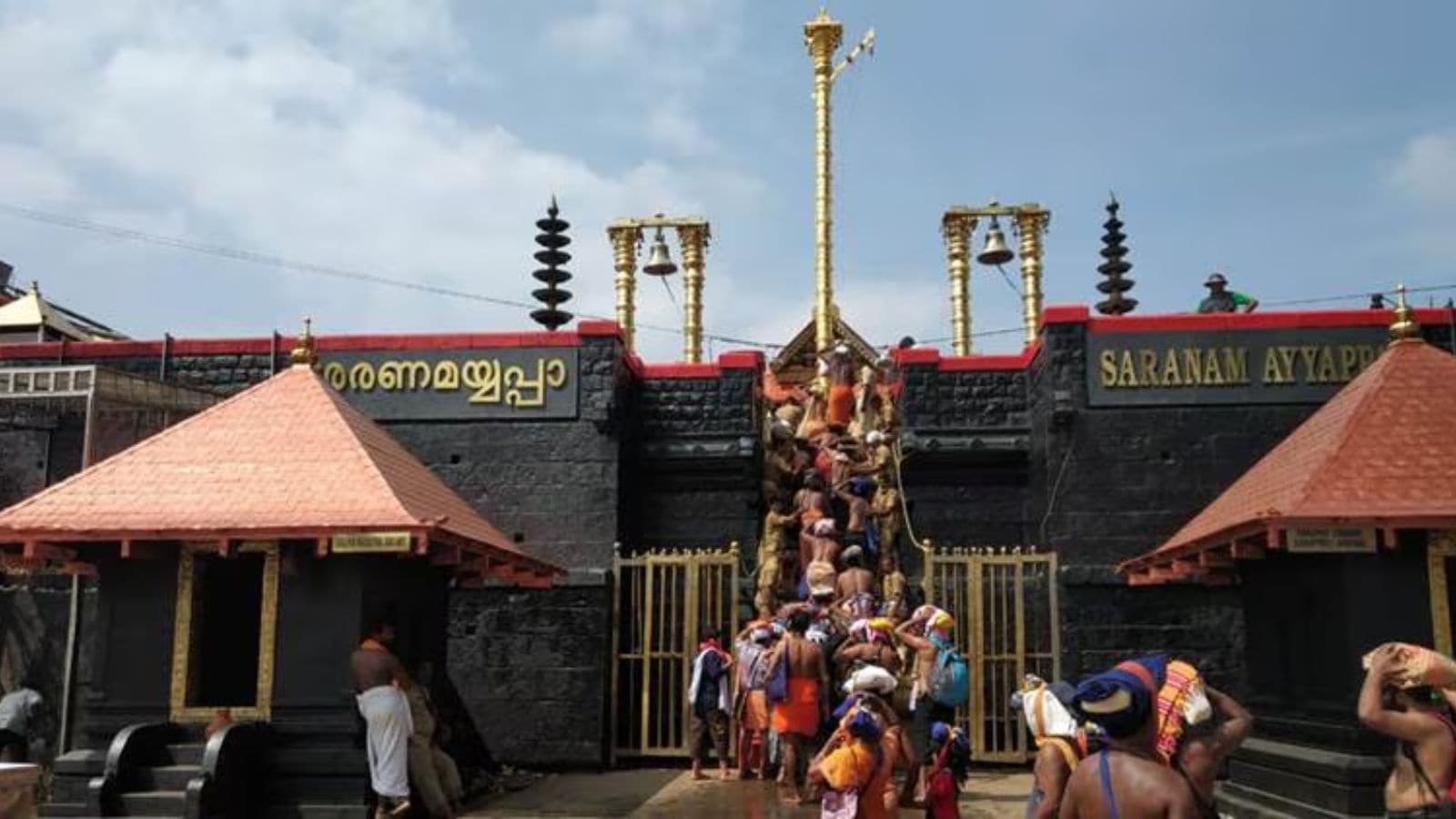
Sabarimala Reference Hearing Live Updates: The Supreme Court today raised questions about the constitutional balance between social reform and preserving India’s civilisation, while the apex court’s nine-judge bench considered the scope of religious denominations’ rights under Articles 25, 26 and 30 of the Constitution.
“But the framers were most conscious of what should be protected, that the civilisation must continue, and therefore, they have come to certain… articles are framed in a particular way. Today, are we as a nine-judge bench going to upset the civilisation is the question,” Justice Nagarathna said.

Story continues below this ad
The remarks came during Senior Advocate Guruswamy’s submissions on the distinction between the words “manage” and “control” in the Constitution, particularly in the context of minority and denominational rights.
Referring to the framers’ intent and debates in the Constituent Assembly, Justice Nagarathna observed that the Constitution was framed with an awareness of both societal drawbacks and the need to preserve what the framers believed must continue as part of India’s civilisation.
The top court also observed that courts may accept a reform measure if people, through their elected representatives, collectively seek social reform, but added that judicial interference may arise if something is “thrusted upon” people or used as a means of “gagging” them.
“If the people of this country, through their elected representatives, raise a common voice that this issue requires social reforms, probably the court will accept it as a social reform. But if it is against the wish and will of the people — something is thrusted upon them or, as a rule of gagging them, maybe the court will interfere,” CJI Surya Kant said.
The observation came after senior advocate Hansaria argued that if the state enacts a social welfare legislation, it should be upheld and not struck down on the ground that it interferes with religious practices.
The apex court also pointed out that whether menstruation is a taboo or not depends on your conscience.
“The question is how you view it and how a devotee or a non-devotee will view it,” Justice Nagarathan said.
The apex court continues hearing the Sabarimala case. This is day 14 of the hearing with the submission of the pleas by the intervenors.
The Supreme Court is hearing the pleas concerning discrimination against women at religious places, including the Sabarimala temple, and the scope of religious freedom under the Constitution.
What happened in the last hearing?
The Supreme Court, in its last hearing, observed that female genital mutilation is an aberration from normal human anatomy. The court observed while hearing the plea challenging the practice of female genital mutilation, which is tagged along with petitions related to discrimination against women at religious places, including the Sabarimala temple.
“Mutilation, the word itself, means that it doesn’t serve any purpose. It is like a contortion to a human anatomy…This is pure and pure aberration to a normal physical anatomy,” Justice Ahsaanuddin Amanullah said.
This came after senior advocate Sidharth Luthra, appearing for the intervenors in the female genital mutilation matter, submitted that the practice curtails a series of rights and that it falls foul of as many as three statutes.
“It is done at the age of 7 when a person is a minor incapable of giving consent, and because it is considered to be part of a belief system, though not ordained by the holy book,” Luthra said.
Constants in Indian society is relationship of humans with religion
Justice BV Nagarathna in the Dawoodi Bohras case highlighted that while India is a sovereign democratic republic, its core identity is a civilisation defined by an “intimate” relationship with religion, a constant that the court must respect even as it seeks to progress.
“What is unique about India as compared to any other region. See, we are a civilisation, why are we a civilisation despite having so many pluralities and diversities. I said diversity is our strength. We are still a civilisation, despite you may call a sovereign, democratic republic. There is a constant. One of the constants in our Indian society is the relationship of human beings, man, woman and child with the religion,” Justice Nagarathna said.
She further added, “Now how a religious practice or a matter of religion is questioned, where it is questioned, whether it can be questioned, whether it has to be a question within a denomination for a reform or whether the state will have to do or you want the court to adjudicate upon all these aspects. This is troubling us. What we lay down is for a civilisation that is India. India must progress despite all its economy, everything, there is a constant in us. We can’t break that constant”.
Nine-judge bench: Chief Justice of India Surya Kant will preside over the bench, which will include Justices B V Nagarathna, M M Sundresh, Ahsanuddin Amanullah, Aravind Kumar, Augustine George Masih, Prasanna B Varale, R Mahadevan and Joymalya Bagchi.
Questions for consideration: The 7 questions for consideration before the court are:
- What is the scope and ambit of the right to freedom of religion under Article 25 of the Constitution of India?
- What is the interplay between the rights of persons under Article 25 of the Constitution and the rights of religious denominations under Article 26?
- Whether the rights of a religious denomination under Article 26 of the Constitution are subject to other provisions of Part III of the Constitution, apart from public order, morality and health?
- What is the scope and extent of the word ‘morality’ under Articles 25 and 26 of the Constitution, and whether it is meant to include constitutional morality?
- What is the scope and extent of judicial review with regard to a religious practice as referred to in Article 25 of the Constitution?
- What is the meaning of the expression “Sections of Hindus” occurring in Article 25 (2) (b) of the Constitution?
- Whether a person not belonging to a religious denomination or religious group can question a practice of that religious denomination or religious group by filing a PIL?

