

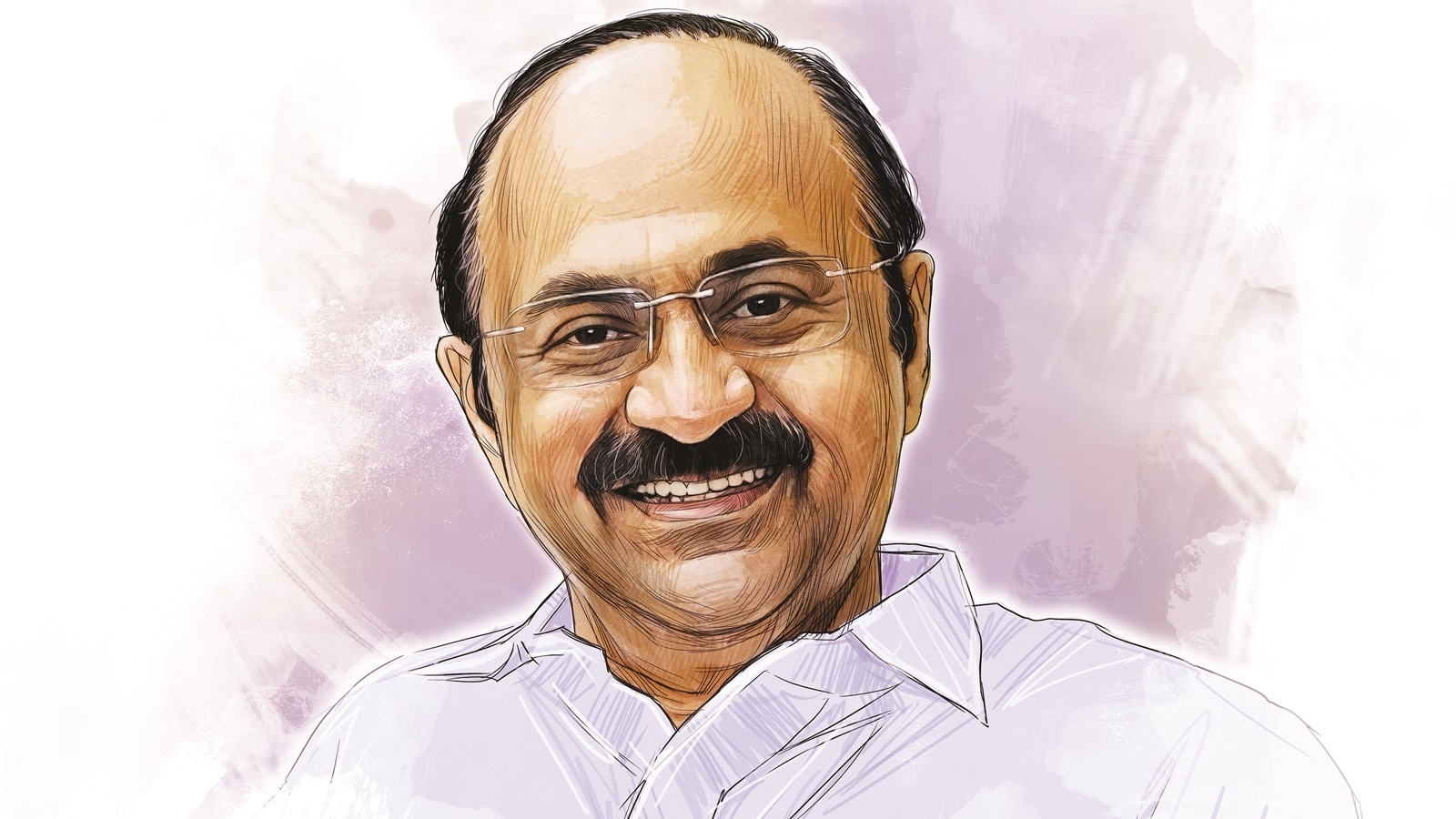
Congress leader VD Satheesan on the UDF’s victory in Kerala, anti-incumbency, organisational reforms and backdoor appointments. Moderated by Liz Mathew, Deputy Editor,
The Indian Express, this session was held on May 6.
Liz Mathew: The UDF’s (United Democratic Front) victory in Kerala is widely seen as having rescued the Congress. Many believe this election was driven more by public anger and anti-incumbency against the ruling government than by strong support for the Congress and its allies. What is your view?
We have secured the most wonderful victory in Keralam’s history over the last 50-60 years, after the 1977 election. In 1977, following the Emergency, we got 111 seats but the Congress itself had only 38 members in that Assembly. This time, the Congress alone has won 63 seats — the highest ever secured by the party in Kerala.
There are several factors behind this victory. First is definitely anti-incumbency against the government. We have been exposing the government in many sectors. Second, we started doing our homework two years back to ensure that wherever the government failed, we should have an alternative. We appointed many commissions, conducted health, education and industry conclaves. We interacted with many experts and prepared documents that were presented to the people.
I conducted a yatra (the 30-day UDF Puthuyuga Yatra in early 2026) from north to south Kerala. Usually, these yatras are all about politics but we spent 75 per cent of the time explaining future Kerala projects. People believe that if they (UDF) come to power, wherever the government failed, the UDF will have alternatives. They will bring a new Kerala.
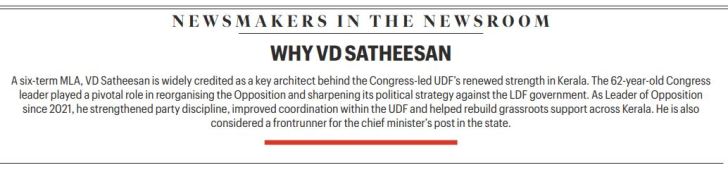
When I took over this position in 2021, we were in a very vulnerable situation. We had 41 seats and all the leaders and workers were demoralised. We worked hard. From 2005 onwards, many social groups had left the UDF but we worked to bring them back on our side. Now the UDF is not only a confederation of various political parties, it is a broader political platform. We have many political parties, social groups, individuals, opinion makers, influencers, the press and the ‘Left’ fellow travellers — meaning those who have been travelling with the CPM for the last three or four decades. Now the LDF is not the Left anymore, they are the extreme Right. We are the Nehruvian Left. The Left fellow travellers, who were with CPM for a long time, believed in our progressive stand. So many leaders left from their side. Several contested in the election as independent candidates with the support of the UDF and many won the election. Now the CPI(M) is facing disintegration. If they do not correct themselves, there is no doubt that what happened in Bengal and Tripura will be repeated in Kerala.
Another factor for our victory was that we had taken an adamant stand on secularism. Whenever any religious leader, no matter who it is, started any hate campaign, we said no. We said don’t speak communalism. When the Social Democratic Party of India (SDPI) offered support to us, we said no. A major community in Kerala, their leader spoke communalism.
Story continues below this ad
Also, there was credibility among the people about what we said and credibility is very important in politics.
Liz Mathew: You were the face of the Opposition but it seems multiple factors and personalities have come to the fore as the leadership issue is being clinched. What are the factors that will be taken into consideration to decide on the leadership?
Our party is a national party. There is a procedure adopted by the All India Congress Committee (AICC) to select a Congress Legislature Party (CLP) leader for the Chief Minister (CM) candidate. There will be a CLP meeting. Observers were sent by the high command and they will take a decision following the procedure.
On coalition politics | ‘Coalition is very important in future politics. For the Congress party also, coalition is very important. We have to plan a coalition agenda and a system, only then will we be able to win elections’
Liz Mathew: You may argue that the Congress is united but many believe that this peace was maintained only for the sake of the election. How do you look at that?
Story continues below this ad
There were groups in the Congress party for a long time, from the ’60s to the ’80s. There were also groups in 2001, when K Karunakaran and AK Antony were here. Even now there are some groups, but they are not bigger than the party in Kerala. That was our aim. I am the first Opposition leader in the history of the Kerala Congress Party who doesn’t have any group. I’m not against any group, but I’m very strict that groups do not become more dominant than the party. UDF is now known as team UDF. When we divided the seats among the UDF partners, there was not a single voice of dissent. We are working like a single party inside and outside the Assembly. Our team UDF is a model for coalitions in the entire country, on how a coalition should work. More than 10 parties are working together with a single voice. We meet every month to decide everything and work together for a conclusion. It is a democratic process.
Liz Mathew: If you forget this race for a moment, what is your view on KC Venugopal and Ramesh Chennithala as Congress leaders?
They are both good as Congress leaders. KC Venugopal is very close to me. We were together in the Assembly. We worked together in the state unit of National Students’ Union of India (NSUI), and we were together in the Youth Congress. At that time, he was the NSUI State President and the State President of the Youth Congress. I was denied many opportunities.
Ramesh Chennithala was our senior leader. When we were in the student movement, he was in the youth movement. When we were in the youth movement, he was in the party, at the national and regional level. They are all competent and we are all very close to each other.
Story continues below this ad
Jatin Anand: Except for Himachal Pradesh, your party now seems to be largely in power only in southern India. Do you see this as an organisational challenge for the Congress going forward? Secondly, you said the UDF is a model for coalition governments across the country. In the context of the recent Assembly election results, what role should the Congress play to bring Opposition parties together?
As you said, Congress is only in power in Karnataka, Telangana, Himachal Pradesh and now Kerala. My opinion is that political parties should be election-oriented. For winning elections, we need to strengthen the organisational setup at the bottom level. We have done that. In all polling booths, we had committees and we used to enrol new voters. We used to do social engineering at the micro level in each panchayat, at the local level. Election engineering is an art. You have to do election work with surgical precision. Whenever we have failed, we have come back. We got only 41 seats in 2021. In 2016, we got 48 seats. In 2026, it is 102. Congress tripled its number.
Organisation should be strong, only then we will we be able to propagate our ideas. My advice or request is to strengthen the party at the first level. Then there should be proper political narratives. We have to study national level politics as well as state level priorities. The political leaders should start thinking about the future. There should be a long-term perspective. Political leaders should discuss the future of the states. Only then will we be able to come back to power in many states. In many places, they use outdated election campaigns. We have to discuss with the people, youngsters too. If we want to communicate with Gen Z, we have to understand their vocabulary and thought process. We have to discuss with various sectors of people — farmers, fishermen, business community and so on.
On talks with religious leaders | ‘For some matters, we have to discuss with them, we have to interact with them… But political decisions have to be taken by political parties alone. Nobody, no religious parties, should be allowed to intervene’
For the second question, coalition is very important. We are the pioneers in coalitions… Like I said, UDF is not a confederation of various political parties, it is a broader political platform. Whenever a coalition party’s candidate is contesting, all other coalition parties should work to make sure they win. Coalition is very important in future politics. For the Congress party also, coalition is very important. We have to plan a coalition agenda and a system, only then will we be able to win elections. We have to win elections; that is very important.
Story continues below this ad
Nidheesh MK: You have never been a minister and have no administrative experience. Do you think the state would benefit from someone with administrative experience, who has been a minister, as the CM candidate?
I have been in the Kerala Assembly for 25 years and we used to discuss all kinds of matters. If you want to speak for 15 minutes, you have to do your homework for at least three hours and need to be updated on everything related to it. The financial situation in Kerala is vulnerable but we have alternatives to strengthen it through better financial management, improved tax administration to prevent leaks of exchequer, and measures to stimulate the economy.
Administrative experience is not everything. VS Achuthanandan did not have administrative experience. When Narendra Modi became CM, what was his administrative experience? He was a party organiser, not even a senior parliamentarian.
I often say to my business friends that governance is like running a business. You need planning, team building, implementation and communication. Selecting the right people shows leadership, then project implementation and marketing. Good governance is very important. In a private company, if a manager is given six months to complete a task and fails, he will be held accountable, but a bureaucrat may take six years instead of six months but nothing happens because he is not accountable. So accountability must be legalised. Officials should be answerable. Leadership must create a system and culture that others follow. Performance auditing should be done regularly. You have to interact with experts, finalise priorities. That is administration.
Story continues below this ad
Arun Janardhan: Over the last decade, the CPM has been accused of creating a large beneficiary ecosystem, not just through backdoor appointments but also through politically-backed organisations and shadow institutions. Now that the UDF is set to take charge, are you prepared to take politically difficult decisions to clean the system, even if it leads to resistance or compromise pressures from the CPM?
We have to take action on those things, especially the backdoor appointments. You are also sabotaging the constitutional system. When you are appointing somebody through the PSC (Public Service Commission) and through the employment exchange, there will be reservation but when you include people through the backdoor, there is no reservation. You are violating constitutional principles. So everybody appointed through the backdoor will be out. We will take strict action and give directions to various departments. We have also said this in the manifesto. The departments where there are vacancies have to report it within 24 hours. Then the PSC has to give them a memo and they will be appointed.
The fiscal situation is very poor. Why? We have shifted from VAT to GST. GST is an end-point tax, consumer-point tax. Kerala is the number one consumer state in the country. In my opinion, Kerala would have been the number one beneficiary in the GST system. But, unfortunately, the tax growth average is below 10. The next thing is that we have to restructure the entire tax administration according to the provisions of the GST. The tax administration structure is very poor.
Arun Janardhan: While in Opposition, your party raised several allegations against the CPM. Now that you are in power, will you pursue investigations in those cases or could there be political compromises?
Story continues below this ad
I assure you that there won’t be any unholy political compromises… The police, gundas, through political criminals, they attacked us for 10 years. When the CM was conducting a yatra from north Kerala to south, we protested by showing the black flag. Our CM was very allergic to the black flag. His police and gundas attacked our youngsters, our students. He called attacking the youngsters a rescue operation, otherwise they would have been killed by accident. So many youngsters were brutally attacked. We will investigate all those cases. We have made allegations against the government to be investigated. There should not be any political vendetta, but for the interest of the state, it has to be investigated.
Liz Mathew: What is your view on the political discourse in Kerala? People like EMS Namboodiripad and K Karunakaran debated with dignity. In your case, one political and social leader called you a liar on social media and vice versa happened.
In Kerala, the CPM started such campaigns. It is not only against political opponents, it is also against the media, especially women journalists. Many of them were attacked by the CPM social media handles.
What are their ethics? I have always had a good name in the press and the public that I do my homework and present a case with statistics. If you would ask me a question on something I don’t know about, I would admit that I don’t know. I would only answer after studying the topic. The CPM wanted to tarnish that image. That is why they started a campaign saying that I’m a liar. But I proved, with one dozen reasons, who the liar was. I counter-attacked. As you said, in politics, there should be a discourse. A democratic process is a proper discourse and the outcome should be beneficial to the public. For example, when the government introduced the silver line speed corridor for the railway, we opposed it after discussing the environmental and fiscal aspects with experts. We started an agitation that climate change was a major component. Kerala’s geographical situation was the main thing. We are the only legislature which discussed the IPCC (Intergovernmental Panel on Climate Change) report.
Story continues below this ad
Liz Mathew: In recent years in Kerala, leaders across the UDF, LDF and BJP-led NDA have increasingly engaged with religious and caste leaders to build political understanding and mobilise support. You have said that people voted beyond such considerations. Do you think political parties still need to keep religious and caste leaders in their good books and consider their views while deciding policies and selecting candidates?
For some matters, we have to discuss with them, we have to interact with them. If they have any problems or a particular community is facing injustice, we have to discuss with them and stand with them. But political decisions have to be taken by political parties alone. Nobody, no religious parties, should be allowed to intervene in political decisions. When they are asking us to sit in front of them, we can sit, but we shouldn’t lie down on the floor; don’t crawl.

