

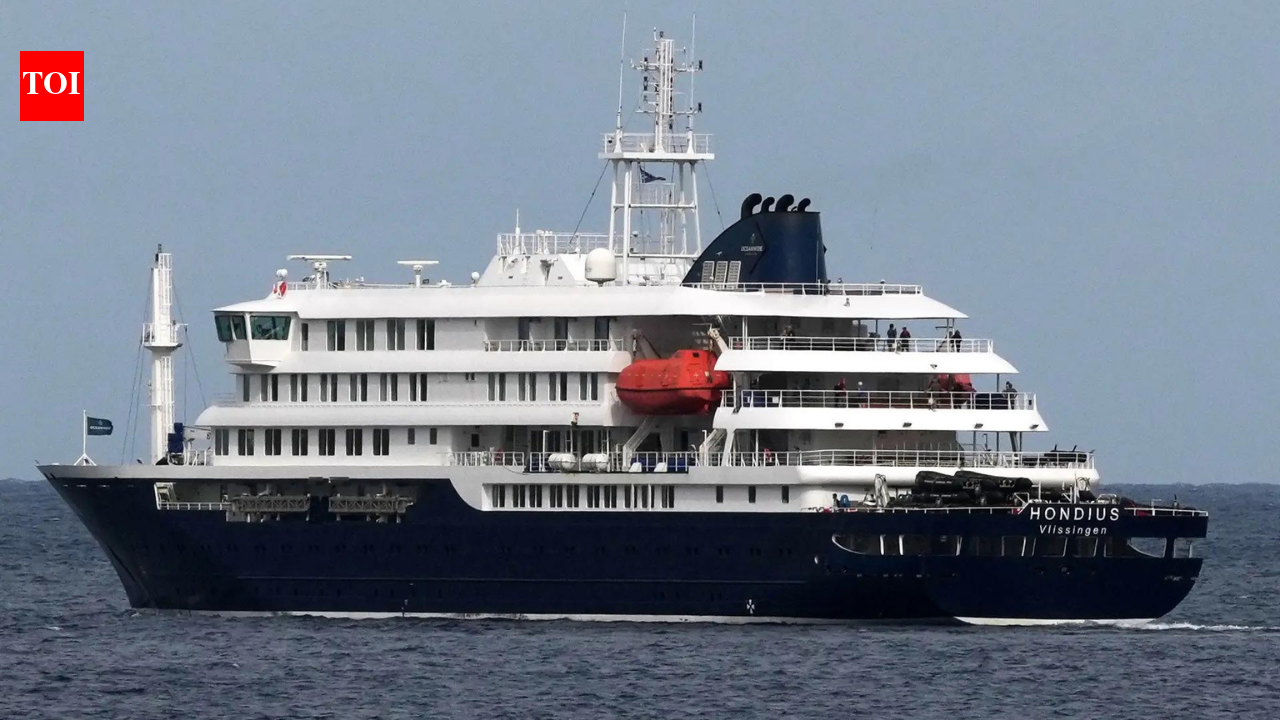
File photo: The MV Hondius cruise ship departs the port in Praia, Cape Verde (Picture credit: AP)
NEW DELHI: Two Indian nationals aboard a cruise ship linked to a hantavirus outbreak are asymptomatic and under observation in accordance with established international health protocols. Meanwhile, director of the ICMR’s National Institute of Virology (NIV) Dr Naveen Kumar said on Friday that there is “no immediate public health threat” to India as the reported cases appear to be isolated.Kumar said there was currently no evidence of community spread and stressed that hantavirus does not spread easily between humans unlike Covid-19.
“The reported hantavirus cases appear to be isolated ones and there is no immediate public health threat to India,” he was quoted as saying by news agency PTI.His remarks came after reports that two Indian nationals aboard the cruise vessel MV Hondius were detected with hantavirus.Meanwhile, sources cited by news agency ANI claimed that the Union health ministry is closely monitoring the evolving situation in coordination with the National Centre for Disease Control (NCDC), Integrated Disease Surveillance Programme (IDSP), WHO and other international health authorities.Also read| Explainer: Can hantavirus outbreak become Covid 2.0?According to the World Health Organisation, the Indian passengers were among a small cluster of suspected infections identified aboard the ship, with health authorities monitoring contacts and taking precautionary measures.As per preliminary information shared through WHO under the International Health Regulations (IHR) framework, a total of eight probable hantavirus cases have been reported onboard the vessel, of which five have been laboratory confirmed, sources told ANI. Three deaths have also been reported.
WHO says public risk remains low
As quoted by news agency AFP, WHO spokesperson Christian Lindmeier said the outbreak posed minimal risk to the general public.“This is a dangerous virus, but only to the person who’s really infected, and the risk to the general population remains absolutely low,” Lindmeier said during a briefing in Geneva.WHO director-general Tedros Adhanom Ghebreyesus also said the organisation assessed the public health risk as low, though more cases could emerge because of the virus’s incubation period.According to WHO, the virus involved is the Andes strain of hantavirus, which has limited capability of human-to-human transmission and generally requires close and prolonged contact for spread.The Dutch-flagged cruise ship carrying more than 140 passengers and crew is headed to the Canary Islands, where Spanish authorities are preparing isolated evacuation procedures.At least three passengers have died and several others have fallen ill.
How hantavirus spreads
Dr Kumar explained that hantaviruses are mainly transmitted through contact with infected rodents or their saliva, urine and faeces.“People usually get infected by inhaling aerosolised virus particles from rodent urine, droppings, or saliva in closed or poorly ventilated spaces such as warehouses, ships, barns and storage areas,” he said.He added that person-to-person transmission is “extremely uncommon”, noting that only limited transmission had been documented in certain South American strains such as the Andes virus.Public health experts say symptoms can initially resemble influenza, dengue or severe respiratory illness, making diagnosis difficult in the early stages.
India has adequate surveillance capacity
Kumar said India has sufficient laboratory infrastructure to detect suspected hantavirus cases through the ICMR-NIV and the nationwide Viral Research and Diagnostic Laboratory Network.“India has diagnostic capacity for hantavirus infection through the ICMR-National Institute of Virology and the nationwide Viral Research and Diagnostic Laboratory Network of 165 labs,” he said.He said symptoms generally appear one to five weeks after exposure and include fever, severe body ache, headache, fatigue, nausea, abdominal pain and dry cough.Severe cases may involve breathing difficulties, low blood pressure and kidney complications.
Global contact tracing underway
Health authorities across multiple countries are tracing passengers who disembarked before the outbreak was confirmed.The WHO confirmed hantavirus in a ship passenger on May 2, nearly two weeks after the first death on board.Several countries, including the UK, South Africa and the Netherlands, are monitoring possible contacts. None of the remaining passengers or crew aboard the vessel are currently symptomatic.In view of the evolving situation, the Public Health Emergency Operations Centre (PHEOC) under IDSP and NCDC convened a high-level review meeting involving senior officials to assess preparedness measures.The Union health ministry is maintaining close coordination with WHO and other international partners while proactively undertaking necessary public health measures, the sources added.

