

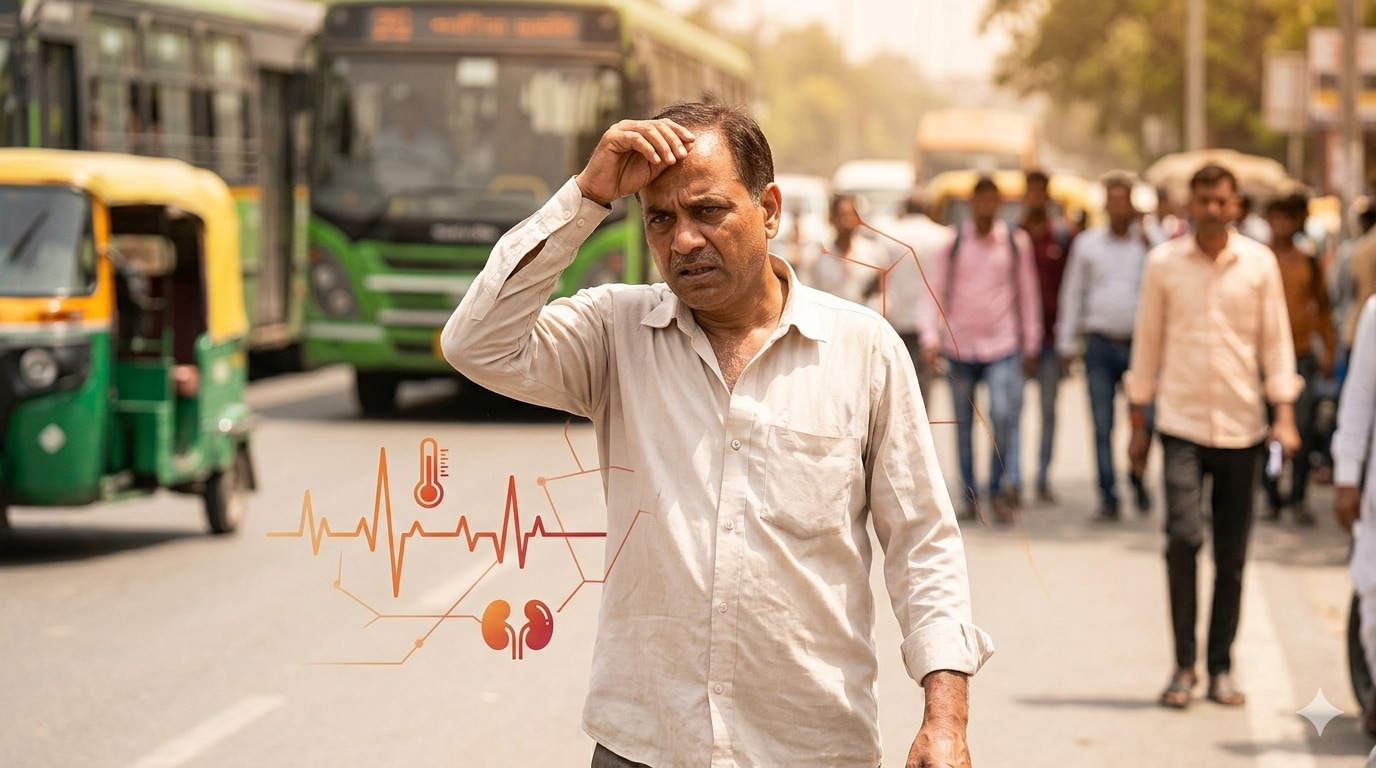
A 62-year-old man collapsed after a routine morning walk between 8 am and 9 am. Being hypertensive, diabetic and having a stent in his heart, he was always cautious about stepping out in midday heat. Still, he felt dizzy, weak and sweated profusely when he entered the OPD of Dr Rommel Tickoo, Director, Internal Medicine, Max Healthcare, Delhi. “Then his sweating reduced, a dangerous transition indicating failure of the body’s cooling mechanism. Nausea followed, he could neither eat or drink anything. He complained of mild breathlessness, gradually became disoriented and drowsy, eventually requiring assistance to walk and collapsing in a heap. His heart was under stress,” says Dr Tickoo.
By the time he was evaluated, his temperature was elevated, his blood pressure had dropped and his pulse was high. His blood sugar had risen sharply to 250 mg/dL, a stress response compounded by dehydration. Laboratory findings revealed creatinine at 1.8 (normal upto 1.3 mg/dL) pointing to acute kidney injury, sodium at 150 mmol/L (normal being upto 145 mmol/L), reflecting significant dehydration. An ECG confirmed a very high heart rate that could trigger a heart attack and stroke. “His stressors were heat exhaustion, dehydration, electrolyte imbalance and evolving organ dysfunction. We sponged him to cool down his body, gave intravenous fluids, monitored his urine output, gave insulin for blood sugar. Within two days, he improved and returned to baseline. What he didn’t know was that even half-hour of easy walking outdoors was enough for him to develop heat stress, when the body’s thermal regulation is overwhelmed, and putting his heart at risk,” he says.

Heat stress can build up rapidly, even with little exposure, because the body cannot dissipate absorbed heat easily. “Not many know that extreme heat forces the heart to work harder, increasing heart rate and output to boost blood flow to the skin for cooling. This strain is driven by dehydration, reduced blood volume, and widened blood vessels, which can lead to cardiovascular disease exacerbations, including hypertension, heart failure, arrhythmias, and acute myocardial infarction,” says Dr Tickoo.
The long-term effects of heat stress
The WHO identifies heat stress as the leading cause of weather-related deaths, which can exacerbate underlying conditions like cardiovascular disease, diabetes, and mental health. Extreme heat now poses a risk to 57 per cent of Indian districts – home to 76 per cent of the population – according to a new independent study launched today by the Council on Energy, Environment and Water (CEEW). The study finds that the top ten most heat-risk-prone states and UTs are Delhi, Andhra Pradesh, Goa, Kerala, Maharashtra, Gujarat, Rajasthan, Karnataka, Tamil Nadu, and Uttar Pradesh. In dry north India, humidity over the past decade has increased by 50 per cent. This significantly raises the ‘felt’ temperature, sometimes by 3-5°C more compared to the recorded air temperature, making even moderate heat more dangerous.
“When body temperature exceeds 37°C, sweating is the primary cooling mechanism, but high humidity hinders evaporation. That’s why those living in urban heat islands across our cities are exposed to adverse consequences of heat stress. But this is mostly unrecognised,” says Dr Dileep Mavalankar, former director of the Indian Institute of Public Health Gandhinagar and the creator of Asia’s first city-wide Heat Action Plan (HAP) for Ahmedabad in 2010.
“Medically, only about one-tenth of heat-related illness presents as direct conditions such as heat stroke, where proteins change structure and cannot function properly, or heat syncope, when blood pressure drops suddenly or when blood pools in the legs. The remaining 90 per cent involve indirect impacts, which target key organs,” says Dr Mavalankar.
For example, the heart pumps faster, often increasing by 10 beats per minute for every degree the body’s internal temperature rises. “Rapid blood vessel expansion can lead to lowered blood pressure, causing dizziness, weakness and fainting. Excessive sweating reduces blood volume, which means the heart has to work harder to circulate the remaining blood, which can trigger irregular heartbeats or worsen pre-existing heart conditions,” he says.
Story continues below this ad
If the kidneys are already vulnerable, then intense heat leads to rapid fluid loss through sweat, reducing blood flow to the kidneys and increasing uric acid concentrations. “Repeated episodes of heat strain, dehydration, and subclinical injury can cause permanent renal damage, known as kidney failure,” says Dr Mavalankar. Those with lung disease, diabetes, and other chronic conditions similarly worsen under heat stress. “Heat increases the rate of insulin absorption. People with diabetes are more vulnerable to heat exhaustion and heat stroke because diabetic nerve damage can inhibit sweating and prevent the body from cooling down. In patients with comorbidities, even 15 to 30 minutes of exposure can significantly stress the heart,” he adds.
Pregnant women are more sensitive to heat stress due to increased blood volume, nearly seven litres by the end of pregnancy, and a lower ratio of body surface area to mass, making it harder to shed heat. “Prolonged heat stress affects pregnant women silently. Intense heat can reduce blood flow to the placenta and increase foetal heart rate. It can impact the function of placenta, which may lead to lower birth weights. Intense heat exposure in the first trimester may contribute to birth defects. Heatwaves increase risks of heatstroke, fainting and high blood pressure,” says Dr Tickoo. He even warns of heat interfering with medication. “Diuretics increase urine production. So if you sweat more, there’s a compound effect, depleting body fluids and causing potentially dangerous drops in potassium,” he warns.
How to track heat illnesses
Dr Mavalankar has long argued that the real burden of heat is grossly underestimated because of how it is measured. During the Ahmedabad heat wave of 2010, there were more than 800 additional deaths. Yet very few were officially classified as heat-related. “Most were recorded under routine causes such as cardiac or renal failure. The correct approach is to track all-cause mortality. If a city like Delhi typically records 300 deaths a day and that number rises to 500 during a heatwave, those excess deaths must be counted — even in the absence of a formally declared epidemic. The same principle applies to morbidity. Emergency room visits rise sharply during heat events, hospital admissions increase, and ambulance calls surge. Government clinic registrations and footfall go up. These are all measurable signals, yet very few cities systematically count or analyse them,” he says.
According to Dr Mavalankar, this data should be automatically captured through computerized systems and shared with institutions such as the Indian Institutes of Technology and local universities for rigorous analysis.
Story continues below this ad
He also points out the need for structured governance. Cities should have designated leadership for heat response, much like vaccination programs. “Places like Nagpur have discussed the idea of a Chief Heat Officer to coordinate action. Nationally, efforts by the National Centre for Disease Control to create pooled data systems are steps in the right direction, but without mandatory reporting and integration, their impact remains limited. A national dashboard combining mortality, hospital data, ambulance calls, and clinic visits would provide a far clearer picture of the crisis and create a unified heat protocol for prevention,” says Dr Mavalankar.
Beyond illness
The effects of heat extend well beyond immediate illness. Worker productivity declines, increasing economic strain. The risk of accidents rises. Mental health conditions deteriorate, often manifesting as irritability and even road rage.
After 2010, Ahmedabad implemented a Heat Action Plan, supported by the National Disaster Management Authority, which later expanded similar frameworks to over 400 cities. “However, these plans lack a legal mandate and dedicated budgets, limiting their effectiveness. Ahmedabad remains the only city in South Asia to demonstrate a substantial impact of a heat action, with mortality falling by about 40 per cent after implementation,” says Dr Mavalankar.
The Ahmedabad model initiated “cool roofs” with reflective white paint in low-income neighborhoods, reducing indoor temperatures significantly. Many cities, including Delhi, have since adopted a multi-layered approach: early warning systems, public awareness, capacity building for health professionals, and emergency response. “A combined data-driven approach is needed, incorporating climate projections and hyperlocal vulnerability assessment. Then heat alerts can protect those at risk and help people plan workarounds during high heat,” says Dr Mavalankar. Last year, data obtained by PTI under the Right to Information (RTI) Act showed that the National Centre for Disease Control (NCDC) reported 7,192 suspected cases of heatstroke. “Given India’s NCD burden, heat stress should be emphasised as an independent risk factor,” says Dr Mavalankar.

