



NEW DELHI: As parts of India sizzled and heatwave conditions were forecast across regions for the next seven days, India Meteorological Department (IMD) Saturday issued comprehensive heatwave safety guidelines and advised citizens to take necessary precautions that include avoiding prolonged exposure to direct sunlight and strenuous outdoor activities during high-temperature periods.IMD, through these advisories covering informal and gig workers, and all those who have to work out in the open, lays down the dos and don’ts. It asked civic and health authorities to be ready with adequate support with drinking water, shelter and emergency kit carrying umbrella, head cover, hand towel, hand fan and electrolyte/glucose/oral rehydration. The health impacts of heatwaves typically involve dehydration, heat cramps, heat exhaustion and/or heat stroke.The advisory comes at a time when maximum temperatures in many parts of northwest, central and peninsular India are ranging from 40-45 degrees Celsius, with the highest maximum temperature of 47.4 degrees being recorded at Banda (UP) Saturday. In several regions, temperatures have been observed to be markedly above normal by five degrees or more.The Met department’s extended temperature outlook on Saturday indicated that heatwave conditions are likely to persist across multiple regions over the next seven days, particularly in parts of northwest India (Punjab, Haryana, Delhi, Rajasthan, Uttar Pradesh); central India (Madhya Pradesh, Chhattisgarh, and Vidarbha region of Maharashtra); and select southern regions (Kerala and Mahe).
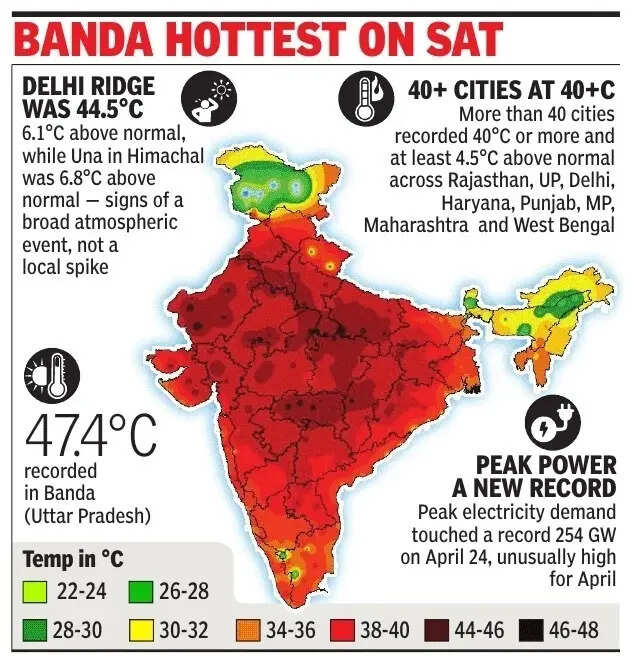
Banda hottest on Saturday
In addition, hot and humid weather conditions are expected in coastal states, including Odisha, West Bengal, Tamil Nadu and Andhra Pradesh, while warm night conditions may continue in northern plains, compounding heat stress during night time.A heatwave is a period of abnormally high temperatures, more than the normal maximum temperature that occurs over a particular region during the summer season. It typically occurs between March and June, and in some rare cases even extend till July. The extreme temperatures and resultant atmospheric conditions adversely affect people as they cause physiological stress, sometimes resulting in death.According to IMD, heatwave is considered if the maximum temperature of a station reaches at least 40 degree C or more for plains and at least 30 degree C or more for hilly regions. Based on departure from normal criteria, heatwave is considered when the departure from normal is 4.5 degree C to 6.4 degree C. If the departure is more than 6.4 degree C, it is called severe heatwave condition.Based on actual maximum temperature, it is called heatwave if the maximum temperature is more than 45 degree C and called severe heatwave if it crosses 47 degree C. IMD declares heatwave when such criteria meet at least in two stations in a meteorological sub-division for at least two consecutive days. Heatwave is then declared on the second day.As far as the coastal area is concerned, heatwave is declared only when maximum temperature departure is 4.5 degree C or more from normal and the actual maximum temperature is 37 degree C or more.“Quantitatively, there are different thresholds used around the globe for declaring heatwaves. It is usually defined based on the temperature thresholds over a region in terms of actual temperature or its departure from normal. In certain countries, it is defined in terms of the heat index based on temperature and humidity or based on the extreme percentile of the temperatures,” said the IMD in its FAQ on heatwave.

