

6 min readNew DelhiApr 22, 2026 05:51 PM IST
Supreme Court news: The Supreme Court has ruled that courts cannot throw out a civil suit merely because the correct court fees haven’t been paid without first giving the plaintiff a chance to fix the defect, setting aside a Madras High Court order that had rejected a Rs 53 crore commercial claim at the threshold.
A bench of Justices Padimighantam Sri Narasimha and Alok Aradhe was hearing an appeal filed by MARG Limited challenging the Madras High Court’s July 28, 2025 decision rejecting its plaint and revived a dispute over an alleged unpaid portion of a larger Rs 105 crore property transaction.

“The deficiency in valuation or court fee does not, by itself, render the suit non-maintainable at the threshold. It is a defect which is capable of being remedied, and the law expressly provides a mechanism for such rectification. The High Court, in overlooking this statutory requirement, has effectively denied the appellant an opportunity to cure the defect…The impugned order, to this extent, therefore, suffers from a manifest error of law,” the court said on April 21, adding that denial of such an opportunity defeats the statutory safeguard built into the law.
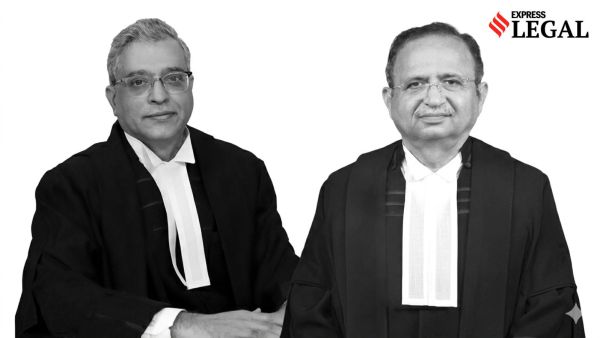 Justices Padimighantam Sri Narasimha and Alok Aradhe of the Supreme Court said that the high court denied the plaintiff an opportunity to cure a defect that is legally curable. (Image enhanced using AI)
Supreme Court: Two-step process mandatory
- Setting aside this approach, the Supreme Court clarified that under Order VII Rule 11 (b) and (c), rejection of a plaint on grounds of undervaluation or insufficient court fees requires a two-step process.
- First, the court must determine that the valuation is incorrect or court fees are deficient and second, it must grant the plaintiff time to correct the defect.
- Only upon failure to comply with such a direction can the plaint be rejected.
- The bench emphasised that the high court bypassed this mandatory requirement, thereby denying the plaintiff an opportunity to cure a defect that is legally curable.
High court erred on court fees, maintainability
The matter arose after the Madras High Court allowed a revision petition filed by the defendants and rejected the plaint at the threshold.
It held that the suit, though framed as one for injunction, was in substance a claim for recovery of approximately Rs 53-55 crore and therefore required payment of ad valorem court fees, which had not been paid.
Ad valorem court fees are mandatory legal charges calculated as a percentage of the monetary value of the subject matter, property, or damages claimed in a lawsuit.
Derived from Latin meaning “according to value,” these fees scale with the claim amount, unlike fixed fees. Common examples include suits for money recovery, partition, and property possession.
Story continues below this ad
The high court further concluded that the transaction between the parties stood concluded upon execution of registered sale deeds and that no independent cause of action survived, leading it to hold the suit as not maintainable.
The court made it clear that technical lapses like undervaluation are curable and cannot be used to short-circuit a full trial where a substantive cause of action exists.
Dispute over Rs 105-crore commercial arrangement
The case stems from a complex commercial transaction involving a Chennai IT property developed by MARG Limited.
In early 2023, amid financial difficulties, the company entered into negotiations with the respondents, culminating in a memorandum of agreement structuring a transaction valued at approximately Rs 105 crore.
Story continues below this ad
Under the arrangement Rs 32.5 crore was paid directly to a bank to settle outstanding dues, eight sale deeds were executed in April 2023 transferring the property and an additional Rs 53 crore was allegedly payable under the MoA, linked to post-sale obligations such as refurbishment and leasing.
The company alleged that this balance amount remained unpaid despite partial implementation of the transaction.
‘Mini-trial’ at threshold not permissible
The Supreme Court also faulted the high court for examining the merits of the dispute at the stage of deciding an application for rejection of plaint.
It reiterated that the plaint must be read as a whole and its averments assumed to be true.
Story continues below this ad
Courts cannot assess the correctness of those averments at this stage.
Questions such as enforceability of agreements must be decided only after trial
By analysing whether the memorandum of agreement (MoA) was a concluded contract, the high court had effectively conducted a “mini-trial”, which the Supreme Court held to be impermissible.
Plaint shows ‘triable issue’
Rejecting the high court’s finding of absence of cause of action, the Supreme Court held that the plaint disclosed a “live and subsisting dispute”.
Story continues below this ad
It noted that the pleadings contained detailed accounts of negotiations, including WhatsApp exchange, assertions of a composite commercial arrangement, evidence of partial performance through sale deeds and allegations of breach involving non-payment of Rs 53 crore
These, the Supreme Court said, constituted a clear cause of action requiring adjudication in a full-fledged trial.
Relief granted
Allowing the appeal, the Supreme Court set aside the Madras High Court’s order rejecting the plaint, directed the trial court to give the plaintiff an opportunity to correct valuation and pay proper court fees and restored the suit for adjudication on merits
There was no order as to costs.

© IE Online Media Services Pvt Ltd

