

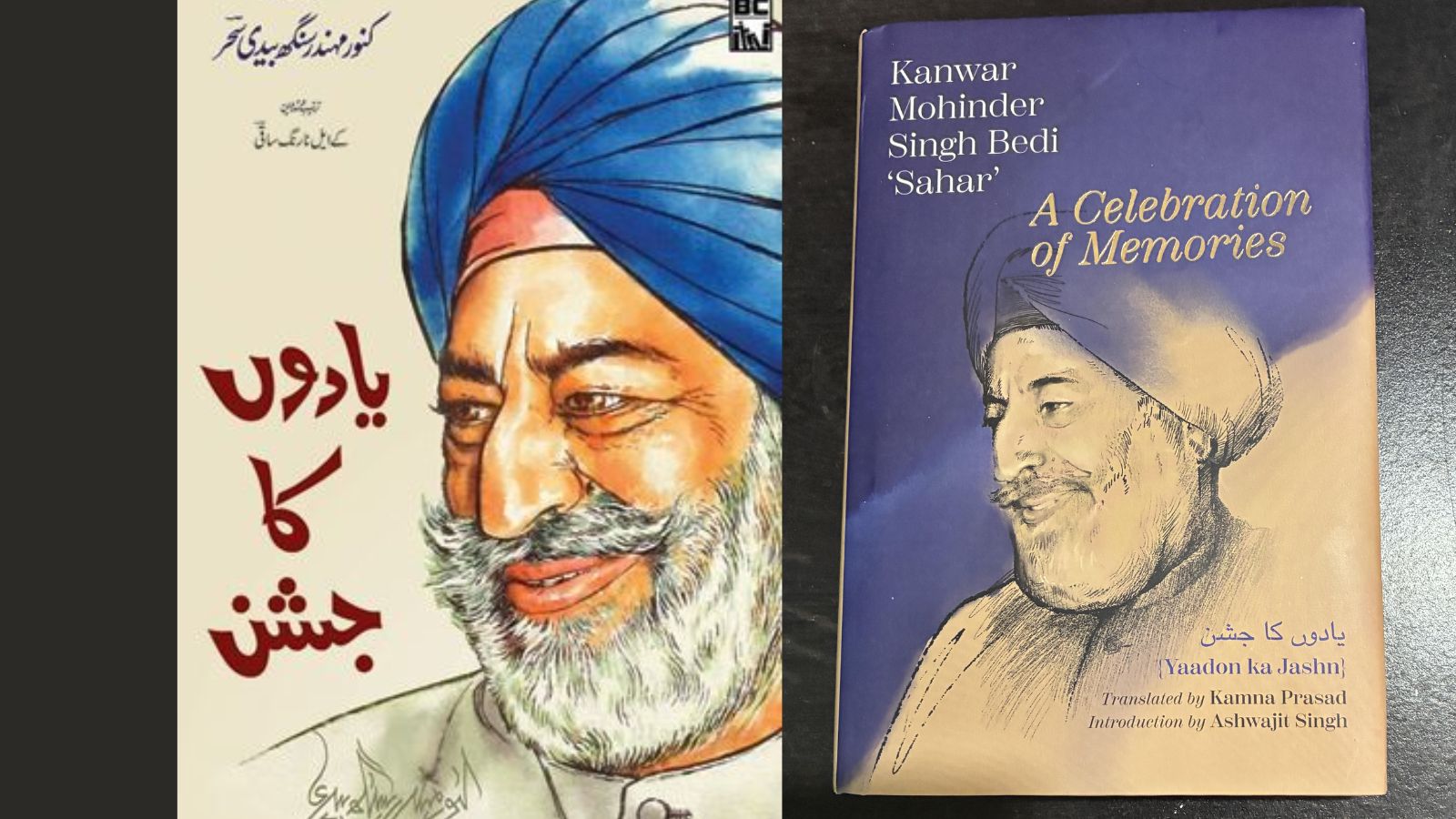
Candid truths of internal conflict, doubt, contradictions, moments of moral weakness, the quest for spiritual solace, the relentless struggle of identity, and incidents of unsettling social hypocrisy, through the observed vignettes with a humanist vision, are produced in a readable narrative momentum in Yadon Ka Jashan (A Celebration of Memories), the autobiography of celebrated Urdu poet and distinguished bureaucrat, Kunwar Mohinder Singh Bedi Sahar (1909–1992).
A distinguished poet with two collections of poetry to his credit, Sahar was famous for meticulously conducting poetic symposiums, and his presence was a must at mushairas across the globe.
Yadon Ka Jashan, wrapped in his inclusive vision of India, carried a sustained meditation on spirituality, belonging, the largely untold agony of Partition, beyond the Hindu-Muslim binary, the literary landscape of the subcontinent, and bureaucratic interventions.
Published in Urdu over four decades ago, it needs to be made accessible to the Anglophone world. This is what Kamna Prasad, well-known cultural curator, author, and translator, does with remarkable ease in her recently published translation, A Celebration of Memories (Speaking Tiger, 2026).
The unfortunate Partition left a permanent mark, and Sahar sought to domesticate the catastrophe through his unflinching commitment to trans-religious harmony, which serves as an ideological cog in his creative oeuvre.
Without vociferously interrogating the political economy of the Partition, he poignantly depicts one of the 20th century’s major humanitarian catastrophes, offering an alternative to the dominant historiography of the Partition. Not many authors discussed the Partition as a self-interrogating question, not to be answered rationally but to precipitate a collapse of all a man stands for.
Sahar tried to understand the moments of cognitive rapture that open space for a different kind of knowing or having a direct experience of the ghastly disaster.
Story continues below this ad
It prompts Kamna Prasad to point out in her perceptive note: “He witnessed the devastation that Partition brought to countless lives, and the secular spirit inherent in him grew even stronger. The experience only deepened his compassion and broadened his vision of humanity. At a time when public discourse grows harsh and tolerance fragile, such lives must endure in our collective memory – not as objects of admiration alone, but as vital reminders of the values that sustain the idea of India: harmony, restraint and a generous regard for one another.”
As a direct descendant of Guru Nanak, Sahar has always stood for a peaceful world, and he regretted that hatred, in the form of visible religiosity, made the faith completely devoid of love and compassion at a time when fellow feeling was needed most.
How Partition belied the naïve hope of early restoration, Sahar reasons out: “At the time of Partition, and indeed for some while after, many people still cherished the thought that order would be restored. Those who had left their homes and crossed over on either side would one day be able to return. But the unrest and communal hostility grew with each passing day, and the thought of returning to one’s home became a distant dream.”
Astutely divided into two parts, My Life and Career and My World, the autobiography, running over 330 pages, is not a confession but a literary and collective moral imagination of the subcontinent’s socio-political landscape, with intellectual and spiritual sensibilities that resonate across borders.
Story continues below this ad
Spots of time: Sahar’s world of words
The first part vividly recalls the formative years, youth, zamindari (large tracts in Pakistan), employment, the Delhi years, final posting before independence, the pain of Partition, and subsequent postings, elevating the personal narrative into a piece of art that captures personal reflections and social concerns. The artistically retentive yet generative memory reveals strongly felt impressions rather than a listless chronology of biographical details with unapologetic honesty.
It recalls much of the political, social and cultural atmosphere of the pre-Partition period. Here, one is reminded of Stephen Spender’s autobiography, World within World (1951), as Sahar, too, emerges as a great diagnostician of human vulnerabilities and an acute observer of the diversity of human consciousness.
The second part, “My World”, is a celebration of memory and resilience. The observations, cut with a marked sense of humour and subtle irony, unravel the epiphanies (in William Wordsworth’s phrase, spots of time) of Sahar’s awe-inspiring literary and intellectual journey. His take on faith and philosophy provides a plausible, if not singular, context for understanding the poet.
The section “Urdu, poetry, and my poet friends” is a moving and evocative portrayal of all those who dominated the literary scene here; one finds intriguing and revealing shadows rather than lackadaisical sketches. His reminiscences about eminent personalities carry much of what has been left unsaid.
Story continues below this ad
The Pataudi patriarch
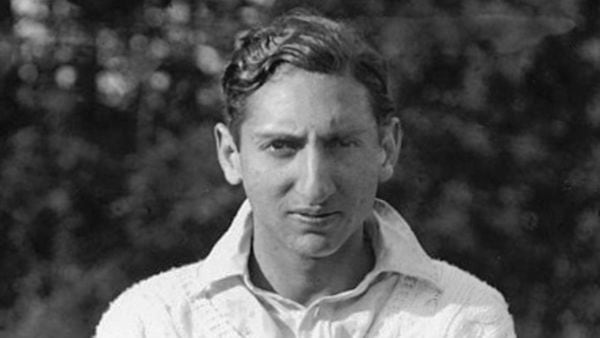 Nawab Iftikhar Ali Pataudi is former captain of the Indian cricket team, and the grandfather of Saif Ali Khan. (Wikimedia Commons)
Besides being the captain of the Indian cricket team, little is heard of Nawab Iftikhar Ali Pataudi, the father of Mansur Ali Khan Pataudi, the former captain of the Indian cricket team, and the grandfather of Saif Ali Khan.
Sahar studied with him at the Chief’s College in Lahore, and his portrayal, written with noticeable candour, maps unknown terrains of his extraordinary personality: “While the world is familiar with his achievements in cricket, few may know that he also represented India in hockey. Besides that, he was an expert billiards player. He possessed this rare quality.”
“Whichever game he took up, he mastered it before moving on. Once, the Nawab sahib of Dujana invited me to his birthday celebrations there and arranged my stay in his palace. From the adjoining room, I could hear someone playing the harmonium, accompanied by the tabla,” he writes.
“The melody was so captivating that I sat listening for quite some time, lost in its charm, occasionally calling out words of praise for the player. That evening, when all the guests gathered, I mentioned the captivating music I had heard from the adjoining room and praised the performer. Nawab Sahib smiled and said, ‘The person staying in the room next to yours is the Nawab of Pataudi. He was practising on the harmonium.’”
Story continues below this ad
Laconic yet evocative sketches of Dr Zakir Hussain, Partap Singh Kairon, Firoze Khan Noon, Mohammad Rafi, Josh Malihabadi, Firaq Gorakhpuri, and others make the autobiography remarkable in many ways.
Burdened by bureaucracy
A Celebration of Memories also showcases the candid truth of Sahar’s chequered administrative career, which offers an implicit critique of both high and mighty colonial and post-colonial bureaucracy.
It tells the tales of the arbitrariness of the political system; romantic obsession with self surfaces, but does not retreat into self-exaltation. Sahar’s prose, draped in lyrical tenderness, is also dense with the idiom of pre-Partition Punjab, precarity and colloquial rigour.
Its luminous and readable translation requires more than bilingual competence and linguistic skills; it is what Said Mahmood describes as cultural stewardship. Kamna lives up to expectations by retaining the creative spark and emotional precision in her rendering, and she deserves accolades.
Story continues below this ad
(Shafey Kidwai, a bilingual author and critic, is the director of Sir Syed Academy, Aligarh Muslim University, Aligarh)

