

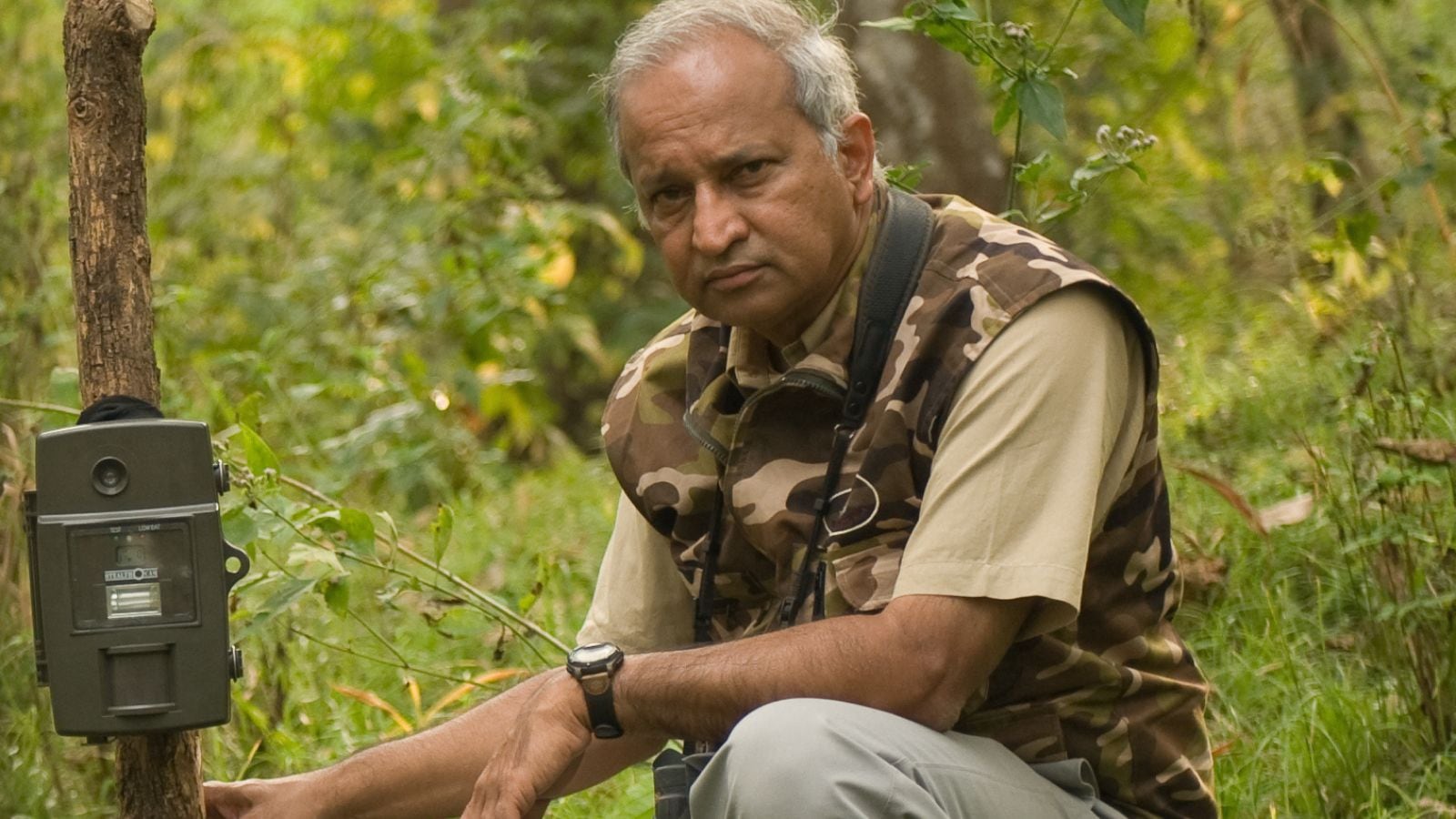
If you had to ask someone about India’s tigers, the bestmanto answer in Bengaluru, and probably India, would be K Ullas Karanth. One of the foremost wildlifescientists of ourtime, Karanth does not consider himself a writer. But that hasn’t stopped him from authoring several books on tigers, and mostrecently,his father and Kannada literary legend — Shivarama Karanth.
Step into Karanth’s workspace, and wildlife books of every stripe fill every available shelf. According to Ullas Karanth, his passion for wildlife goes back to his father. He recalled, “My father was a famous Kannada writer. But one side of him, which was unusual, is that he was very interested in nature and science — also an aesthete with nature and wildlife.”

He added, “He was an incredibly voracious reader with a huge library. But there was hardly any literature there, all popular science, art, cinema, etc. That is what I also grew up on…”
Ullas Karanth was homeschooled until he was 11 years old. Growing up in a wooded area surrounded by animals, he also picked up the habit of birdwatching from a friend of his mother.
How ‘shikar’ tales transformed Karanth
Karanth did not immediately go into the field of wildlife research. As he puts it, “There was no career in it. So I had to earn a living and joined an engineering college. But I was very bored with it”. At this point, he had read all the majorshikartales one could find, especially those by hunters and woodsmen such as Kenneth Anderson and Jim Corbett.He had then comeacross an article by scientist George Schaller, who had studied tigers in Kanha.
He said, “I realised this is the way you should understand wildlife, using quantitative modern methods, not storytelling about any individual animal.”
For a long time, Karanth was a naturalist and conservationist without a formal education in wildlife – pursuing his passion on the side while working in various fields from farming to tractor sales.
‘Nobody was pursuing serious science on tigers’
Story continues below this ad
His breakthrough came in 1983, when he attended a Bombay Natural History Society conference where researcher Mel Sunquist was present. Recalling the state of wildlife research in those days, Karanth said, “After Schaller, wildlifescience had died in India. Nobody was pursuing serious science on tigers and large mammals. I ended up studying at the University of Florida under Sunquist in the mid-80s. We collaborated in a project to radio collar and track tigers in Nagarhole for the first time in 1986.”
Later on,Karanth started publishing academic research while also being involved in conservation. He said, “I saw that there was a disconnect between people who were doing conservation and the people writing in scientific journals. It was like writing a recipe book without cooking a meal. Conservation has to be science-based. I started as a conservationist before I was trained as a biologist. Bridging that gap by writing about wildlife in a way that was accessible to people but conveyed accurate information – that is why I started withWay of the Tiger (2001).”
He had also published a collection of essays under the nameA View from the Machan: How Science Can Save the Fragile Predatorin 2006. More recently, in 2022, he came out withAmong Tigers: Fighting to Bring Back Asia’s Big Cats,targeting a more global audience.
Growing up Karanth(co-authored with his sisters Kshama Rau and Malavika Kapur) is one book that has nothing to do with tigers atall..It deals with Kota Shivaram Karanth, a titan of Kannada Literature, from the perspective of his children.
Father, a formidable persona
Story continues below this ad
Ullas Karanth said, “It was something I owed my father…he was a formidable persona. He had written three biographies of himself — in 1848, in the 80s, and in 1995 — thematicbooks about his interests, but with a very autobiographical nature. There are so many scholars of his works, so we never thought there was a gap. But after he died, there were so many things that were not out in the public domain — his mentors, whom he had mentored, his friends and supporters, etc, as well as my mother Leela Karanth, who was an incredible person. All these were not known to the public.”
This ended up being an endeavour of several years. Karanth recalled, “In some sense, it was fun to write because we remembered so many good things, things that made us wonder – was there really a man like this? Some things were difficult, like his last years.”
Currently, Ullas Karanth is working on his personal memoirs, which are set to come out later this year under the titleTiger Memories.

