

Struggling with tricky and important concepts in UPSC Prelims? The exam increasingly tests your conceptual clarity and ability to apply core ideas, especially in the most dynamic subjects: Science, Economy, and Environment (SEE).
UPSC Essentials’ new initiative, UPSC Prelims ‘SEE’ Snapshot, brings you, every Wednesday, a quick, exam-focused revision of key concepts. In each article, we pick three important current themes from Science, Economy, and Environment and decode them strictly through the Prelims lens—focusing on concepts and clarity.
SCIENCE
Phytoremediation
Core Concept:
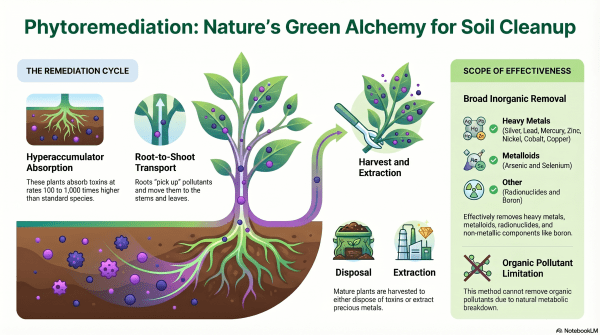
— Turning toward more sustainable and eco-friendly technologies to remediate the soil pollution, scientists have developed methods of “Phytoremediation”, a remediation method that uses living organisms like plants, microalgae, and seaweeds.
— It uses “hyperaccumulator” plants to absorb the toxic materials present in the soil and accumulate in their living tissue. Even though most plants do sometimes accumulate toxic substances, hyperaccumulators have the unusual ability to absorb hundreds or thousands of times greater amounts of these substances than is normal for most plants.
— In phytoremediation, suitable plant species can be used to ‘pick up’ the pollutants from the soil through their roots and transport them to their stem, leaves and other parts. After this, these plants can be harvested and either disposed of or even used to extract these toxic metals from the plant.
 (Image: Created by Google NotebookLM)
— This process can be used to remove metals like silver, cadmium, cobalt, chromium, copper, mercury, manganese, molybdenum, nickel, lead and zinc; metalloids such as arsenic and selenium; some radionuclides; and non-metallic components such as boron.
Story continues below this ad
Phytoremediation: Using Plants to Clean Toxic Soil
DEFINITION
What is Phytoremediation?
Phytoremediation is a method of cleaning contaminated soil using living organisms — primarily plants, but also microalgae and seaweeds. It targets toxic heavy metals that have entered the soil through industrialisation, mining, chemical spills, pesticides, and fertiliser use.
KEY CONCEPT
What are Hyperaccumulator Plants?
Hyperaccumulators are plants with the rare ability to absorb hundreds or thousands of times more toxic substances than ordinary plants. While most plants accumulate some toxins, hyperaccumulators store these metals in their living tissue at extraordinary concentrations. Most discovered species accumulate nickel, cobalt, and manganese — found across the Mediterranean, Brazil, Cuba, New Caledonia, and Southeast Asia.
The 4-Step Remediation Process
◆
Step 1 — Select suitable plant species
Native hyperaccumulator plants are carefully chosen based on the specific metals present in the contaminated soil and the local ecology of the region.
◆
Step 2 — Roots absorb toxic metals
The plant roots draw up pollutants from the soil, including metals like cadmium, lead, nickel, zinc, mercury, arsenic, and selenium — powered entirely by sunlight.
◆
Step 3 — Metals transported to stems and leaves
The absorbed metals travel from the roots upward into the stems, leaves, and other above-ground parts of the plant, where they accumulate in the plant tissue.
◆
Step 4 — Harvest, dispose or extract
The metal-laden plants are harvested and either safely disposed of, or processed to extract the concentrated toxic metals from the plant matter for further use or containment.
LIMITATION
What it cannot remove
Phytoremediation cannot remove organic pollutants from soil. These compounds undergo metabolic breakdown inside the plant before they can be accumulated, making the method ineffective for chemical contaminants such as petroleum byproducts.
Why Phytoremediation Stands Out
★
Cost-effective
The only major costs are standard crop management — planting, watering, weeding, fertilising, pruning, fencing, and harvesting. No expensive specialised equipment or infrastructure is required.
★
No external energy source needed
Plants grow and perform remediation entirely using sunlight. Unlike conventional methods, this process does not require fossil fuels or electricity to operate.
★
Enriches soil health
While removing toxins, the plants also enrich the soil with organic matter and beneficial microorganisms, helping to restore the chemical and biological qualities of degraded land.
★
Protects against erosion
As the plants grow across the contaminated area, their root systems and canopy protect the exposed soil from wind and water erosion — preventing further spread of pollutants.
The Trade-offs to Consider
✗
Extremely slow process
Restoring a contaminated area can take up to 10 years or more. During this entire period, the land cannot be used for agriculture, grazing, or any other economic activity — creating a large opportunity cost proportional to the area’s size.
✗
Risk of invasive species
If the wrong plant species are introduced, they can grow out of control and disrupt the ecological balance of not just the remediation site but the entire surrounding region. Scientists strongly recommend using only species native to the area — which also eases legal issues around seed procurement and transport.
IMPORTANT NOTE
Careful plant selection is critical
Scientists propose using only native species for phytoremediation projects. Native plants are already adapted to local climate conditions and pose no legal or ecological risk — making selection a highly site-specific scientific decision.
CONTEXT
Why conventional methods are falling short
Existing soil remediation technologies have been widely criticised for their high costs and for causing adverse effects of their own. A paper in the journal Agriculture described them as “lacking in terms of sustainability” — setting the stage for eco-friendly alternatives like phytoremediation.
Phytoremediation
Strengths
Low cost — crop management only
Solar-powered, no external energy
Improves soil biology
Prevents erosion while active
Takes up to 10+ years
Cannot remove organic pollutants
Conventional Methods
Characteristics
High financial cost
Requires specialised technology
Adverse effects on environment
Deemed unsustainable
May work faster
Can address wider pollutant range
Sources: JNKVV Research Journal (2015) · MDPI Agriculture Journal — “Utilizing Mediterranean Plants to Remove Contaminants from the Soil Environment” · The Indian Express
📍UPSC Twist Points– Phytoremediation vs Bioremediation
— Bioremediation is the use of microbes to clean up contaminated soil and groundwater. Microbes are very small organisms, such as bacteria, that live naturally in the environment.
— Bioremediation stimulates the growth of certain microbes that use contaminants as a source of food and energy. Contaminants treated using bioremediation include oil and other petroleum products, solvents and pesticides.
ECONOMY
Shrinkflation
Core Concept:
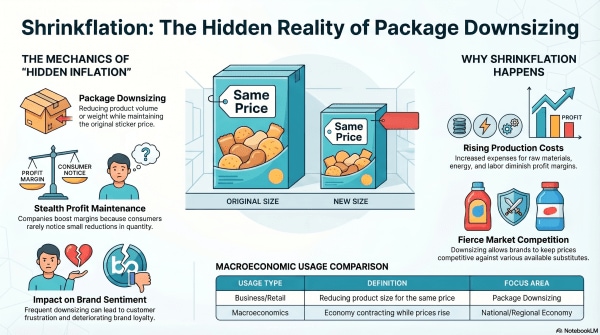
— Consumer products getting smaller in size but not changing price is a practice that is known as “shrinkflation”—a combination of the words ‘shrink’ and ‘inflation’. It is closely related to “skimpflation”, a practice that sees companies reduce the quality of their product or service while keeping the price the same. It primarily affects FMCGs, particularly in the food and beverage sector.
Story continues below this ad
— Companies face higher prices for their supplies and may try to pass that onto the consumer. Downsizing a product reduces costs for manufacturers.
 (Image: Created by Google NotebookLM)
— Consumers tend to be price-sensitive but they may not notice subtle changes in packaging, or read the fine print on the size or weight of a product. The result is that consumers are less likely to notice getting less if the price is the same. Thus, we see that shrinkflation is basically a form of hidden inflation.
📍UPSC Twist Points– Shrinkflation vs Stagflation
— Stagflation is described as an economic situation characterised by economic stagnation, meaning slow economic growth typically accompanied by an increase in unemployment, and inflation, meaning a persistent rise in the general price level.
— Typically, inflation occurs during periods of rapid economic growth, with the demand for goods outpacing their availability, increasing their prices. Similarly, during a period of economic decline, inflation falls as there is less money chasing the same goods.
Story continues below this ad
Shrinkflation, Skimpflation & Stagflation — Explained
WHAT IS SHRINKFLATION?
Same price. Less product.
When companies reduce the size or quantity of a product while keeping the price unchanged, it’s called shrinkflation — a blend of ‘shrink’ and ‘inflation’. It is a form of hidden inflation because the consumer pays the same but gets less.
Who is most affected?
☕
Instant noodles & beverages
Among the first FMCG categories hit — pack weights quietly reduced while shelf price stays constant.
🚗
Juice, milk packs & auto parts
West Asia war-driven input cost shocks have spread shrinkflation beyond food to automotive components.
👁
Why consumers miss it
Buyers are price-sensitive but rarely read fine print on weight or size. Subtle packaging changes go unnoticed.
WHAT IS SKIMPFLATION?
Same price. Lower quality.
Skimpflation is shrinkflation’s close cousin — instead of reducing quantity, companies reduce the quality of ingredients or materials in a product or service, while the price tag remains unchanged.
Shrinkflation
Less quantity
Smaller pack, same price. You get fewer grams or ml for the same rupee amount.
Skimpflation
Lower quality
Same pack size, inferior ingredients or materials. You pay the same but for a degraded product.
KEY DISTINCTION
Both involve inflation — but work very differently
Shrinkflation is a corporate pricing tactic — companies quietly reduce product size to preserve margins. Stagflation is a macroeconomic condition — an entire economy stuck with high inflation and stagnant growth simultaneously. One is a business decision; the other is an economic crisis.
Side-by-side comparison
Shrinkflation
Microeconomic
At the firm/product level. A company’s response to rising input costs.
Stagflation
Macroeconomic
At the economy level. A structural crisis of stagnant GDP + high inflation + rising unemployment.
△
Common trigger: supply shocks
Both can be triggered by the same event — like an oil price shock from the West Asia conflict — that raises costs across the entire economy.
🔒
Both reduce purchasing power
Shrinkflation quietly erodes the consumer’s value per rupee. Stagflation crushes income growth while prices surge — a dual squeeze on households.
📋
Policy response differs
Shrinkflation can be addressed through consumer awareness and labelling regulation. Stagflation creates a policy trap — no easy cure exists.
DEFINITION
What is Stagflation?
Stagflation is a simultaneous rise in inflation and stagnation of economic growth, often accompanied by high unemployment. It contradicts the conventional economic logic that inflation and unemployment move in opposite directions.
Three conditions that define stagflation
Condition 1
Economy slows down
Condition 2
Unemployment stays high
Condition 3
Inflation remains elevated
🏢
Why it’s a policy trap
Measures to fix inflation (raising rates, cutting spending) worsen unemployment. Measures to boost growth risk fuelling more inflation. Policymakers are caught between two fires.
💸
Dual squeeze on households
Rising prices erode savings while stagnant incomes and job losses reduce purchasing power — people are pressured from both sides simultaneously.
🏭
Why it’s a contradiction
Normally, slow growth suppresses inflation — less money chases the same goods. Stagflation breaks this rule: growth stalls but prices keep rising anyway, usually driven by supply shocks like oil crises.
Sources: Indian Express · Iain Macleod, UK Parliament (1965)
— Stagflation presents a precarious situation for policymakers as policies that address either of these issues can end up worsening the other. An increase in unemployment amid a decline in economic growth is accompanied by a sluggish rise in incomes, while making sense of rising inflation. This puts dual pressures on the people, even as their purchasing power is reduced.
ENVIRONMENT
Bioluminiscence
Core Concept:
— Bioluminescence is the property of a living organism to produce and emit light. This phenomenon is rare in ecosystems on land, but it is common in the marine environment.
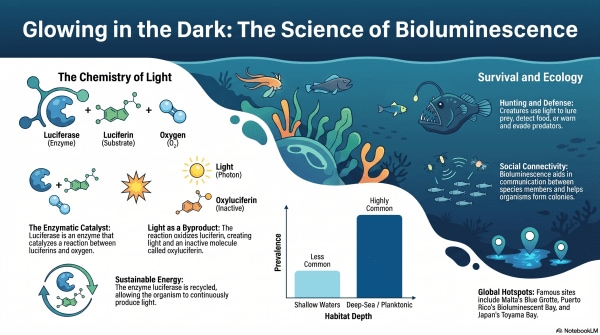
— Many marine organisms such as bacteria, algae, jellyfish, worms, crustaceans, sea stars, fish and sharks, are able to produce their own light. Luminescence is generally higher in deep-living and planktonic organisms than in shallow species. Also, the appearance of bioluminescent light differs, depending on the habitat and organism in which it is found.
Story continues below this ad
— According to NOAA, bioluminescence is the result of an enzymatic reaction. An enzyme speeds up the chemical reaction by helping a substrate react. The enzyme is reused in the reaction instead of being transformed into another molecule.
 (Image: Created by Google NotebookLM)
— Bioluminescence is not common in India. However, there are several tourist places across the world which are famous for the phenomenon. The Blue Grotto in Malta is one of nine caves near the island of Filfa that produces a phosphorescent glow. Similar to the Blue Grotto is Bioluminescent Bay in Puerto Rico, San Diego in California, Navarre Beach in Florida, and Toyama Bay in Japan.
 Bioluminscence is caused by bright plankton that illuminates the water body. (Photo: Shutterstock)
📍UPSC Twist Points– Bioluminescence vs Biofluorescence
— Biofluorescence is a phenomenon in which living organisms absorb light of a shorter wavelength (higher energy) and re-emit it at a longer wavelength (lower energy).
Story continues below this ad
— It is a type of fluorescence that specifically occurs in living organisms. The phenomenon has been observed in various plants, animals, and some microorganisms, often appearing as vibrant colours under specific lighting conditions.
Bioluminescence — Nature’s Living Light
CORE CONCEPT
The ability of living organisms to produce and emit light
Bioluminescence is rare in land ecosystems but extremely common in marine environments. It occurs across a wide range of organisms — from microscopic bacteria to large sharks — and varies in appearance depending on the habitat and species.
Who glows in the ocean?
◆
Bacteria & Algae (Phytoplankton)
Microscopic marine organisms that create the iconic blue glow seen in bioluminescent bays and beaches.
◆
Jellyfish, Worms & Crustaceans
Invertebrates that use light for defence, communication, and attracting prey in marine habitats.
◆
Sea Stars, Fish & Sharks
Larger marine animals capable of bioluminescence — more common in deep-living species than shallow-water ones.
★
Deep-sea & Planktonic Organisms
Luminescence is significantly higher in deep-living and planktonic organisms compared to shallow-water species.
GLOBAL HOTSPOTS
Where can you witness it?
Blue Grotto, Malta · Bioluminescent Bay, Puerto Rico · San Diego, California · Navarre Beach, Florida · Toyama Bay, Japan. The phenomenon is rare in India.
NOAA RESEARCH
Light produced through an enzymatic chemical reaction
According to NOAA, bioluminescence is the result of an enzymatic reaction — a process where an enzyme speeds up a chemical reaction by helping a substrate react. Crucially, the enzyme is reused rather than being transformed into another molecule.
How the reaction works — step by step
1
Substrate present
A light-emitting substrate (a molecule capable of producing light) exists within the organism’s cells.
2
Enzyme activates the reaction
An enzyme binds to the substrate and dramatically speeds up the chemical reaction — without being consumed in the process.
3
Light is emitted
The reaction releases energy in the form of visible light — the characteristic blue-green glow seen in most bioluminescent organisms.
4
Enzyme is recycled
The enzyme is not destroyed — it is released and reused in subsequent reactions, making bioluminescence an efficient biological process.
KEY PROPERTY
Cold light — no heat produced
Unlike a light bulb, bioluminescence produces virtually no heat. Nearly all the energy from the reaction is converted directly into light — making it one of the most efficient light-producing processes in nature.
UPSC TWIST POINT
Two different phenomena — often confused
Bioluminescence and biofluorescence are distinct processes. One involves producing light internally; the other involves absorbing external light and re-emitting it. Understanding this distinction is a common UPSC examination angle.
Side-by-side comparison
Bioluminescence
Produces its own light
Light is generated internally through an enzymatic chemical reaction within the organism’s body. No external light source needed.
Biofluorescence
Absorbs & re-emits light
Organism absorbs light of a shorter wavelength (higher energy) and re-emits it at a longer wavelength (lower energy). Requires an external light source.
⚡
Energy source
Bioluminescence: internal chemical energy. Biofluorescence: external light energy (e.g. UV or blue light).
◉
Where it occurs
Biofluorescence is observed in various plants, animals, and some microorganisms — often appearing as vibrant colours under specific lighting conditions.
→
Type of phenomenon
Biofluorescence is a type of fluorescence specific to living organisms. Bioluminescence is a form of chemiluminescence specific to living organisms.
Sources: NOAA · Indian Express UPSC Research Notes
Prelims Practice MCQ
Let’s see how much can you recall
Consider the following statements:
1. Phytoremediation uses hyperaccumulator plants to remove heavy metals from contaminated soil.
2. Shrinkflation refers to reduction in product quality while keeping the price unchanged.
Story continues below this ad
3. Bioluminescence is caused by an enzymatic chemical reaction within living organisms.
How many of the statements given above are correct?
(a) Only one
(b) Only two
(c) All three
(d) None
UPSC Prelims ‘SEE’ Snapshot: Talking cars, GDP rebasing and Nor’westers — quick look
🚨Click Here to read the UPSC Essentials Quiz Magazine for Prelims 2026. Share your views and suggestions in the comment box or at manas.srivastava@indianexpress.com🚨
Story continues below this ad
Subscribe to ourUPSC newsletter.Stay updated with the latest UPSC articles by joining our Telegram channel –Indian ExpressUPSC Hub, and follow us onInstagramand X.

