

I initially resisted the offer of the Ministry of Petroleum and Natural Gas when the UPA government was formed in May 2004 because I considered MoPNG a notorious den of bribery against patronage to undeserving second-rate politicians and their clients. But, when I was overruled and given “temporary” charge of the ministry, I was pleasantly surprised to discover through briefings by senior officers and public-sector oil honchos that the ministry had, in fact, a key role to play in “energy security” to complement, on an equal footing, the external affairs ministry’s responsibility for “geopolitical security” and the finance/commerce ministries’ responsibility for “economic security”, which together with MoPNG, add up to “national security”.
At that time, two decades ago, our dependency on oil and gas imports was about 70 per cent of our requirements. It is now nearer 90 per cent. Deeply impressed by economist Vijay Kelkar’s comment that natural gas would be to the 21st century what petroleum had been in the 20th and coal in the 19th and wood till the 18th, I focused my energies, and those of the ministry and its subordinate bodies, in particular the Directorate General of Hydrocarbons (DGH), as well as the public-sector oil companies, on the critical issue of “energy security”.

This required a two-track approach: Domestic and external. On the domestic track, we had to build a global network of research institutions that would provide the technology to drill through the lava and volcanic rock-laden “Deccan trap” to get to our own domestic on-shore reserves, which were at a depth hundreds of metres below the surface and had only been tapped in similar circumstances, but on a much smaller scale, in Colorado. Off-shore, we had to penetrate some 10,000 metres in the Arabian Sea (against the North Sea’s 150 metres) to replicate our principal source of offshore energy, Bombay High, discovered in 1973. This, too, required a global science and technology network but held greater promise because Exxon was drilling at deep depths in the Gulf of Mexico. Wherever I travelled, I sought to bring into our ken the networking of technological institutions as the key to energy security through technology that held the potential to yield abundant domestic Indian supplies of oil and gas.
I also prioritised, against some objection from both the finance and external affairs ministries, securing against fierce Chinese competition our own foreign exploratory fields, especially in our abundantly petroleum-endowed proximate neighbourhood, ranging from Iran and the Gulf to Central Asia, especially around the Caspian Sea: Turkmenistan, Kazakhstan, the Russian Federation and Azerbaijan, even landlocked Uzbekistan, visiting exploration sites and pipelines from Baku on the Caspian to the terminal at Ceyhan on the eastern Mediterranean in Turkey. I even overcame my instinctive dislike of Israel to examine whether we could avoid the choke point of the Strait of Hormuz (whose closing is now causing severe cooking-gas shortage in India) by extending the Baku-Ceyhan pipeline through Ashkelon and Eilat at the head of the Gulf of Aqaba to bring Central Asian oil and gas direct to the Indian Ocean and parallel pipelines from North Africa to the Indian Ocean, escaping the choke points of the Bab al-Mandab on the Red Sea and the Strait of Hormuz.
Above all, I pitched for piping natural gas from Iran through Pakistan to energy-and-coal deficient Rajasthan, as well as from Sittwe (Akyab) off the Myanmar coast (where GAIL had discovered natural gas) through Cox’s Bazar and Jessore in Bangladesh to supply vast quantities of piped natural gas to the upcoming giant petrochemical complex in Haldia, West Bengal.
Little of this fructified because I was relieved of my “temporary” charge of MoPNG within 20 months. My successors did not prioritise “energy security”, through the domestic or external routes, concentrating instead on procuring as much petroleum and gas as could be procured from foreign markets, thus raising our external dependence to 90 per cent and leaving us even more dependent on outside sources instead of focusing on our own domestic and external sources of supply.
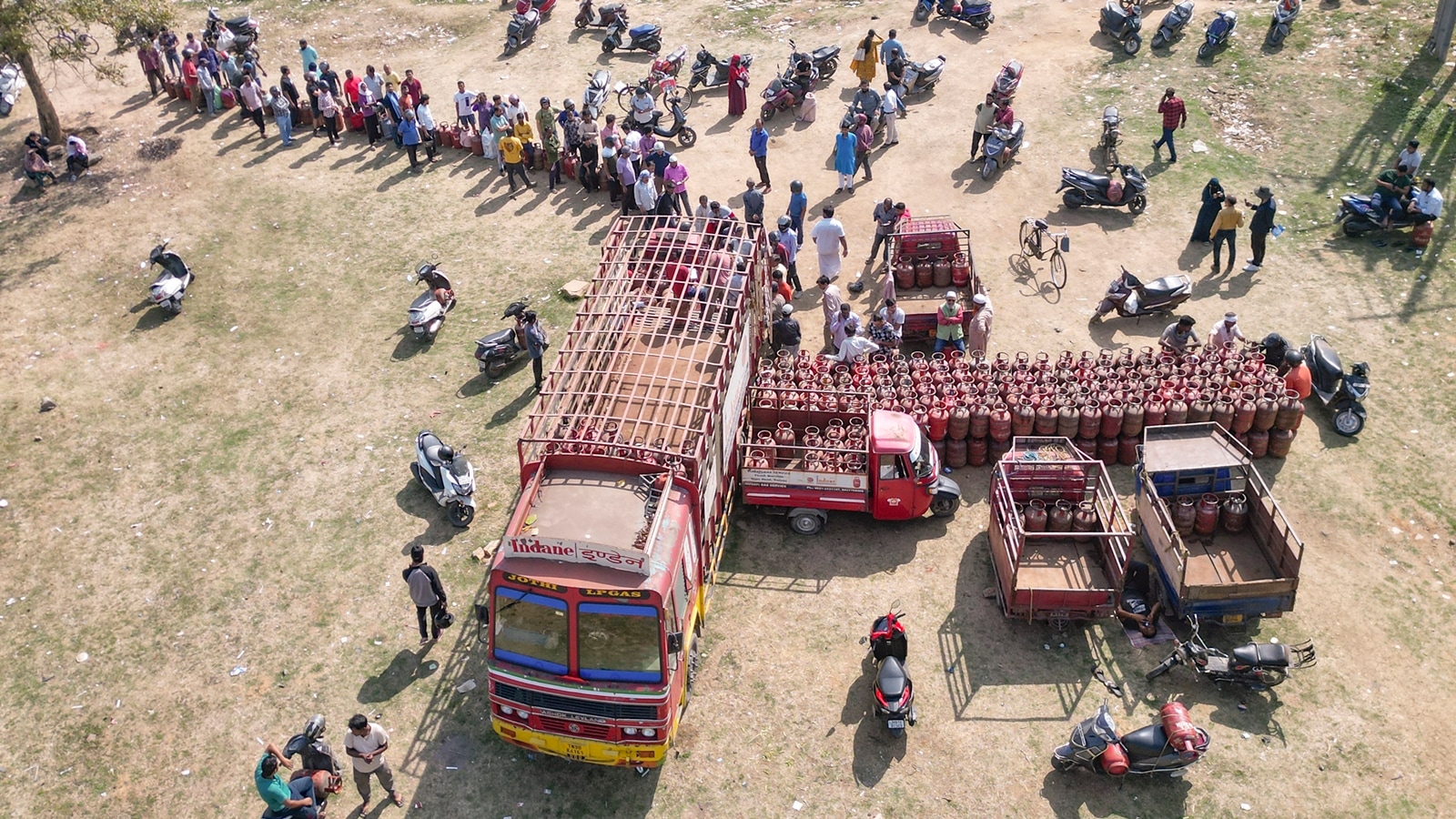
It is this lack of attention to “energy security” in the pursuit of purchasing external supplies that has brought us to the present cooking-gas crisis. Instead of treating MoPNG as the handmaiden of S Jaishankar’s external affairs ministry, the Hamas attack on Israel in 2023 — three years ago — and the sharp Israeli response of undertaking genocide in Gaza should have alerted MoPNG to the imperative need to stock up on cooking gas, especially as our overall petroleum policies had resulted in our becoming the world’s second largest consumer of LPG cooking gas at 3 million tonnes a month, 60 per cent of which is imported.
Far too late, the Essential Commodities Act has been invoked, oil refineries have been ordered to ramp up LPG output and the minister says he is in touch with “over 40 countries” to secure LPG. But why was all this not done a year ago when it became clear, especially after the vicious 12-day war of June 2025, that when all-out war happened, as it obviously would, the obvious Iranian retaliation would be to close the choke point of the Strait of Hormuz?
We have strategic reserves of crude oil. We even have two strategic caverns of LPG at Visakhapatnam and Mangaluru, but the total “strategic” stock of LPG, we now discover, is no more than a day’s consumption or perhaps a couple of days more. Is this not gross irresponsibility? Why did we not order LPG purchases on the high seas to stock up — albeit at higher prices but not so high as now? Why did we not pursue domestic and external energy security as the principal goal of the ministry over the last two decades, but especially after West Asia started tottering on the brink of war? Hardeep Puri is now closing the stable door — but long after the horse has fled.
The writer is former Union Minister of Petroleum and Natural Gas, 2004-06

